 Add to Chrome
 Add to Firefox
 Add to Edge
QUIVER: Quantum-Informed Views for Enhanced Representations in Large ML Models
Jun 01, 2026
Large machine learning models benefit substantially from multimodal inputs that provide a complementary view of the same example. We introduce QUIVER (QUantum-Informed Views for Enhanced Representations, a paradigm that enriches classical data-driven features with a quantum Fisher view: a geometrically motivated, basis-independent summary of higher-order correlations captured by a variational quantum circuit (VQC) trained to perform the same task. Unlike classical feature augmentation, the quantum Fisher information matrix encodes the intrinsic geometry of the learned quantum state manifold. While this feature map, motivated by quantum information theory, is ordinarily non-trivial to model classically, it can surface statistical structure that additional classical data or model capacity finds difficult to learn. This makes the quantum Fisher view a genuinely complementary modality rather than a redundant one. We demonstrate that QUIVER improves standard performance metrics on two benchmark datasets from very different fields: QM9 for predicting molecule properties, and JetClass for predicting jet flavor at the Large Hadron Collider (LHC). The core contribution, however, is domain-agnostic: the quantum Fisher view can be fused into a broad class of model architectures via targeted modifications to the base architecture, to incorporate information about the quantum geometry of the problem. These results demonstrate that quantum-geometric features, extracted from simulated variational circuits, can deliver measurable value for standard machine learning tasks, well before the advent of fault-tolerant quantum hardware.

Particle-Lund Multimodality in Jet Taggers
May 26, 2026The Lund plane offers a physics-motivated, hierarchical representation of QCD radiation within jets, while transformer-based taggers have reached state-of-the-art performance by learning directly from raw particle constituents and their pairwise relations. We investigate whether transformers implicitly capture hierarchical QCD structure from constituent-level inputs, or whether explicit physics representations remain complementary. To test this, we introduce PLuM, a multimodal architecture that projects particle constituents and Lund plane splittings into a shared latent space, processing both jointly with a unified transformer. Cross-attention allows the model to probe whether structured QCD information provides discriminating power beyond what particles alone encode. We observe systematic gains for top-quark and $\mathrm{H}\to\mathrm{b}\bar{\mathrm{b}}$ tagging, while finding no comparable improvement for $\mathrm{H}\to\mathrm{c}\bar{\mathrm{c}}$ or $\mathrm{H}\to 4\mathrm{q}$ topologies. This selective enhancement suggests that explicit hierarchical information about b-jet formation remains complementary to raw particle representations even in highly expressive architectures, while other topologies are already well-captured at constituent level. For high-impact LHC analyses such as Lorentz-boosted di-Higgs searches in the four $\mathrm{b}$ quark final state ($\mathrm{H}\mathrm{H}(4\mathrm{b})$), the gains are substantial: at a $25\%$ di-Higgs efficiency working point, PLuM achieves $25\%$ higher background rejection than the baseline. Our results indicate that physically structured representations of QCD radiation retain discriminating value in the transformer era, motivating further study into how different aspects of jet dynamics are encoded by deep learning algorithms.
From Information Geometry to Jet Substructure: A Triality of Cumulant Tensors, Energy Correlators, and Hypergraphs
May 04, 2026Pairwise Fisher graphs capture local covariance information, but they cannot distinguish an irreducible multi-observable radiation pattern from a collection of ordinary pairwise correlations. We show that this missing structure is naturally supplied by higher-order Fisher tensors. In a finite basis of binned EECs, ECFs, or EFPs, and in the natural exponential-family coordinates generated by that basis, the same local tensor has three equivalent interpretations: a coefficient in the local Kullback-Leibler expansion, a connected cumulant of the chosen correlator observables, and a signed weight on a hyperedge linking those observables. This gives an exact Fisher-correlator-hypergraph triality in the local exponential-family embedding. The triality provides a direct construction of physics-informed hypergraphs from correlator data. Extending the quadratic Fisher matrix to the first non-trivial higher tensor identifies genuinely connected multi-observable radiation patterns, supplies hyperedge weights for higher-order Laplacians and message passing, and gives a principled criterion for compressing observable bases beyond pairwise information. We develop these constructions and spell out why the exact cumulant interpretation is special to natural exponential-family coordinates. We illustrate the framework in four applications. In a minimal local-KL study, the cubic Fisher tensor reduces the KL truncation error and isolates the dominant triplet structure. In a two-versus-three prong jet substructure benchmark, the hypergraph selector improves compressed-basis classification. In a 33-observable basis-design problem, the Fisher hypergraph retains more third-order local response at twelve observables. A low-capacity learning benchmark then shows how the same Fisher hyperedges can be used as an interpretable inductive bias for message passing on correlator observables.
Contrastive Metric Learning for Point Cloud Segmentation in Highly Granular Detectors
Mar 24, 2026We propose a novel clustering approach for point-cloud segmentation based on supervised contrastive metric learning (CML). Rather than predicting cluster assignments or object-centric variables, the method learns a latent representation in which points belonging to the same object are embedded nearby while unrelated points are separated. Clusters are then reconstructed using a density-based readout in the learned metric space, decoupling representation learning from cluster formation and enabling flexible inference. The approach is evaluated on simulated data from a highly granular calorimeter, where the task is to separate highly overlapping particle showers represented as sets of calorimeter hits. A direct comparison with object condensation (OC) is performed using identical graph neural network backbones and equal latent dimensionality, isolating the effect of the learning objective. The CML method produces a more stable and separable embedding geometry for both electromagnetic and hadronic particle showers, leading to improved local neighbourhood consistency, a more reliable separation of overlapping showers, and better generalization when extrapolating to unseen multiplicities and energies. This translates directly into higher reconstruction efficiency and purity, particularly in high-multiplicity regimes, as well as improved energy resolution. In mixed-particle environments, CML maintains strong performance, suggesting robust learning of the shower topology, while OC exhibits significant degradation. These results demonstrate that similarity-based representation learning combined with density-based aggregation is a promising alternative to object-centric approaches for point cloud segmentation in highly granular detectors.
Machine Learning on Heterogeneous, Edge, and Quantum Hardware for Particle Physics (ML-HEQUPP)
Feb 24, 2026The next generation of particle physics experiments will face a new era of challenges in data acquisition, due to unprecedented data rates and volumes along with extreme environments and operational constraints. Harnessing this data for scientific discovery demands real-time inference and decision-making, intelligent data reduction, and efficient processing architectures beyond current capabilities. Crucial to the success of this experimental paradigm are several emerging technologies, such as artificial intelligence and machine learning (AI/ML) and silicon microelectronics, and the advent of quantum algorithms and processing. Their intersection includes areas of research such as low-power and low-latency devices for edge computing, heterogeneous accelerator systems, reconfigurable hardware, novel codesign and synthesis strategies, readout for cryogenic or high-radiation environments, and analog computing. This white paper presents a community-driven vision to identify and prioritize research and development opportunities in hardware-based ML systems and corresponding physics applications, contributing towards a successful transition to the new data frontier of fundamental science.
JetFormer: A Scalable and Efficient Transformer for Jet Tagging from Offline Analysis to FPGA Triggers
Jan 23, 2026We present JetFormer, a versatile and scalable encoder-only Transformer architecture for particle jet tagging at the Large Hadron Collider (LHC). Unlike prior approaches that are often tailored to specific deployment regimes, JetFormer is designed to operate effectively across the full spectrum of jet tagging scenarios, from high-accuracy offline analysis to ultra-low-latency online triggering. The model processes variable-length sets of particle features without relying on input of explicit pairwise interactions, yet achieves competitive or superior performance compared to state-of-the-art methods. On the large-scale JetClass dataset, a large-scale JetFormer matches the accuracy of the interaction-rich ParT model (within 0.7%) while using 37.4% fewer FLOPs, demonstrating its computational efficiency and strong generalization. On benchmark HLS4ML 150P datasets, JetFormer consistently outperforms existing models such as MLPs, Deep Sets, and Interaction Networks by 3-4% in accuracy. To bridge the gap to hardware deployment, we further introduce a hardware-aware optimization pipeline based on multi-objective hyperparameter search, yielding compact variants like JetFormer-tiny suitable for FPGA-based trigger systems with sub-microsecond latency requirements. Through structured pruning and quantization, we show that JetFormer can be aggressively compressed with minimal accuracy loss. By unifying high-performance modeling and deployability within a single architectural framework, JetFormer provides a practical pathway for deploying Transformer-based jet taggers in both offline and online environments at the LHC. Code is available at https://github.com/walkieq/JetFormer.
Re-Simulation-based Self-Supervised Learning for Pre-Training Foundation Models
Mar 11, 2024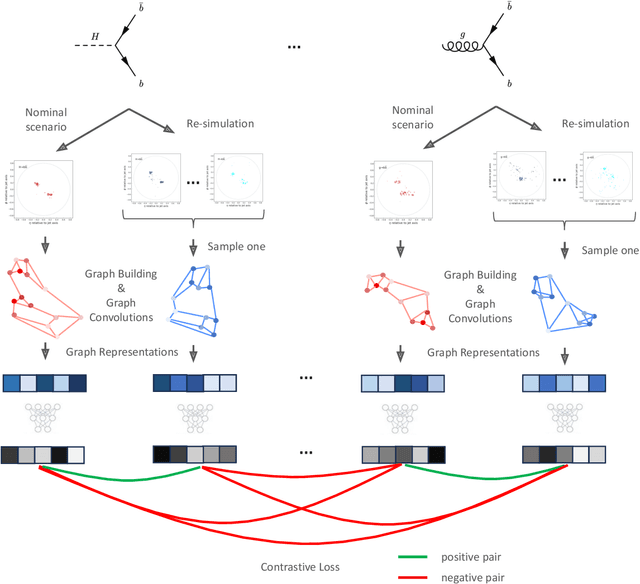
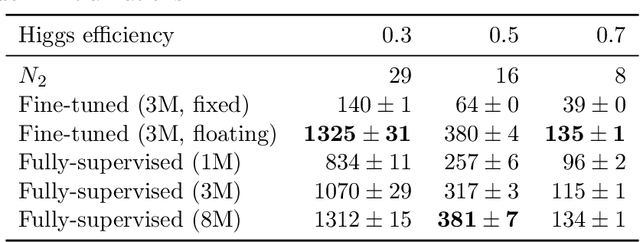
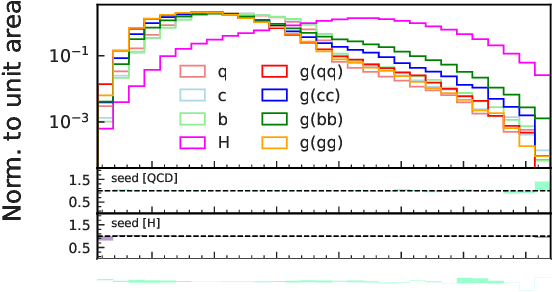
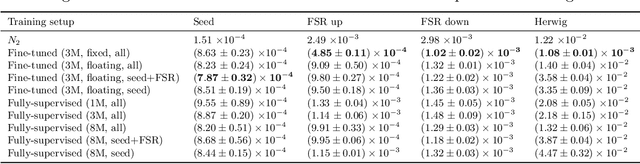
Self-Supervised Learning (SSL) is at the core of training modern large machine learning models, providing a scheme for learning powerful representations that can be used in a variety of downstream tasks. However, SSL strategies must be adapted to the type of training data and downstream tasks required. We propose RS3L, a novel simulation-based SSL strategy that employs a method of re-simulation to drive data augmentation for contrastive learning. By intervening in the middle of the simulation process and re-running simulation components downstream of the intervention, we generate multiple realizations of an event, thus producing a set of augmentations covering all physics-driven variations available in the simulator. Using experiments from high-energy physics, we explore how this strategy may enable the development of a foundation model; we show how R3SL pre-training enables powerful performance in downstream tasks such as discrimination of a variety of objects and uncertainty mitigation. In addition to our results, we make the RS3L dataset publicly available for further studies on how to improve SSL strategies.
Autoencoders for Real-Time SUEP Detection
Jun 26, 2023Confining dark sectors with pseudo-conformal dynamics can produce Soft Unclustered Energy Patterns, or SUEPs, at the Large Hadron Collider: the production of dark quarks in proton-proton collisions leading to a dark shower and the high-multiplicity production of dark hadrons. The final experimental signature is spherically-symmetric energy deposits by an anomalously large number of soft Standard Model particles with a transverse energy of a few hundred MeV. The dominant background for the SUEP search, if it gets produced via gluon-gluon fusion, is multi-jet QCD events. We have developed a deep learning-based Anomaly Detection technique to reject QCD jets and identify any anomalous signature, including SUEP, in real-time in the High-Level Trigger system of the Compact Muon Solenoid experiment at the Large Hadron Collider. A deep convolutional neural autoencoder network has been trained using QCD events by taking transverse energy deposits in the inner tracker, electromagnetic calorimeter, and hadron calorimeter sub-detectors as 3-channel image data. To tackle the biggest challenge of the task, due to the sparse nature of the data: only ~0.5% of the total ~300 k image pixels have non-zero values, a non-standard loss function, the inverse of the so-called Dice Loss, has been exploited. The trained autoencoder with learned spatial features of QCD jets can detect 40% of the SUEP events, with a QCD event mistagging rate as low as 2%. The model inference time has been measured using the Intel CoreTM i5-9600KF processor and found to be ~20 ms, which perfectly satisfies the High-Level Trigger system's latency of O(100) ms. Given the virtue of the unsupervised learning of the autoencoders, the trained model can be applied to any new physics model that predicts an experimental signature anomalous to QCD jets.
Triggering Dark Showers with Conditional Dual Auto-Encoders
Jun 22, 2023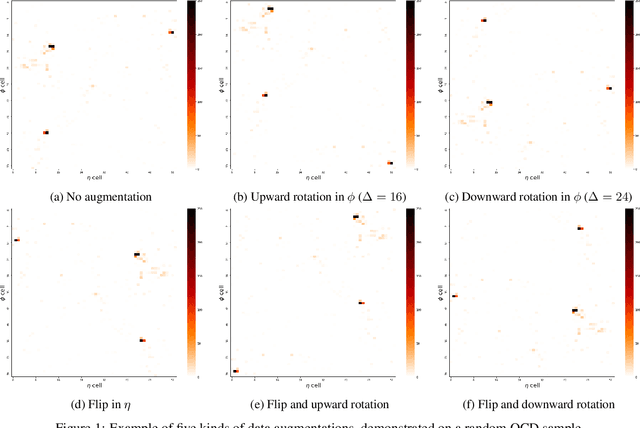
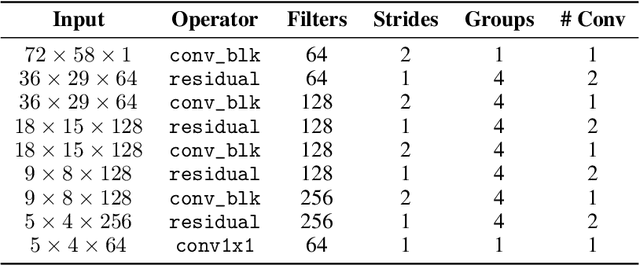
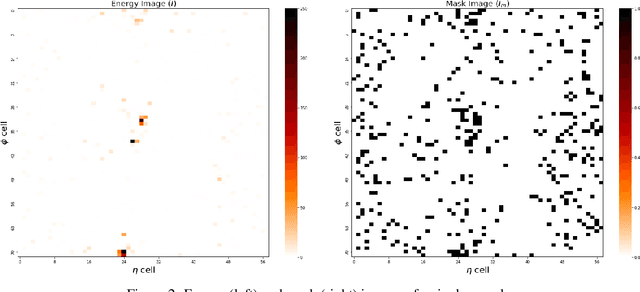
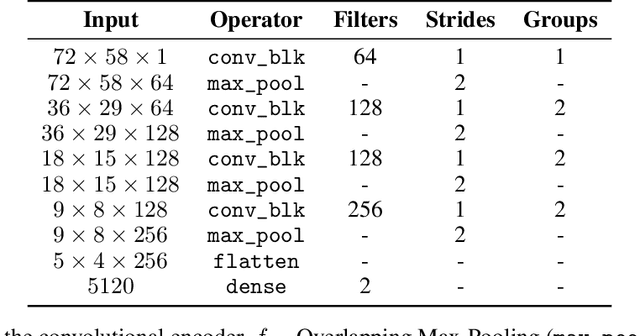
Auto-encoders (AEs) have the potential to be effective and generic tools for new physics searches at colliders, requiring little to no model-dependent assumptions. New hypothetical physics signals can be considered anomalies that deviate from the well-known background processes generally expected to describe the whole dataset. We present a search formulated as an anomaly detection (AD) problem, using an AE to define a criterion to decide about the physics nature of an event. In this work, we perform an AD search for manifestations of a dark version of strong force using raw detector images, which are large and very sparse, without leveraging any physics-based pre-processing or assumption on the signals. We propose a dual-encoder design which can learn a compact latent space through conditioning. In the context of multiple AD metrics, we present a clear improvement over competitive baselines and prior approaches. It is the first time that an AE is shown to exhibit excellent discrimination against multiple dark shower models, illustrating the suitability of this method as a performant, model-independent algorithm to deploy, e.g., in the trigger stage of LHC experiments such as ATLAS and CMS.