 Add to Chrome
 Add to Firefox
 Add to Edge
QUIVER: Quantum-Informed Views for Enhanced Representations in Large ML Models
Jun 01, 2026
Large machine learning models benefit substantially from multimodal inputs that provide a complementary view of the same example. We introduce QUIVER (QUantum-Informed Views for Enhanced Representations, a paradigm that enriches classical data-driven features with a quantum Fisher view: a geometrically motivated, basis-independent summary of higher-order correlations captured by a variational quantum circuit (VQC) trained to perform the same task. Unlike classical feature augmentation, the quantum Fisher information matrix encodes the intrinsic geometry of the learned quantum state manifold. While this feature map, motivated by quantum information theory, is ordinarily non-trivial to model classically, it can surface statistical structure that additional classical data or model capacity finds difficult to learn. This makes the quantum Fisher view a genuinely complementary modality rather than a redundant one. We demonstrate that QUIVER improves standard performance metrics on two benchmark datasets from very different fields: QM9 for predicting molecule properties, and JetClass for predicting jet flavor at the Large Hadron Collider (LHC). The core contribution, however, is domain-agnostic: the quantum Fisher view can be fused into a broad class of model architectures via targeted modifications to the base architecture, to incorporate information about the quantum geometry of the problem. These results demonstrate that quantum-geometric features, extracted from simulated variational circuits, can deliver measurable value for standard machine learning tasks, well before the advent of fault-tolerant quantum hardware.

From Information Geometry to Jet Substructure: A Triality of Cumulant Tensors, Energy Correlators, and Hypergraphs
May 04, 2026Pairwise Fisher graphs capture local covariance information, but they cannot distinguish an irreducible multi-observable radiation pattern from a collection of ordinary pairwise correlations. We show that this missing structure is naturally supplied by higher-order Fisher tensors. In a finite basis of binned EECs, ECFs, or EFPs, and in the natural exponential-family coordinates generated by that basis, the same local tensor has three equivalent interpretations: a coefficient in the local Kullback-Leibler expansion, a connected cumulant of the chosen correlator observables, and a signed weight on a hyperedge linking those observables. This gives an exact Fisher-correlator-hypergraph triality in the local exponential-family embedding. The triality provides a direct construction of physics-informed hypergraphs from correlator data. Extending the quadratic Fisher matrix to the first non-trivial higher tensor identifies genuinely connected multi-observable radiation patterns, supplies hyperedge weights for higher-order Laplacians and message passing, and gives a principled criterion for compressing observable bases beyond pairwise information. We develop these constructions and spell out why the exact cumulant interpretation is special to natural exponential-family coordinates. We illustrate the framework in four applications. In a minimal local-KL study, the cubic Fisher tensor reduces the KL truncation error and isolates the dominant triplet structure. In a two-versus-three prong jet substructure benchmark, the hypergraph selector improves compressed-basis classification. In a 33-observable basis-design problem, the Fisher hypergraph retains more third-order local response at twelve observables. A low-capacity learning benchmark then shows how the same Fisher hyperedges can be used as an interpretable inductive bias for message passing on correlator observables.
Bidirectional Cross-Attention Fusion of High-Res RGB and Low-Res HSI for Multimodal Automated Waste Sorting
Mar 14, 2026Growing waste streams and the transition to a circular economy require efficient automated waste sorting. In industrial settings, materials move on fast conveyor belts, where reliable identification and ejection demand pixel-accurate segmentation. RGB imaging delivers high-resolution spatial detail, which is essential for accurate segmentation, but it confuses materials that look similar in the visible spectrum. Hyperspectral imaging (HSI) provides spectral signatures that separate such materials, yet its lower spatial resolution limits detail. Effective waste sorting therefore needs methods that fuse both modalities to exploit their complementary strengths. We present Bidirectional Cross-Attention Fusion (BCAF), which aligns high-resolution RGB with low-resolution HSI at their native grids via localized, bidirectional cross-attention, avoiding pre-upsampling or early spectral collapse. BCAF uses two independent backbones: a standard Swin Transformer for RGB and an HSI-adapted Swin backbone that preserves spectral structure through 3D tokenization with spectral self-attention. We also analyze trade-offs between RGB input resolution and the number of HSI spectral slices. Although our evaluation targets RGB-HSI fusion, BCAF is modality-agnostic and applies to co-registered RGB with lower-resolution, high-channel auxiliary sensors. On the benchmark SpectralWaste dataset, BCAF achieves state-of-the-art performance of 76.4% mIoU at 31 images/s and 75.4% mIoU at 55 images/s. We further evaluate a novel industrial dataset: K3I-Cycling (first RGB subset already released on Fordatis). On this dataset, BCAF reaches 62.3% mIoU for material segmentation (paper, metal, plastic, etc.) and 66.2% mIoU for plastic-type segmentation (PET, PP, HDPE, LDPE, PS, etc.).
End-to-End Optimal Detector Design with Mutual Information Surrogates
Mar 18, 2025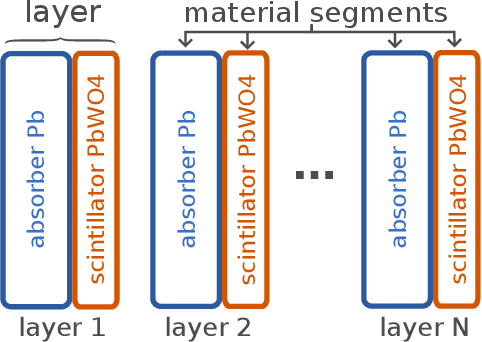
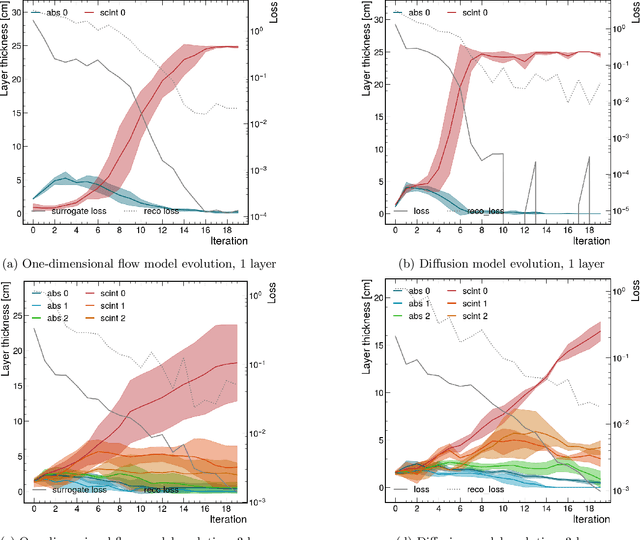
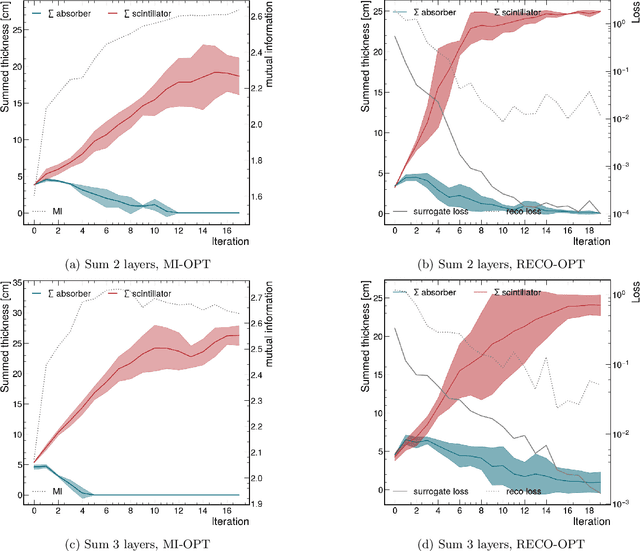
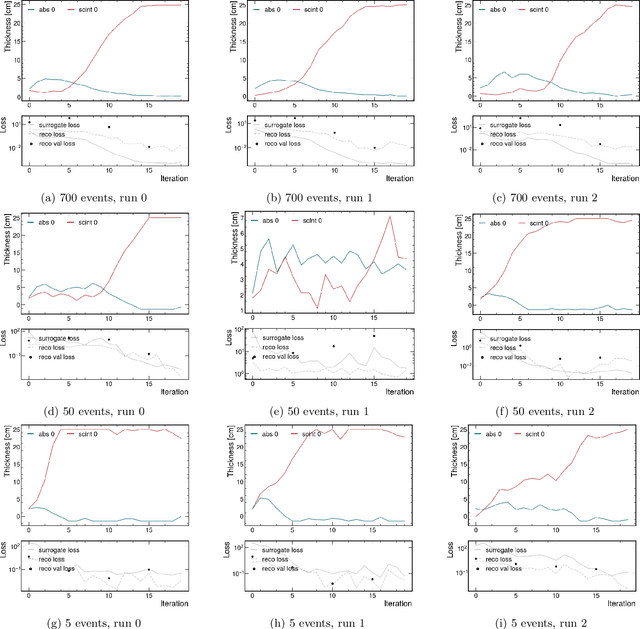
We introduce a novel approach for end-to-end black-box optimization of high energy physics (HEP) detectors using local deep learning (DL) surrogates. These surrogates approximate a scalar objective function that encapsulates the complex interplay of particle-matter interactions and physics analysis goals. In addition to a standard reconstruction-based metric commonly used in the field, we investigate the information-theoretic metric of mutual information. Unlike traditional methods, mutual information is inherently task-agnostic, offering a broader optimization paradigm that is less constrained by predefined targets. We demonstrate the effectiveness of our method in a realistic physics analysis scenario: optimizing the thicknesses of calorimeter detector layers based on simulated particle interactions. The surrogate model learns to approximate objective gradients, enabling efficient optimization with respect to energy resolution. Our findings reveal three key insights: (1) end-to-end black-box optimization using local surrogates is a practical and compelling approach for detector design, providing direct optimization of detector parameters in alignment with physics analysis goals; (2) mutual information-based optimization yields design choices that closely match those from state-of-the-art physics-informed methods, indicating that these approaches operate near optimality and reinforcing their reliability in HEP detector design; and (3) information-theoretic methods provide a powerful, generalizable framework for optimizing scientific instruments. By reframing the optimization process through an information-theoretic lens rather than domain-specific heuristics, mutual information enables the exploration of new avenues for discovery beyond conventional approaches.