 Add to Chrome
 Add to Firefox
 Add to Edge
Long Range Language Modeling via Gated State Spaces
Jul 02, 2022
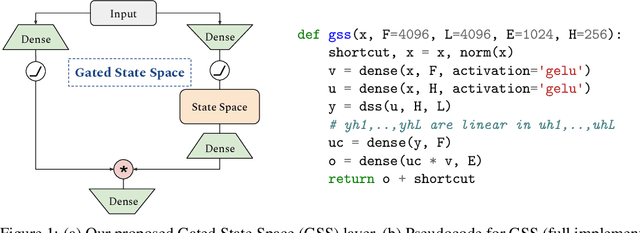
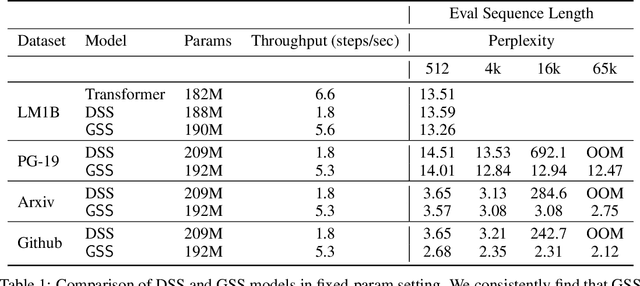
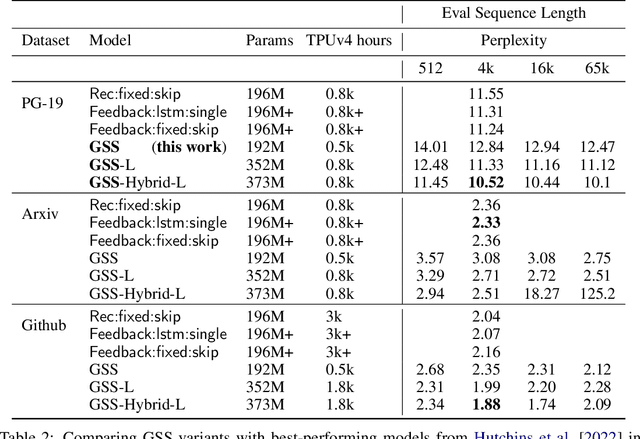
State space models have shown to be effective at modeling long range dependencies, specially on sequence classification tasks. In this work we focus on autoregressive sequence modeling over English books, Github source code and ArXiv mathematics articles. Based on recent developments around the effectiveness of gated activation functions, we propose a new layer named Gated State Space (GSS) and show that it trains significantly faster than the diagonal version of S4 (i.e. DSS) on TPUs, is fairly competitive with several well-tuned Transformer-based baselines and exhibits zero-shot generalization to longer inputs while being straightforward to implement. Finally, we show that leveraging self-attention to model local dependencies improves the performance of GSS even further.

Solving Quantitative Reasoning Problems with Language Models
Jul 01, 2022
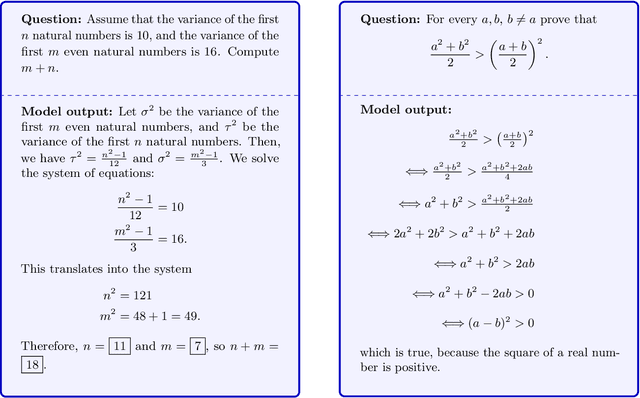


Language models have achieved remarkable performance on a wide range of tasks that require natural language understanding. Nevertheless, state-of-the-art models have generally struggled with tasks that require quantitative reasoning, such as solving mathematics, science, and engineering problems at the college level. To help close this gap, we introduce Minerva, a large language model pretrained on general natural language data and further trained on technical content. The model achieves state-of-the-art performance on technical benchmarks without the use of external tools. We also evaluate our model on over two hundred undergraduate-level problems in physics, biology, chemistry, economics, and other sciences that require quantitative reasoning, and find that the model can correctly answer nearly a third of them.
Understanding the effect of sparsity on neural networks robustness
Jun 22, 2022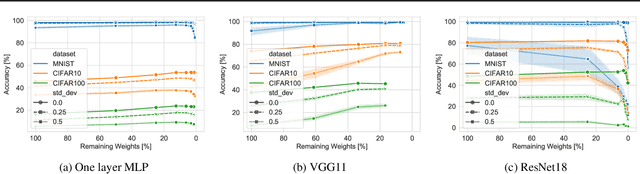
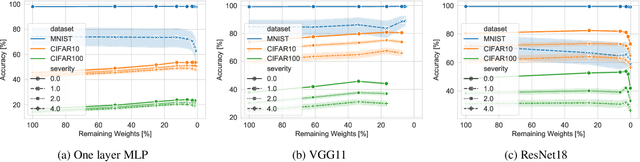
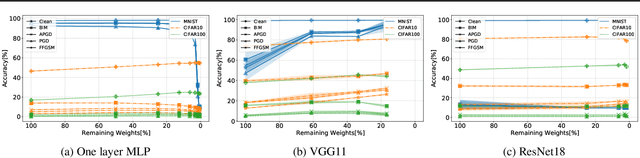
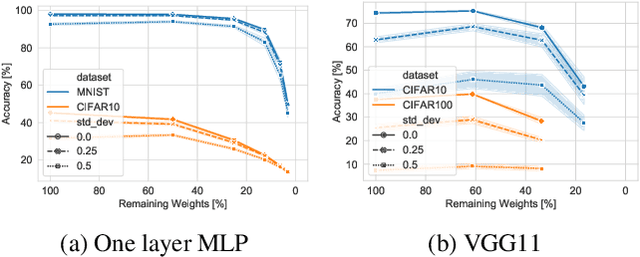
This paper examines the impact of static sparsity on the robustness of a trained network to weight perturbations, data corruption, and adversarial examples. We show that, up to a certain sparsity achieved by increasing network width and depth while keeping the network capacity fixed, sparsified networks consistently match and often outperform their initially dense versions. Robustness and accuracy decline simultaneously for very high sparsity due to loose connectivity between network layers. Our findings show that a rapid robustness drop caused by network compression observed in the literature is due to a reduced network capacity rather than sparsity.
Beyond the Imitation Game: Quantifying and extrapolating the capabilities of language models
Jun 10, 2022Language models demonstrate both quantitative improvement and new qualitative capabilities with increasing scale. Despite their potentially transformative impact, these new capabilities are as yet poorly characterized. In order to inform future research, prepare for disruptive new model capabilities, and ameliorate socially harmful effects, it is vital that we understand the present and near-future capabilities and limitations of language models. To address this challenge, we introduce the Beyond the Imitation Game benchmark (BIG-bench). BIG-bench currently consists of 204 tasks, contributed by 442 authors across 132 institutions. Task topics are diverse, drawing problems from linguistics, childhood development, math, common-sense reasoning, biology, physics, social bias, software development, and beyond. BIG-bench focuses on tasks that are believed to be beyond the capabilities of current language models. We evaluate the behavior of OpenAI's GPT models, Google-internal dense transformer architectures, and Switch-style sparse transformers on BIG-bench, across model sizes spanning millions to hundreds of billions of parameters. In addition, a team of human expert raters performed all tasks in order to provide a strong baseline. Findings include: model performance and calibration both improve with scale, but are poor in absolute terms (and when compared with rater performance); performance is remarkably similar across model classes, though with benefits from sparsity; tasks that improve gradually and predictably commonly involve a large knowledge or memorization component, whereas tasks that exhibit "breakthrough" behavior at a critical scale often involve multiple steps or components, or brittle metrics; social bias typically increases with scale in settings with ambiguous context, but this can be improved with prompting.
Block-Recurrent Transformers
Mar 11, 2022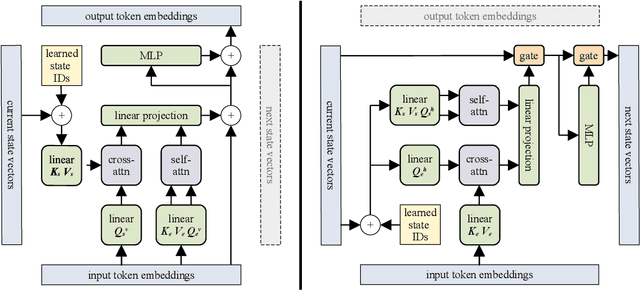
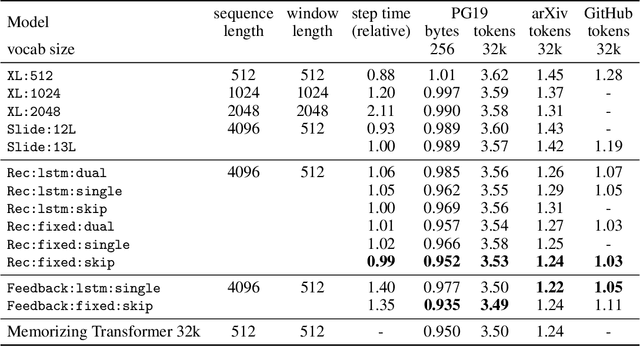
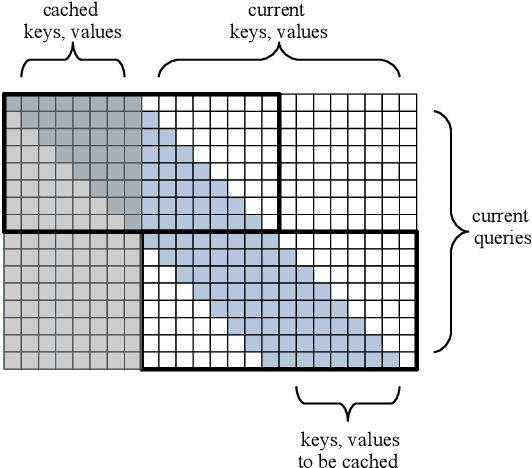
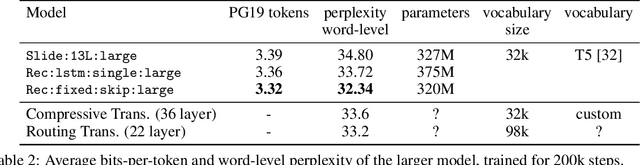
We introduce the Block-Recurrent Transformer, which applies a transformer layer in a recurrent fashion along a sequence, and has linear complexity with respect to sequence length. Our recurrent cell operates on blocks of tokens rather than single tokens, and leverages parallel computation within a block in order to make efficient use of accelerator hardware. The cell itself is strikingly simple. It is merely a transformer layer: it uses self-attention and cross-attention to efficiently compute a recurrent function over a large set of state vectors and tokens. Our design was inspired in part by LSTM cells, and it uses LSTM-style gates, but it scales the typical LSTM cell up by several orders of magnitude. Our implementation of recurrence has the same cost in both computation time and parameter count as a conventional transformer layer, but offers dramatically improved perplexity in language modeling tasks over very long sequences. Our model out-performs a long-range Transformer XL baseline by a wide margin, while running twice as fast. We demonstrate its effectiveness on PG19 (books), arXiv papers, and GitHub source code.
Leveraging Unlabeled Data to Predict Out-of-Distribution Performance
Feb 09, 2022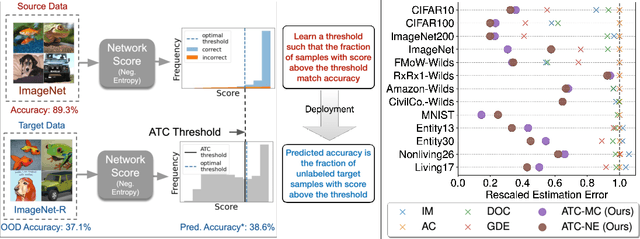
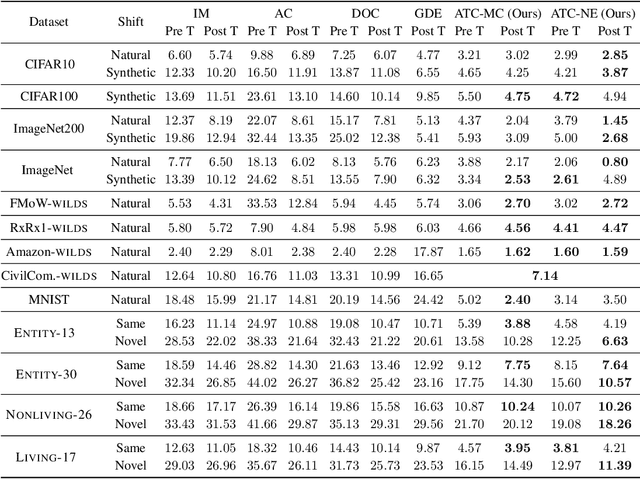
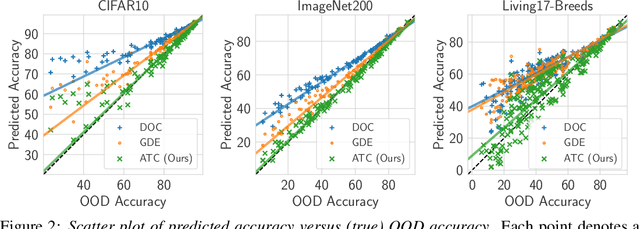
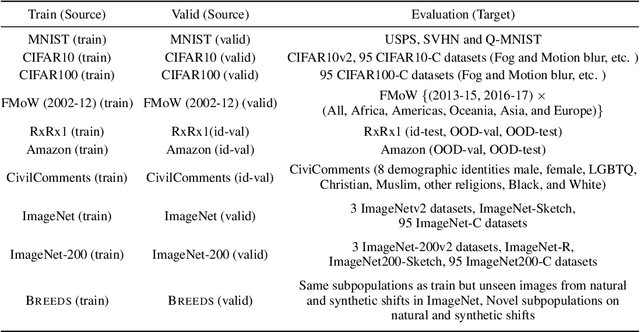
Real-world machine learning deployments are characterized by mismatches between the source (training) and target (test) distributions that may cause performance drops. In this work, we investigate methods for predicting the target domain accuracy using only labeled source data and unlabeled target data. We propose Average Thresholded Confidence (ATC), a practical method that learns a threshold on the model's confidence, predicting accuracy as the fraction of unlabeled examples for which model confidence exceeds that threshold. ATC outperforms previous methods across several model architectures, types of distribution shifts (e.g., due to synthetic corruptions, dataset reproduction, or novel subpopulations), and datasets (Wilds, ImageNet, Breeds, CIFAR, and MNIST). In our experiments, ATC estimates target performance $2$-$4\times$ more accurately than prior methods. We also explore the theoretical foundations of the problem, proving that, in general, identifying the accuracy is just as hard as identifying the optimal predictor and thus, the efficacy of any method rests upon (perhaps unstated) assumptions on the nature of the shift. Finally, analyzing our method on some toy distributions, we provide insights concerning when it works.
Data Scaling Laws in NMT: The Effect of Noise and Architecture
Feb 04, 2022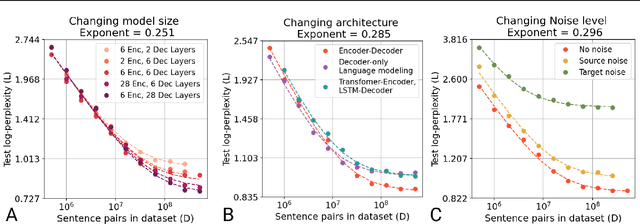
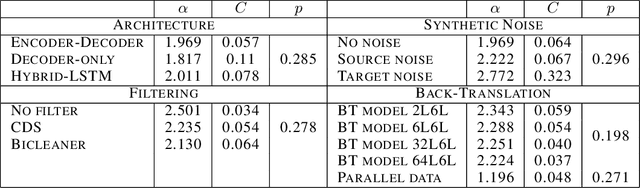
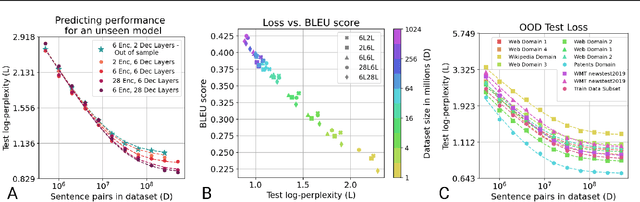
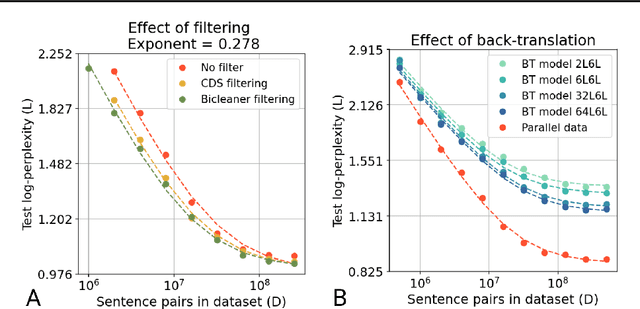
In this work, we study the effect of varying the architecture and training data quality on the data scaling properties of Neural Machine Translation (NMT). First, we establish that the test loss of encoder-decoder transformer models scales as a power law in the number of training samples, with a dependence on the model size. Then, we systematically vary aspects of the training setup to understand how they impact the data scaling laws. In particular, we change the following (1) Architecture and task setup: We compare to a transformer-LSTM hybrid, and a decoder-only transformer with a language modeling loss (2) Noise level in the training distribution: We experiment with filtering, and adding iid synthetic noise. In all the above cases, we find that the data scaling exponents are minimally impacted, suggesting that marginally worse architectures or training data can be compensated for by adding more data. Lastly, we find that using back-translated data instead of parallel data, can significantly degrade the scaling exponent.
The Role of Permutation Invariance in Linear Mode Connectivity of Neural Networks
Oct 12, 2021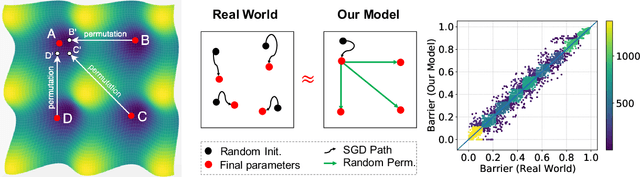
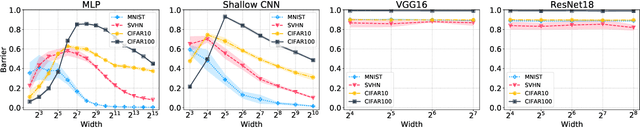
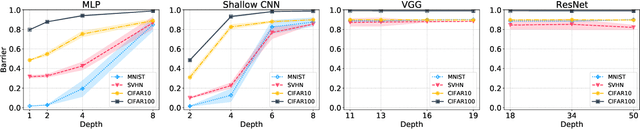
In this paper, we conjecture that if the permutation invariance of neural networks is taken into account, SGD solutions will likely have no barrier in the linear interpolation between them. Although it is a bold conjecture, we show how extensive empirical attempts fall short of refuting it. We further provide a preliminary theoretical result to support our conjecture. Our conjecture has implications for lottery ticket hypothesis, distributed training, and ensemble methods.
A Loss Curvature Perspective on Training Instability in Deep Learning
Oct 08, 2021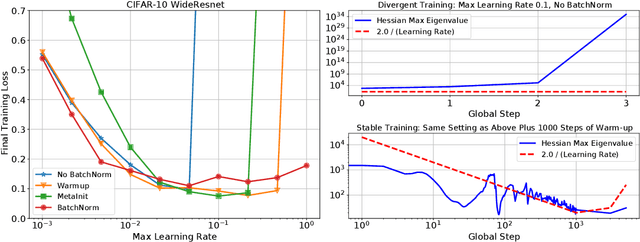
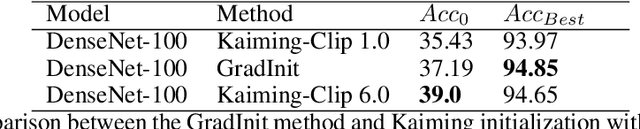
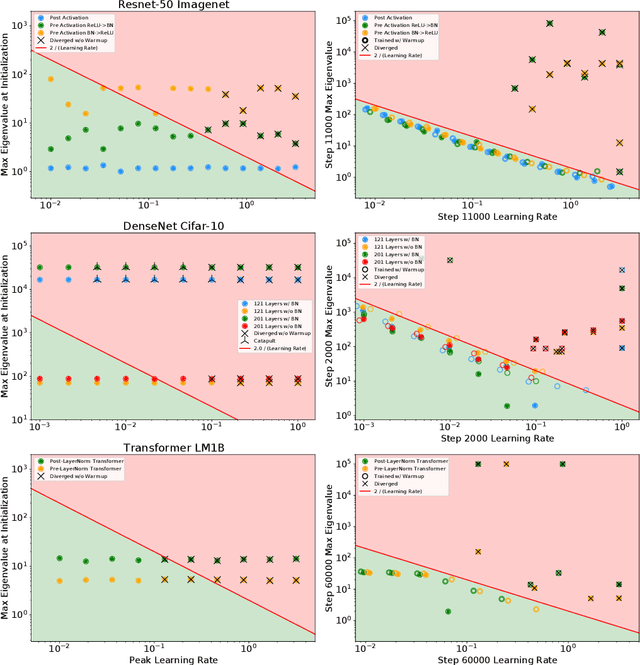
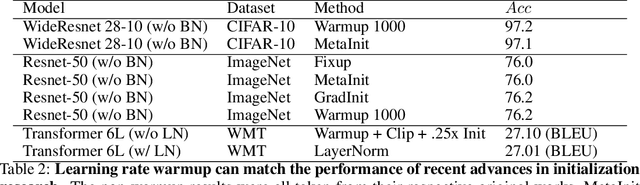
In this work, we study the evolution of the loss Hessian across many classification tasks in order to understand the effect the curvature of the loss has on the training dynamics. Whereas prior work has focused on how different learning rates affect the loss Hessian observed during training, we also analyze the effects of model initialization, architectural choices, and common training heuristics such as gradient clipping and learning rate warmup. Our results demonstrate that successful model and hyperparameter choices allow the early optimization trajectory to either avoid -- or navigate out of -- regions of high curvature and into flatter regions that tolerate a higher learning rate. Our results suggest a unifying perspective on how disparate mitigation strategies for training instability ultimately address the same underlying failure mode of neural network optimization, namely poor conditioning. Inspired by the conditioning perspective, we show that learning rate warmup can improve training stability just as much as batch normalization, layer normalization, MetaInit, GradInit, and Fixup initialization.
Exploring the Limits of Large Scale Pre-training
Oct 05, 2021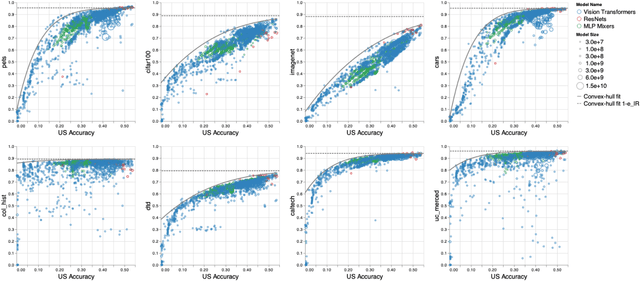
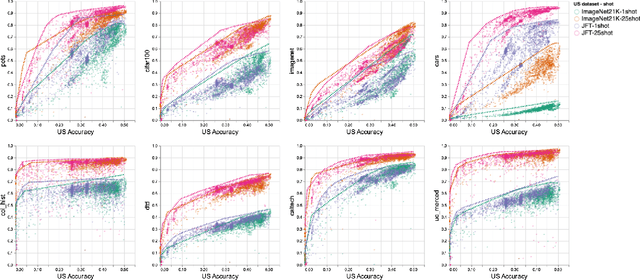
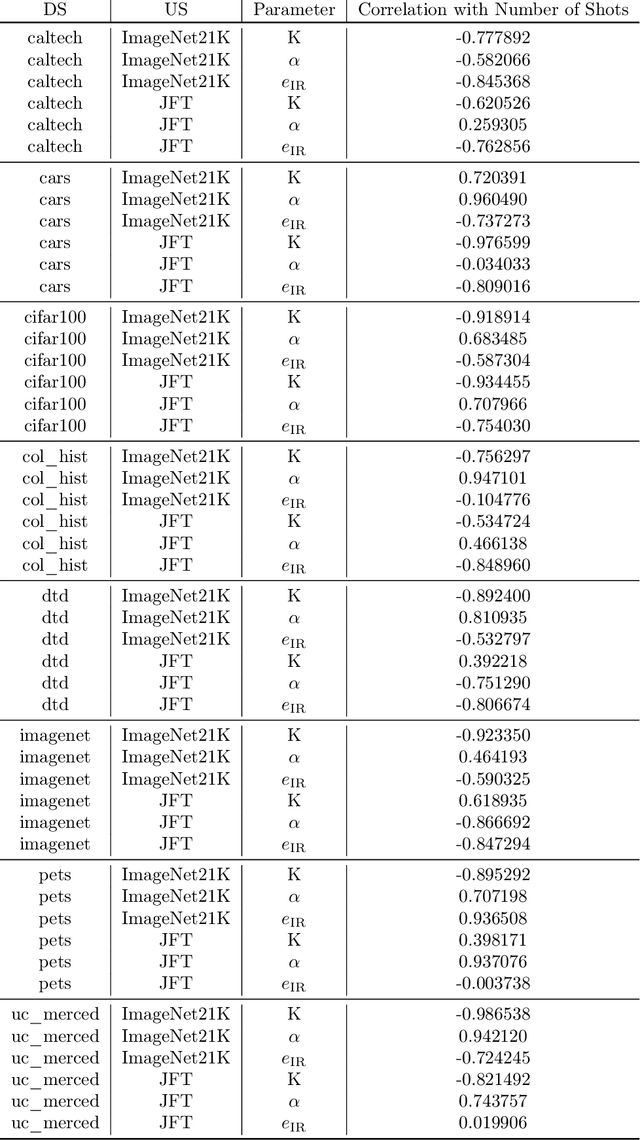
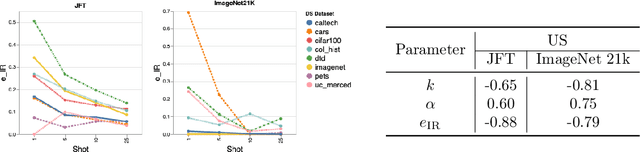
Recent developments in large-scale machine learning suggest that by scaling up data, model size and training time properly, one might observe that improvements in pre-training would transfer favorably to most downstream tasks. In this work, we systematically study this phenomena and establish that, as we increase the upstream accuracy, the performance of downstream tasks saturates. In particular, we investigate more than 4800 experiments on Vision Transformers, MLP-Mixers and ResNets with number of parameters ranging from ten million to ten billion, trained on the largest scale of available image data (JFT, ImageNet21K) and evaluated on more than 20 downstream image recognition tasks. We propose a model for downstream performance that reflects the saturation phenomena and captures the nonlinear relationship in performance of upstream and downstream tasks. Delving deeper to understand the reasons that give rise to these phenomena, we show that the saturation behavior we observe is closely related to the way that representations evolve through the layers of the models. We showcase an even more extreme scenario where performance on upstream and downstream are at odds with each other. That is, to have a better downstream performance, we need to hurt upstream accuracy.