 Add to Chrome
 Add to Firefox
 Add to Edge
MedXIAOHE: A Comprehensive Recipe for Building Medical MLLMs
Feb 16, 2026
We present MedXIAOHE, a medical vision-language foundation model designed to advance general-purpose medical understanding and reasoning in real-world clinical applications. MedXIAOHE achieves state-of-the-art performance across diverse medical benchmarks and surpasses leading closed-source multimodal systems on multiple capabilities. To achieve this, we propose an entity-aware continual pretraining framework that organizes heterogeneous medical corpora to broaden knowledge coverage and reduce long-tail gaps (e.g., rare diseases). For medical expert-level reasoning and interaction, MedXIAOHE incorporates diverse medical reasoning patterns via reinforcement learning and tool-augmented agentic training, enabling multi-step diagnostic reasoning with verifiable decision traces. To improve reliability in real-world use, MedXIAOHE integrates user-preference rubrics, evidence-grounded reasoning, and low-hallucination long-form report generation, with improved adherence to medical instructions. We release this report to document our practical design choices, scaling insights, and evaluation framework, hoping to inspire further research.

DOLG: Single-Stage Image Retrieval with Deep Orthogonal Fusion of Local and Global Features
Aug 11, 2021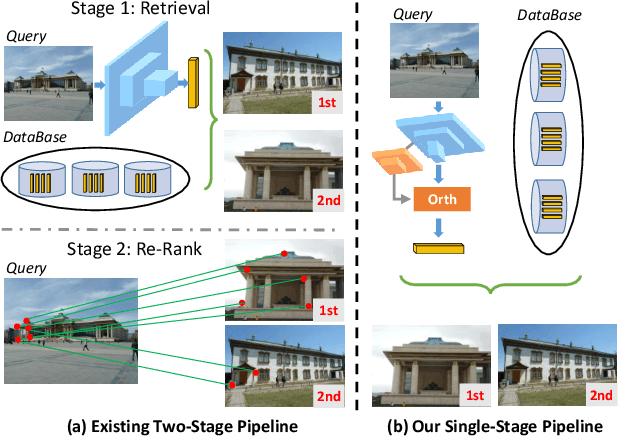
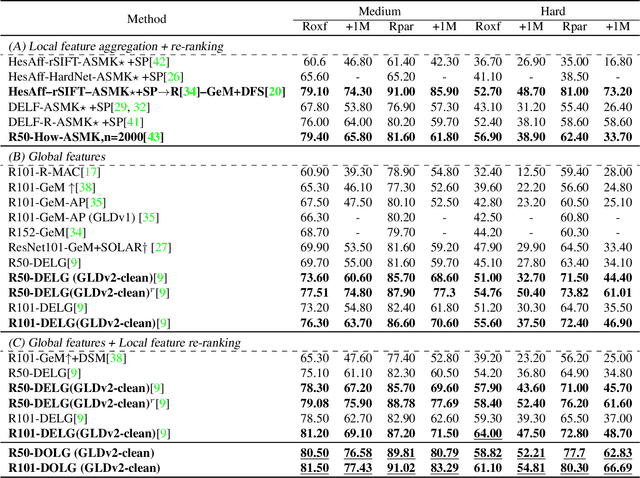
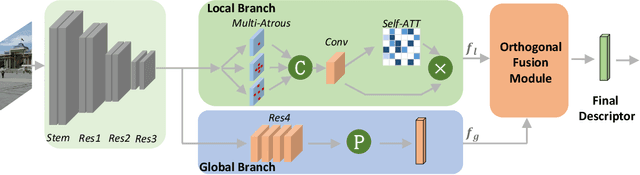
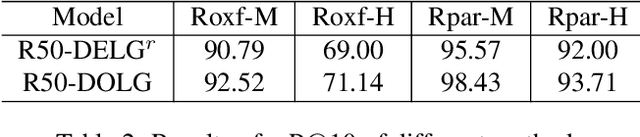
Image Retrieval is a fundamental task of obtaining images similar to the query one from a database. A common image retrieval practice is to firstly retrieve candidate images via similarity search using global image features and then re-rank the candidates by leveraging their local features. Previous learning-based studies mainly focus on either global or local image representation learning to tackle the retrieval task. In this paper, we abandon the two-stage paradigm and seek to design an effective single-stage solution by integrating local and global information inside images into compact image representations. Specifically, we propose a Deep Orthogonal Local and Global (DOLG) information fusion framework for end-to-end image retrieval. It attentively extracts representative local information with multi-atrous convolutions and self-attention at first. Components orthogonal to the global image representation are then extracted from the local information. At last, the orthogonal components are concatenated with the global representation as a complementary, and then aggregation is performed to generate the final representation. The whole framework is end-to-end differentiable and can be trained with image-level labels. Extensive experimental results validate the effectiveness of our solution and show that our model achieves state-of-the-art image retrieval performances on Revisited Oxford and Paris datasets.