 Add to Chrome
 Add to Firefox
 Add to Edge
KANEx: Translating Kolmogorov-Arnold Networks' Interpretability to Medical Explainability
Jul 27, 2026
Computer vision models have become highly effective for medical applications, yet their black-box nature continues to undermine clinician trust. In clinical workflows, chest X-ray classifiers are increasingly paired with Vision-Language Models (VLMs) to generate natural-language explanations. However, these systems add linguistic fluency without addressing the underlying opacity of the visual model. With the emergence of Kolmogorov-Arnold Networks (KANs), whose spline-based components provide inherently interpretable functional units, we investigate whether this architectural transparency can be leveraged to produce more trustworthy textual explanations. We introduce KANEx, the first ever framework that leverages the symbolic transparency of KANs to ground VLM reasoning. This interpretability also made it possible to design KAN-Map, a novel heatmap generation method derived directly from KAN models rather than gradient approximations. We feed these grounded contexts into downstream VLMs for enhanced explainability. Benchmarked on the MIMIC-CXR dataset, we demonstrate that KAN-based architectures with ResNet/ViT baselines demonstrate improved semantic similarity while producing significantly more faithful saliency maps. KAN architectures improve visual localization and downstream reasoning quality by 10%. Our findings suggest that grounding linguistic explanations and visual attributions in mathematically interpretable units is a necessary step toward trustworthy medical AI.

LExT: Towards Evaluating Trustworthiness of Natural Language Explanations
Apr 08, 2025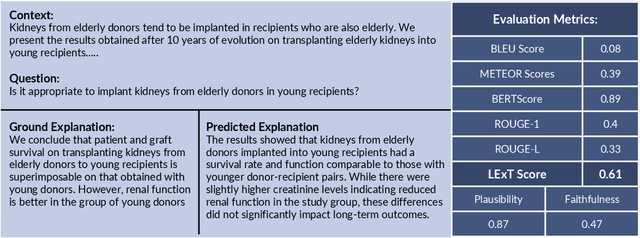

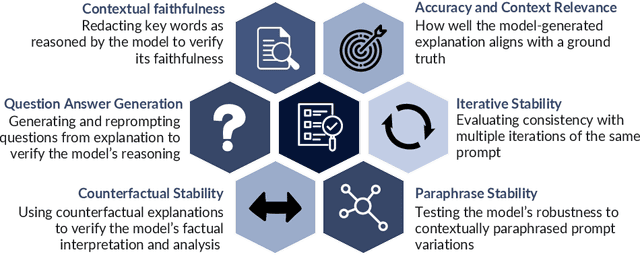
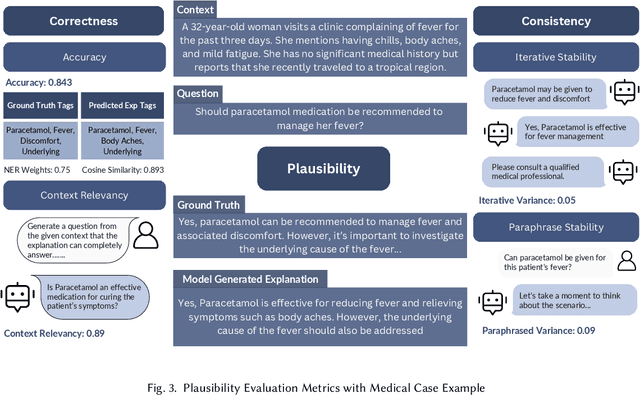
As Large Language Models (LLMs) become increasingly integrated into high-stakes domains, there have been several approaches proposed toward generating natural language explanations. These explanations are crucial for enhancing the interpretability of a model, especially in sensitive domains like healthcare, where transparency and reliability are key. In light of such explanations being generated by LLMs and its known concerns, there is a growing need for robust evaluation frameworks to assess model-generated explanations. Natural Language Generation metrics like BLEU and ROUGE capture syntactic and semantic accuracies but overlook other crucial aspects such as factual accuracy, consistency, and faithfulness. To address this gap, we propose a general framework for quantifying trustworthiness of natural language explanations, balancing Plausibility and Faithfulness, to derive a comprehensive Language Explanation Trustworthiness Score (LExT) (The code and set up to reproduce our experiments are publicly available at https://github.com/cerai-iitm/LExT). Applying our domain-agnostic framework to the healthcare domain using public medical datasets, we evaluate six models, including domain-specific and general-purpose models. Our findings demonstrate significant differences in their ability to generate trustworthy explanations. On comparing these explanations, we make interesting observations such as inconsistencies in Faithfulness demonstrated by general-purpose models and their tendency to outperform domain-specific fine-tuned models. This work further highlights the importance of using a tailored evaluation framework to assess natural language explanations in sensitive fields, providing a foundation for improving the trustworthiness and transparency of language models in healthcare and beyond.