 Add to Chrome
 Add to Firefox
 Add to Edge
Long-Term Memorability On Advertisements
Sep 01, 2023
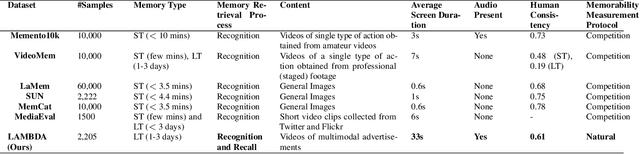
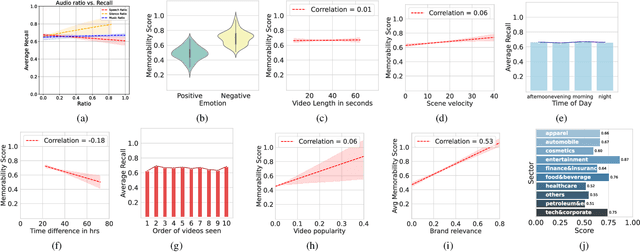
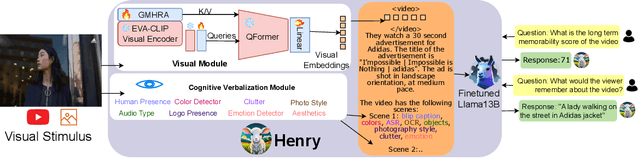

Marketers spend billions of dollars on advertisements but to what end? At the purchase time, if customers cannot recognize a brand for which they saw an ad, the money spent on the ad is essentially wasted. Despite its importance in marketing, until now, there has been no study on the memorability of ads in the ML literature. Most studies have been conducted on short-term recall (<5 mins) on specific content types like object and action videos. On the other hand, the advertising industry only cares about long-term memorability (a few hours or longer), and advertisements are almost always highly multimodal, depicting a story through its different modalities (text, images, and videos). With this motivation, we conduct the first large scale memorability study consisting of 1203 participants and 2205 ads covering 276 brands. Running statistical tests over different participant subpopulations and ad-types, we find many interesting insights into what makes an ad memorable - both content and human factors. For example, we find that brands which use commercials with fast moving scenes are more memorable than those with slower scenes (p=8e-10) and that people who use ad-blockers remember lower number of ads than those who don't (p=5e-3). Further, with the motivation of simulating the memorability of marketing materials for a particular audience, ultimately helping create one, we present a novel model, Sharingan, trained to leverage real-world knowledge of LLMs and visual knowledge of visual encoders to predict the memorability of a content. We test our model on all the prominent memorability datasets in literature (both images and videos) and achieve state of the art across all of them. We conduct extensive ablation studies across memory types, modality, brand, and architectural choices to find insights into what drives memory.

LOCATE: Self-supervised Object Discovery via Flow-guided Graph-cut and Bootstrapped Self-training
Aug 22, 2023Learning object segmentation in image and video datasets without human supervision is a challenging problem. Humans easily identify moving salient objects in videos using the gestalt principle of common fate, which suggests that what moves together belongs together. Building upon this idea, we propose a self-supervised object discovery approach that leverages motion and appearance information to produce high-quality object segmentation masks. Specifically, we redesign the traditional graph cut on images to include motion information in a linear combination with appearance information to produce edge weights. Remarkably, this step produces object segmentation masks comparable to the current state-of-the-art on multiple benchmarks. To further improve performance, we bootstrap a segmentation network trained on these preliminary masks as pseudo-ground truths to learn from its own outputs via self-training. We demonstrate the effectiveness of our approach, named LOCATE, on multiple standard video object segmentation, image saliency detection, and object segmentation benchmarks, achieving results on par with and, in many cases surpassing state-of-the-art methods. We also demonstrate the transferability of our approach to novel domains through a qualitative study on in-the-wild images. Additionally, we present extensive ablation analysis to support our design choices and highlight the contribution of each component of our proposed method.
FODVid: Flow-guided Object Discovery in Videos
Jul 10, 2023
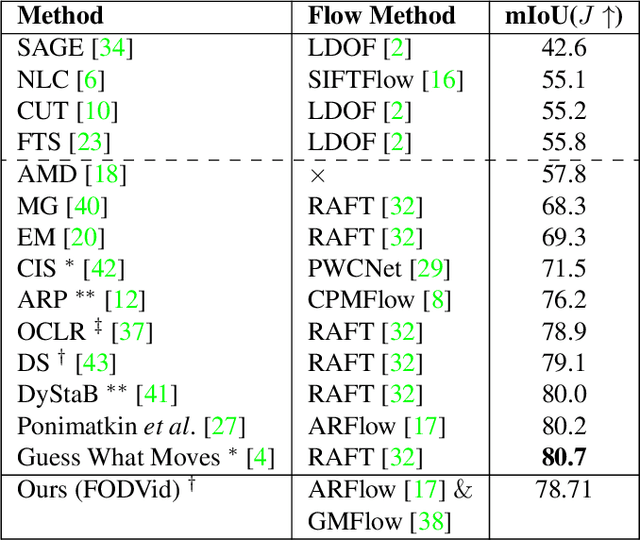
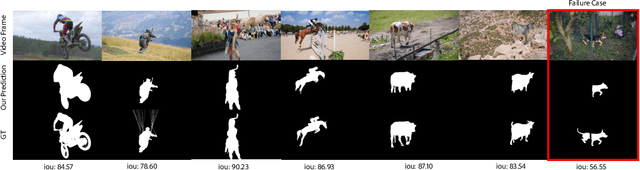
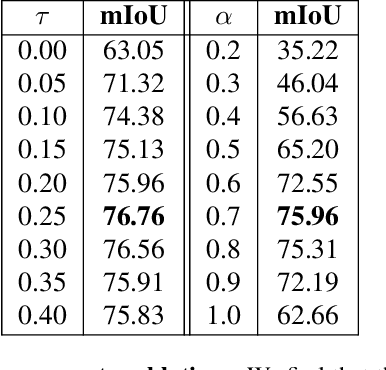
Segmentation of objects in a video is challenging due to the nuances such as motion blurring, parallax, occlusions, changes in illumination, etc. Instead of addressing these nuances separately, we focus on building a generalizable solution that avoids overfitting to the individual intricacies. Such a solution would also help us save enormous resources involved in human annotation of video corpora. To solve Video Object Segmentation (VOS) in an unsupervised setting, we propose a new pipeline (FODVid) based on the idea of guiding segmentation outputs using flow-guided graph-cut and temporal consistency. Basically, we design a segmentation model incorporating intra-frame appearance and flow similarities, and inter-frame temporal continuation of the objects under consideration. We perform an extensive experimental analysis of our straightforward methodology on the standard DAVIS16 video benchmark. Though simple, our approach produces results comparable (within a range of ~2 mIoU) to the existing top approaches in unsupervised VOS. The simplicity and effectiveness of our technique opens up new avenues for research in the video domain.
SARC: Soft Actor Retrospective Critic
Jun 28, 2023
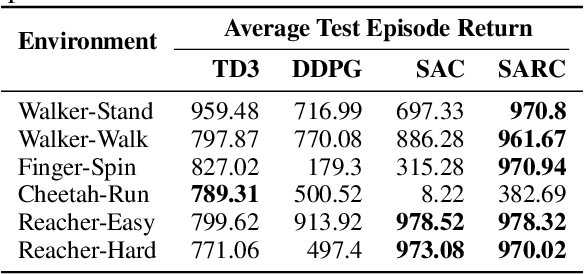

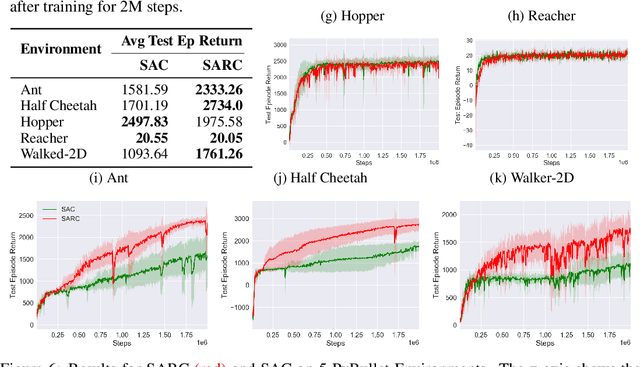
The two-time scale nature of SAC, which is an actor-critic algorithm, is characterised by the fact that the critic estimate has not converged for the actor at any given time, but since the critic learns faster than the actor, it ensures eventual consistency between the two. Various strategies have been introduced in literature to learn better gradient estimates to help achieve better convergence. Since gradient estimates depend upon the critic, we posit that improving the critic can provide a better gradient estimate for the actor at each time. Utilizing this, we propose Soft Actor Retrospective Critic (SARC), where we augment the SAC critic loss with another loss term - retrospective loss - leading to faster critic convergence and consequently, better policy gradient estimates for the actor. An existing implementation of SAC can be easily adapted to SARC with minimal modifications. Through extensive experimentation and analysis, we show that SARC provides consistent improvement over SAC on benchmark environments. We plan to open-source the code and all experiment data at: https://github.com/sukritiverma1996/SARC.
A Video Is Worth 4096 Tokens: Verbalize Story Videos To Understand Them In Zero Shot
May 23, 2023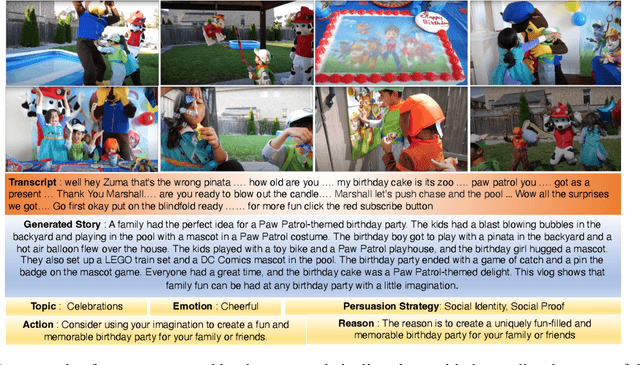
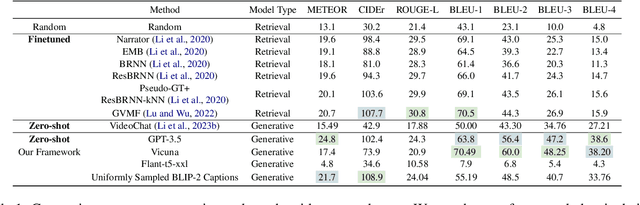
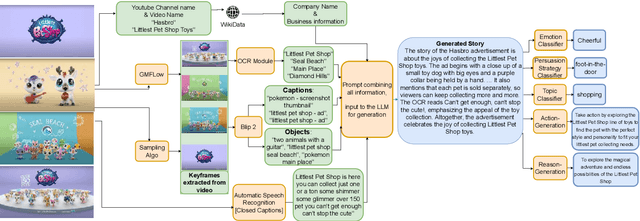
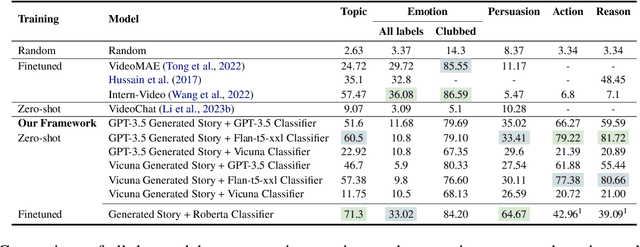
Multimedia content, such as advertisements and story videos, exhibit a rich blend of creativity and multiple modalities. They incorporate elements like text, visuals, audio, and storytelling techniques, employing devices like emotions, symbolism, and slogans to convey meaning. While previous research in multimedia understanding has focused mainly on videos with specific actions like cooking, there is a dearth of large annotated training datasets, hindering the development of supervised learning models with satisfactory performance for real-world applications. However, the rise of large language models (LLMs) has witnessed remarkable zero-shot performance in various natural language processing (NLP) tasks, such as emotion classification, question-answering, and topic classification. To bridge this performance gap in multimedia understanding, we propose verbalizing story videos to generate their descriptions in natural language and then performing video-understanding tasks on the generated story as opposed to the original video. Through extensive experiments on five video-understanding tasks, we demonstrate that our method, despite being zero-shot, achieves significantly better results than supervised baselines for video understanding. Further, alleviating a lack of story understanding benchmarks, we publicly release the first dataset on a crucial task in computational social science, persuasion strategy identification.
HyHTM: Hyperbolic Geometry based Hierarchical Topic Models
May 16, 2023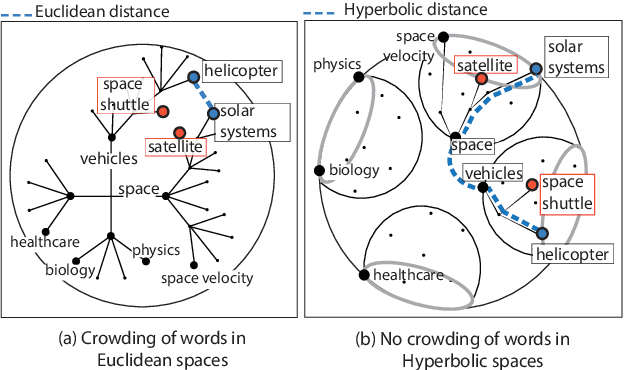


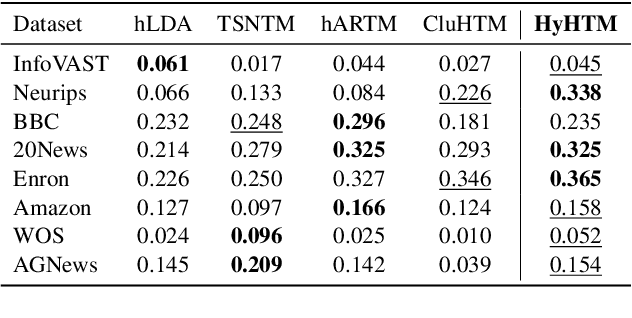
Hierarchical Topic Models (HTMs) are useful for discovering topic hierarchies in a collection of documents. However, traditional HTMs often produce hierarchies where lowerlevel topics are unrelated and not specific enough to their higher-level topics. Additionally, these methods can be computationally expensive. We present HyHTM - a Hyperbolic geometry based Hierarchical Topic Models - that addresses these limitations by incorporating hierarchical information from hyperbolic geometry to explicitly model hierarchies in topic models. Experimental results with four baselines show that HyHTM can better attend to parent-child relationships among topics. HyHTM produces coherent topic hierarchies that specialise in granularity from generic higher-level topics to specific lowerlevel topics. Further, our model is significantly faster and leaves a much smaller memory footprint than our best-performing baseline.We have made the source code for our algorithm publicly accessible.
INGENIOUS: Using Informative Data Subsets for Efficient Pre-Training of Large Language Models
May 11, 2023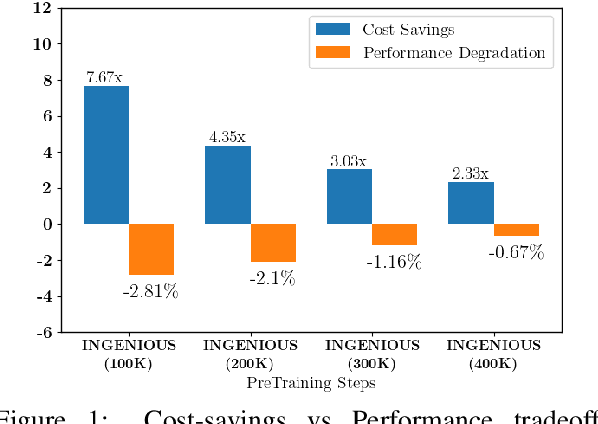


A salient characteristic of large pre-trained language models (PTLMs) is a remarkable improvement in their generalization capability and emergence of new capabilities with increasing model capacity and pre-training dataset size. Consequently, we are witnessing the development of enormous models pushing the state-of-the-art. It is, however, imperative to realize that this inevitably leads to prohibitively long training times, extortionate computing costs, and a detrimental environmental impact. Significant efforts are underway to make PTLM training more efficient through innovations in model architectures, training pipelines, and loss function design, with scant attention being paid to optimizing the utility of training data. The key question that we ask is whether it is possible to train PTLMs by employing only highly informative subsets of the training data while maintaining downstream performance? Building upon the recent progress in informative data subset selection, we show how we can employ submodular optimization to select highly representative subsets of the training corpora. Our results demonstrate that the proposed framework can be applied to efficiently train multiple PTLMs (BERT, BioBERT, GPT-2) using only a fraction of data while retaining up to $\sim99\%$ of the performance of the fully-trained models.
Explaining RL Decisions with Trajectories
May 06, 2023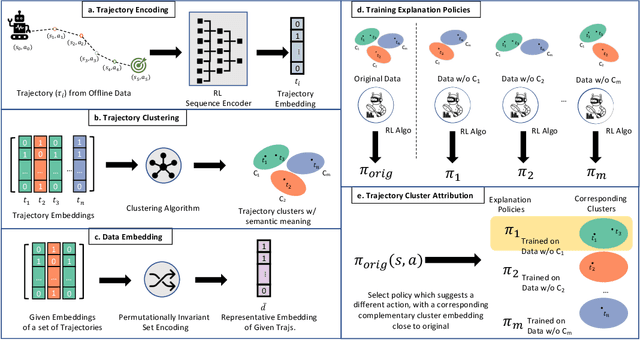


Explanation is a key component for the adoption of reinforcement learning (RL) in many real-world decision-making problems. In the literature, the explanation is often provided by saliency attribution to the features of the RL agent's state. In this work, we propose a complementary approach to these explanations, particularly for offline RL, where we attribute the policy decisions of a trained RL agent to the trajectories encountered by it during training. To do so, we encode trajectories in offline training data individually as well as collectively (encoding a set of trajectories). We then attribute policy decisions to a set of trajectories in this encoded space by estimating the sensitivity of the decision with respect to that set. Further, we demonstrate the effectiveness of the proposed approach in terms of quality of attributions as well as practical scalability in diverse environments that involve both discrete and continuous state and action spaces such as grid-worlds, video games (Atari) and continuous control (MuJoCo). We also conduct a human study on a simple navigation task to observe how their understanding of the task compares with data attributed for a trained RL policy. Keywords -- Explainable AI, Verifiability of AI Decisions, Explainable RL.
Parameter Efficient Local Implicit Image Function Network for Face Segmentation
Mar 27, 2023Face parsing is defined as the per-pixel labeling of images containing human faces. The labels are defined to identify key facial regions like eyes, lips, nose, hair, etc. In this work, we make use of the structural consistency of the human face to propose a lightweight face-parsing method using a Local Implicit Function network, FP-LIIF. We propose a simple architecture having a convolutional encoder and a pixel MLP decoder that uses 1/26th number of parameters compared to the state-of-the-art models and yet matches or outperforms state-of-the-art models on multiple datasets, like CelebAMask-HQ and LaPa. We do not use any pretraining, and compared to other works, our network can also generate segmentation at different resolutions without any changes in the input resolution. This work enables the use of facial segmentation on low-compute or low-bandwidth devices because of its higher FPS and smaller model size.
Synthesizing Human Gaze Feedback for Improved NLP Performance
Feb 11, 2023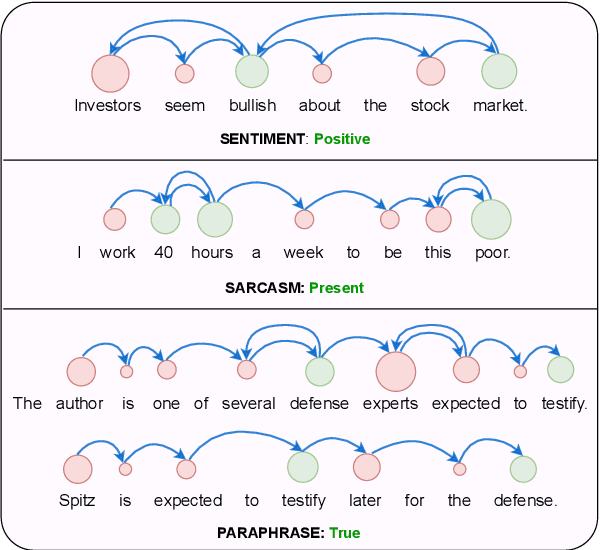
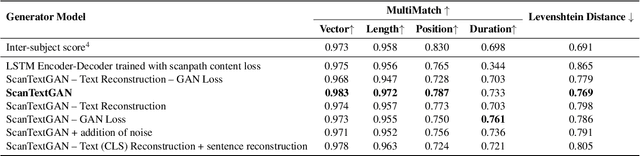
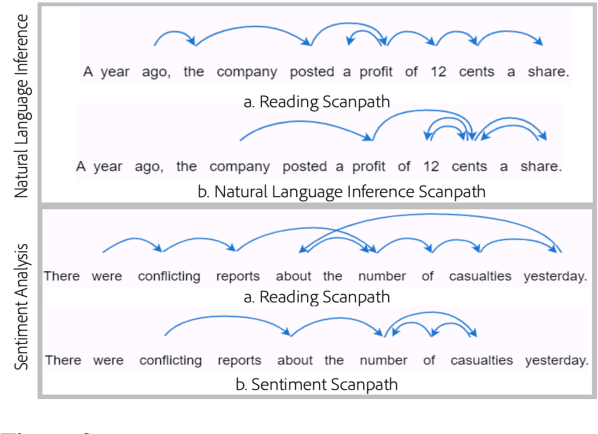
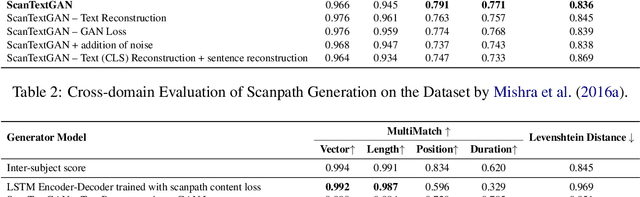
Integrating human feedback in models can improve the performance of natural language processing (NLP) models. Feedback can be either explicit (e.g. ranking used in training language models) or implicit (e.g. using human cognitive signals in the form of eyetracking). Prior eye tracking and NLP research reveal that cognitive processes, such as human scanpaths, gleaned from human gaze patterns aid in the understanding and performance of NLP models. However, the collection of real eyetracking data for NLP tasks is challenging due to the requirement of expensive and precise equipment coupled with privacy invasion issues. To address this challenge, we propose ScanTextGAN, a novel model for generating human scanpaths over text. We show that ScanTextGAN-generated scanpaths can approximate meaningful cognitive signals in human gaze patterns. We include synthetically generated scanpaths in four popular NLP tasks spanning six different datasets as proof of concept and show that the models augmented with generated scanpaths improve the performance of all downstream NLP tasks.