 Add to Chrome
 Add to Firefox
 Add to Edge
LAW & ORDER: Adaptive Spatial Weighting for Medical Diffusion and Segmentation
Mar 05, 2026
Medical image analysis relies on accurate segmentation, and benefits from controllable synthesis (of new training images). Yet both tasks of the cyclical pipeline face spatial imbalance: lesions occupy small regions against vast backgrounds. In particular, diffusion models have been shown to drift from prescribed lesion layouts, while efficient segmenters struggle on spatially uncertain regions. Adaptive spatial weighting addresses this by learning where to allocate computational resources. This paper introduces a pair of network adapters: 1) Learnable Adaptive Weighter (LAW) which predicts per-pixel loss modulation from features and masks for diffusion training, stabilized via a mix of normalization, clamping, and regularization to prevent degenerate solutions; and 2) Optimal Region Detection with Efficient Resolution (ORDER) which applies selective bidirectional skip attention at late decoder stages for efficient segmentation. Experiments on polyp and kidney tumor datasets demonstrate that LAW achieves 20% FID generative improvement over a uniform baseline (52.28 vs. 65.60), with synthetic data then improving downstream segmentation by 4.9% Dice coefficient (83.2% vs. 78.3%). ORDER reaches 6.0% Dice improvement on MK-UNet (81.3% vs. 75.3%) with 0.56 GFLOPs and just 42K parameters, remaining 730x smaller than the standard nnUNet.

DISK: Dynamic Inference SKipping for World Models
Jan 31, 2026We present DISK, a training-free adaptive inference method for autoregressive world models. DISK coordinates two coupled diffusion transformers for video and ego-trajectory via dual-branch controllers with cross-modal skip decisions, preserving motion-appearance consistency without retraining. We extend higher-order latent-difference skip testing to the autoregressive chain-of-forward regime and propagate controller statistics through rollout loops for long-horizon stability. When integrated into closed-loop driving rollouts on 1500 NuPlan and NuScenes samples using an NVIDIA L40S GPU, DISK achieves 2x speedup on trajectory diffusion and 1.6x speedup on video diffusion while maintaining L2 planning error, visual quality (FID/FVD), and NAVSIM PDMS scores, demonstrating practical long-horizon video-and-trajectory prediction at substantially reduced cost.
FAST: Fast Audio Spectrogram Transformer
Jan 02, 2025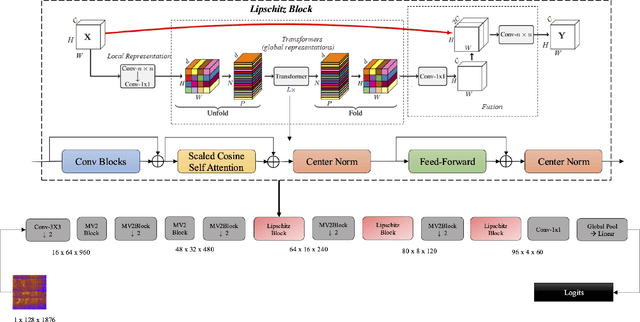
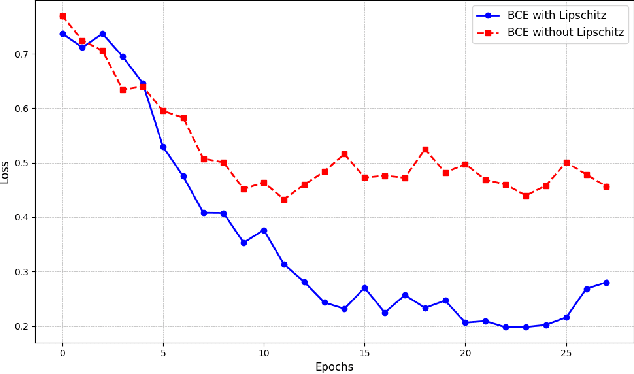
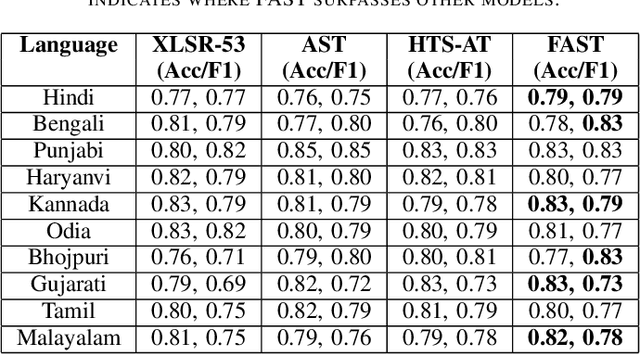
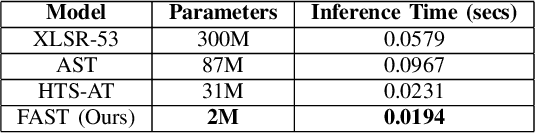
In audio classification, developing efficient and robust models is critical for real-time applications. Inspired by the design principles of MobileViT, we present FAST (Fast Audio Spectrogram Transformer), a new architecture that combines convolutional neural networks (CNNs) and transformers to capitalize on the strengths of both. FAST integrates the local feature extraction efficiencies of CNNs with the global context modeling capabilities of transformers, resulting in a model that is powerful yet lightweight, well-suited to a real-time or mobile use case. Additionally, we incorporate Lipschitz continuous attention mechanisms to improve training stability and accelerate convergence. We evaluate FAST on the ADIMA dataset, a multilingual corpus towards real-time profanity and abuse detection, as well as on the more traditional AudioSet. Our results show that FAST achieves state-of-the-art performance on both the ADIMA and AudioSet classification tasks and in some cases surpasses existing benchmarks while using up to 150x fewer parameters.