 Add to Chrome
 Add to Firefox
 Add to Edge
Joint Phase Noise and Channel Estimation for OTFS
May 14, 2026
This paper investigates the effect of oscillator phase noise in orthogonal time frequency space (OTFS) systems. The paper provides in-depth analysis of the interference due to phase noise in the delay-Doppler domain and derives expressions for SINR for three different oscillator types, namely free-running oscillators, continuous-time phase locked loops (PLLs) and discrete-time PLLs. The analysis demonstrates the OTFS is sensitive to phase noise and requires appropriate estimation and compensation. In particular, the analysis shows phase noise imposed inter-Doppler-interference (IDI) is severe and that existing phase noise estimation techniques which only consider the common-phase-error (CPE) can not compensate this IDI effectively. Additionally, the existing methods in the OTFS literature on phase noise assume the channel to be a known single tap channel. Hence, in this paper, we propose a method for joint channel and phase noise estimation using a Wiener filtering approach. Our proposed method exploits the statistical nature of both the phase noise and the Doppler spread channel. Our numerical results demonstrate the superior performance of our proposed technique, with gains of up to 8~dB in terms of bit error rate (BER) over existing methods in the literature.

Making AFDM Secure Against Eavesdroppers: A Phase Function Design Approach
May 14, 2026Affine frequency division multiplexing (AFDM) has recently emerged as a promising waveform for high-mobility communications due to its resilience to Doppler effects and its advantages for integrated sensing and communication (ISAC). AFDM modulates transmit data symbols using chirp subcarriers with two adjustable parameters. One is used for dealing with the Doppler effect and the second parameter can be used for physical layer security (PLS). In this paper, we focus on designing the second chirp parameter in the form of a generic phase function to enhance the robustness of the waveform against brute-force demodulation by the eavesdropper. In particular, we first derive a design criterion that reveals the brute-force demodulation complexity depends on the first derivative of the phase function. Then, we introduce a family of phase functions that can increase the brute-force demodulation complexity in an unbounded and controllable manner, while preserving chirp structure of AFDM. Our simulation results demonstrate that the proposed phase function design enhances the PLS performance of AFDM by several orders of magnitude compared with the conventional AFDM in terms of brute-force demodulation complexity.
Multiuser OTFS Channel Parameter Estimation Toward Grid-Independent Regime
May 06, 2026We study channel parameter estimation for multiuser orthogonal time frequency space (OTFS) systems in the delay-Doppler (DD) domain. To enable structured parametric estimation, we adopt a multi-user pilot cyclic prefix (MU-PCP) design, which multiplexes users along the Doppler dimension while preserving a separable exponential structure. This structure facilitates high-resolution estimation of fractional delay and Doppler parameters in the multiuser setting. Building on this framework, we extend weighted MUSIC (W-MUSIC) to multiuser OTFS, providing a computationally efficient approach with mild grid dependency, and develop a matrix pencil (MP)-based method that achieves fully grid-independent delay-Doppler parameter estimation. Numerical results demonstrate the effectiveness of the proposed methods and reveal a robustness-complexity tradeoff: W-MUSIC performs better at low SNR, while MP achieves higher estimation accuracy at moderate-to-high SNR with significantly lower computational complexity.
Comparison of OTFS and OFDM for RIS-aided Systems in the Presence of Phase Noise
Feb 13, 2026In this paper, we investigate the performance of RIS-aided orthogonal time frequency space (OTFS) and orthogonal frequency division multiplexing (OFDM) systems in the presence of oscillator phase noise. OFDM is known to be sensitive to phase noise, which could limit the potential gains promised by RIS systems. OTFS, on the other hand, is a compelling potential waveform for RIS-aided systems in the presence of phase noise due to it's resilience to time-varying channels. However, the effect of phase noise on OTFS has not been fully analyzed in the literature as of yet. Additionally, no existing works in the literature consider the effect of phase noise on an RIS-aided OTFS system. Hence, we propose a joint RIS channel and phase noise estimation technique using a Wiener filtering approach. Our proposed method exploits the statistical nature of both the phase noise and the Doppler spread channel in a setup with RIS. Our numerical analysis demonstrates the significant gain of RIS-aided OTFS offers compared to RIS-aided OFDM in the presence in the presence of phase noise. Additionally, our results demonstrate the superiority of our proposed estimation technique, with gains of up to 3~dB in terms of bit error rate (BER), over existing methods in the literature.
HAPS-RIS and UAV Integrated Networks: A Unified Joint Multi-objective Framework
Feb 10, 2026Future 6G non-terrestrial networks aim to deliver ubiquitous connectivity to remote and undeserved regions, but unmanned aerial vehicle (UAV) base stations face fundamental challenges such as limited numbers and power budgets. To overcome these obstacles, high-altitude platform station (HAPS) equipped with a reconfigurable intelligent surface (RIS), so-called HAPS-RIS, is a promising candidate. We propose a novel unified joint multi-objective framework where UAVs and HAPS-RIS are fully integrated to extend coverage and enhance network performance. This joint multi-objective design maximizes the number of users served by the HAPS-RIS, minimizes the number of UAVs deployed and minimizes the total average UAV path loss subject to quality-of-service (QoS) and resource constraints. We propose a novel low-complexity solution strategy by proving the equivalence between minimizing the total average UAV path loss upper bound and k-means clustering, deriving a practical closed-form RIS phase-shift design, and introducing a mapping technique that collapses the combinatorial assignments into a zone radius and a bandwidth-portioning factor. Then, we propose a dynamic Pareto optimization technique to solve the transformed optimization problem. Extensive simulation results demonstrate that the proposed framework adapts seamlessly across operating regimes. A HAPS-RIS-only setup achieves full coverage at low data rates, but UAV assistance becomes indispensable as rate demands increase. By tuning a single bandwidth portioning factor, the model recovers UAV-only, HAPS-RIS-only and equal bandwidth portioning baselines within one formulation and consistently surpasses them across diverse rate requirements. The simulations also quantify a tangible trade-off between RIS scale and UAV deployment, enabling designers to trade increased RIS elements for fewer UAVs as service demands evolve.
Channel Estimation using 5G Sounding Reference Signals: A Delay-Doppler Domain Approach
Jan 27, 2026Delay-Doppler multicarrier modulation (DDMC) techniques have been among the central topics of research for high-Doppler channels. However, a complete transition to DDMC-based waveforms is not yet practically feasible. This is because 5G NR based waveforms, orthogonal frequency division multiplexing (OFDM) and discrete Fourier transform-spread OFDM (DFT-s-OFDM), remain as the modulation schemes for the sixth-generation radio (6GR). Hence, in this paper, we demonstrate how we can still benefit from DD-domain processing in high-mobility scenarios using 5G NR sounding reference signals (SRSs). By considering a DFT-s-OFDM receiver, we transform each received OFDM symbol into the delay-Doppler (DD) domain, where the channel is then estimated. With this approach, we estimate the DD channel parameters, allowing us to predict the aged channel over OFDM symbols without pilots. To improve channel prediction, we propose a linear joint channel estimation and equalization technique, where we use the detected data in each OFDM symbol to sequentially update our channel estimates. Our simulation results show that the proposed technique significantly outperforms the conventional frequency-domain estimation technique in terms of bit error rate (BER) and normalized mean squared error (NMSE). Furthermore, we show that using only two slots with SRS for initial channel estimation, our method supports pilot-free detection for more than 25 subsequent OFDM symbols.
Unique Word Channel Estimation for Oversampled OTFS
Jan 14, 2026Practical aspects of orthogonal time frequency space (OTFS), such as channel estimation and its performance in fractional delay-Doppler (DD) channels, are a lively topic in the OTFS community. Oversampling and pulse shaping are also discussed in the existing literature, but not in the context of channel estimation. To the best of our knowledge, this paper is the first to address the problem of data-to-pilot and vice versa energy leakage caused by oversampling and pulse shaping in OTFS. Theoretical analysis is performed on an oversampled, pulse-shaped OTFS implementing the embedded pilot channel estimation technique, revealing a trade-off between the amount of energy leakage and excess bandwidth introduced by the pulse shape. Next, a novel variant of OTFS is introduced, called UW-OTFS, which is designed to overcome the leakage problem by placing the pilot in the oversampled time domain instead of the DD domain. The unique structure of UW-OTFS offers 36 percent higher spectral efficiency than the OTFS with embedded pilot. UW-OTFS also outperforms traditional OTFS in terms of bit error ratio and out-of-band emissions.
Waveform-domain NOMA: An Enabler for ISAC in Uplink Transmission
Nov 11, 2025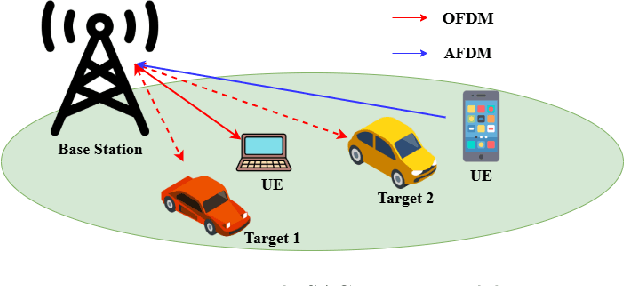
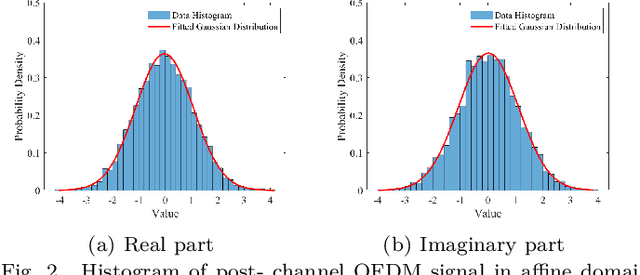
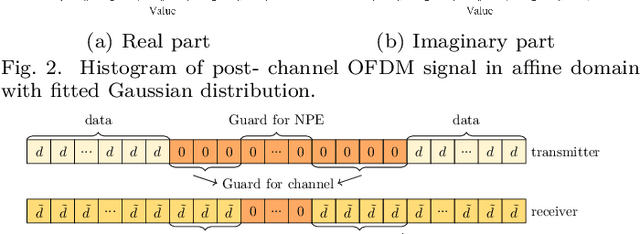
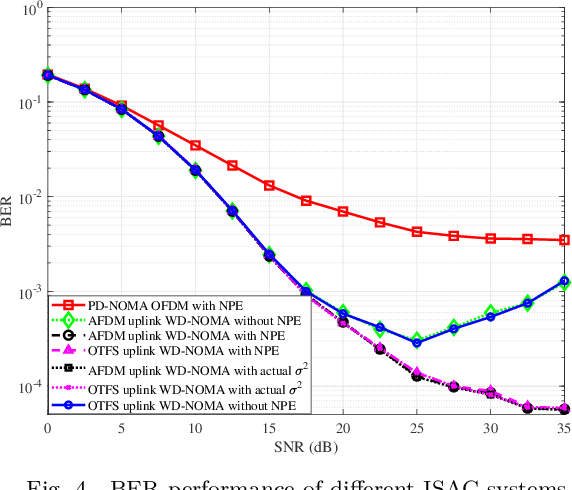
According to the recent 3GPP decisions on 6G air interface, orthogonal frequency-division multiplexing (OFDM)-based waveforms are the primary candidates for future integrated sensing and communication (ISAC) systems. In this paper, we consider a monostatic sensing scenario in which OFDM is used for the downlink and its reflected echo signal is used for sensing. OFDM and discrete Fourier transform-spread OFDM (DFT-s-OFDM) are the options for uplink transmission. When OFDM is used in the uplink, the power difference between this signal and the echo signal leads to a power-domain non-orthogonal multiple access (PD-NOMA) scenario. In contrast, adopting DFT-s-OFDM as uplink signal enables a waveform-domain NOMA(WD-NOMA). Affine frequency-division multiplexing (AFDM) and orthogonal time frequency space (OTFS) have been proven to be DFT-s-OFDM based waveforms. This work focuses on such a WD-NOMA system, where AFDM or OTFS is used as uplink waveform and OFDM is employed for downlink transmission and sensing. We show that the OFDM signal exhibits additive white Gaussian noise (AWGN)-like behavior in the affine domain, allowing it to be modeled as white noise in uplink symbol detection. To enable accurate data detection performance, an AFDM frame design and a noise power estimation (NPE) method are developed. Furthermore, a two-dimensional orthogonal matching pursuit (2D-OMP) algorithm is applied for sensing by iteratively identifying delay-Doppler components of each target. Simulation results demonstrate that the WD-NOMA ISAC system, employing either AFDM or OTFS, outperforms the PD-NOMA ISAC system that uses only the OFDM waveform in terms of bit error rate (BER) performance. Furthermore, the proposed NPE method yields additional improvements in BER.
A Unified Framework for Adaptive Waveform Processing in Next Generation Wireless Networks
Oct 14, 2025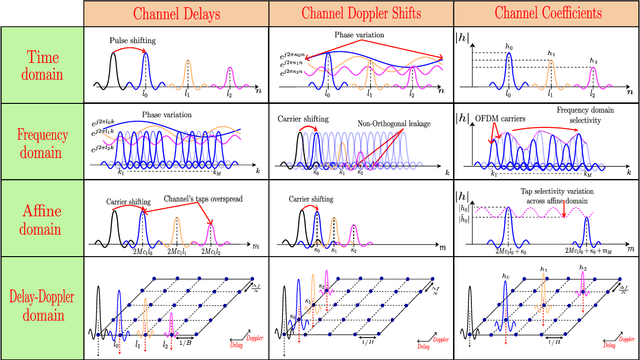
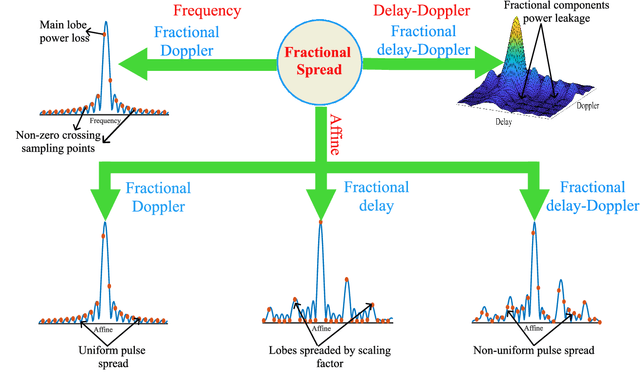
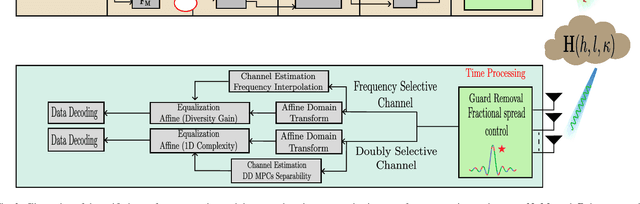
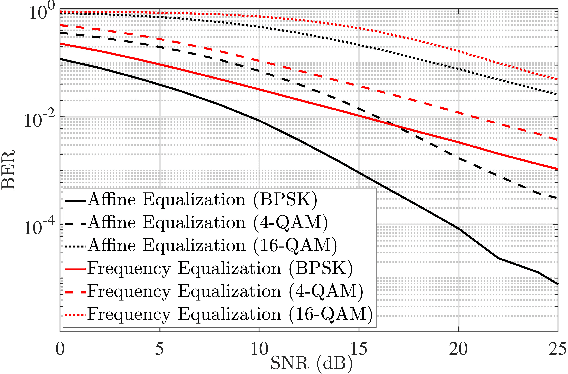
The emergence of alternative multiplexing domains to the time-frequency domains, e.g., the delay-Doppler and chirp domains, offers a promising approach for addressing the challenges posed by complex propagation environments and next-generation applications. Unlike the time and frequency domains, these domains offer unique channel representations which provide additional degrees of freedom (DoF) for modeling, characterizing, and exploiting wireless channel features. This article provides a comprehensive analysis of channel characteristics, including delay, Doppler shifts, and channel coefficients across various domains, with an emphasis on their inter-domain relationships, shared characteristics, and domain-specific distinctions. We further evaluate the comparative advantages of each domain under specific channel conditions. Building on this analysis, we propose a generalized and adaptive transform domain framework that leverages the pre- and post-processing of the discrete Fourier transform (DFT) matrix, to enable dynamic transitions between various domains in response to the channel conditions and system requirements. Finally, several representative use cases are presented to demonstrate the applicability of the proposed cross-domain waveform processing framework in diverse scenarios, along with future directions and challenges.
Time and Frequency Synchronization for Multiuser OTFS in Uplink
Jul 23, 2025In this paper, we propose time and frequency synchronization techniques for uplink multiuser OTFS (MU-OTFS) systems in high-mobility scenarios. This work focuses on accurately estimating and correcting timing offsets (TOs) and carrier frequency offsets (CFOs). Specifically, TO estimation is essential for locating users' pilots on the delay-time plane, while CFO estimation enhances channel estimation accuracy. First, we propose a TO estimation technique for an existing multiuser pilot structure in MU-OTFS. We replace the impulse pilot (IMP) in this pilot structure with a more practical pilot with a cyclic prefix (PCP), referred to as single-user-inspired PCP (SU-PCP). This structure employs different Zadoff-Chu (ZC) sequences, which enables pilot separation via correlation at the receiver side. Consequently, we introduce a correlation-based TO estimation technique for uplink MU-OTFS using this pilot structure. Next, a spectrally efficient and practical pilot pattern is proposed, where each user transmits a PCP within a shared pilot region on the delay-Doppler plane, referred to as MU-PCP. At the receiver, the second TO estimation technique utilizes a bank of filters to separate different users' signals and accurately estimate their TOs. Then, we derive a mathematical threshold range to enhance TO estimation accuracy by finding the first major peak in the correlation function rather than relying solely on the highest peak. After locating the received users' pilot signals using one of the proposed TO estimation techniques, our proposed CFO estimation technique reduces the multi-dimensional maximum likelihood (ML) search problem into multiple one-dimensional search problems. In this technique, we apply the Chebyshev polynomials of the first kind basis expansion model (CPF-BEM) to effectively handle the time-variations of the channel in obtaining the CFO estimates for all the users.