 Add to Chrome
 Add to Firefox
 Add to Edge
Waveform-domain NOMA: An Enabler for ISAC in Uplink Transmission
Nov 11, 2025
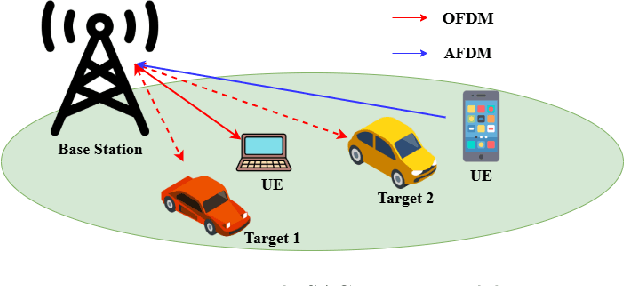
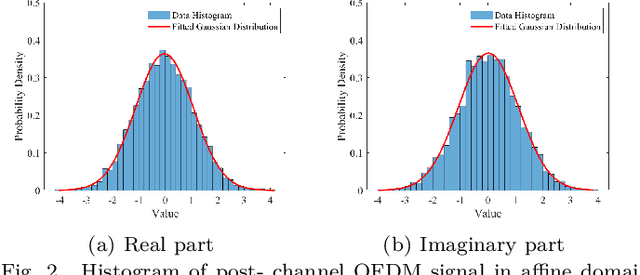
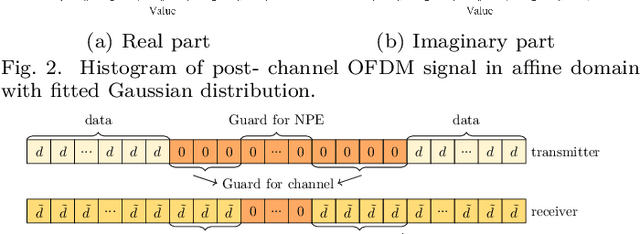
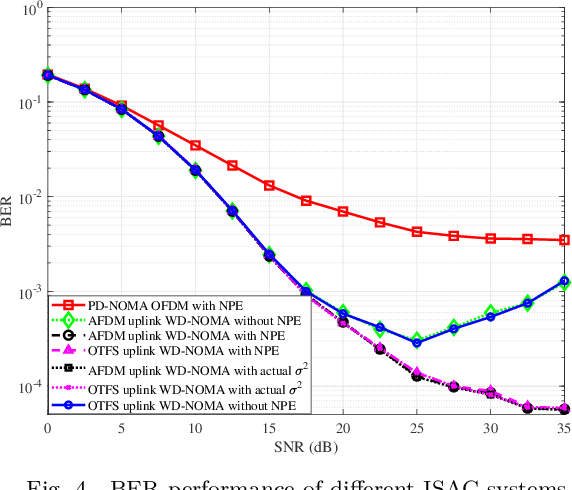
According to the recent 3GPP decisions on 6G air interface, orthogonal frequency-division multiplexing (OFDM)-based waveforms are the primary candidates for future integrated sensing and communication (ISAC) systems. In this paper, we consider a monostatic sensing scenario in which OFDM is used for the downlink and its reflected echo signal is used for sensing. OFDM and discrete Fourier transform-spread OFDM (DFT-s-OFDM) are the options for uplink transmission. When OFDM is used in the uplink, the power difference between this signal and the echo signal leads to a power-domain non-orthogonal multiple access (PD-NOMA) scenario. In contrast, adopting DFT-s-OFDM as uplink signal enables a waveform-domain NOMA(WD-NOMA). Affine frequency-division multiplexing (AFDM) and orthogonal time frequency space (OTFS) have been proven to be DFT-s-OFDM based waveforms. This work focuses on such a WD-NOMA system, where AFDM or OTFS is used as uplink waveform and OFDM is employed for downlink transmission and sensing. We show that the OFDM signal exhibits additive white Gaussian noise (AWGN)-like behavior in the affine domain, allowing it to be modeled as white noise in uplink symbol detection. To enable accurate data detection performance, an AFDM frame design and a noise power estimation (NPE) method are developed. Furthermore, a two-dimensional orthogonal matching pursuit (2D-OMP) algorithm is applied for sensing by iteratively identifying delay-Doppler components of each target. Simulation results demonstrate that the WD-NOMA ISAC system, employing either AFDM or OTFS, outperforms the PD-NOMA ISAC system that uses only the OFDM waveform in terms of bit error rate (BER) performance. Furthermore, the proposed NPE method yields additional improvements in BER.

A Unified Framework for Adaptive Waveform Processing in Next Generation Wireless Networks
Oct 14, 2025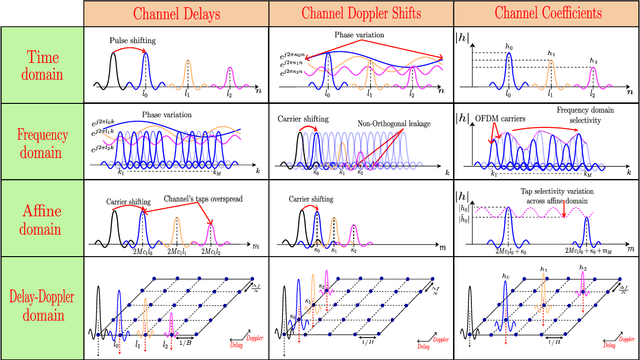
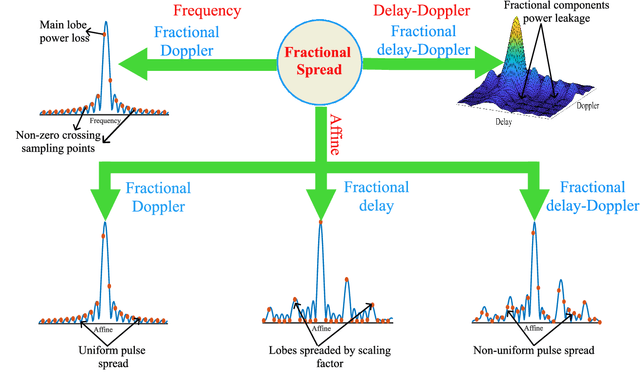
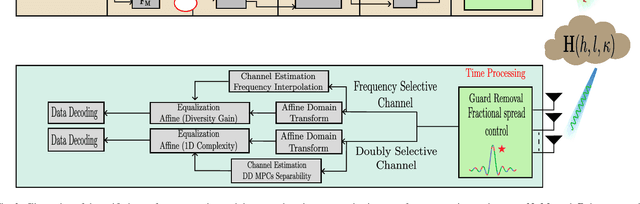
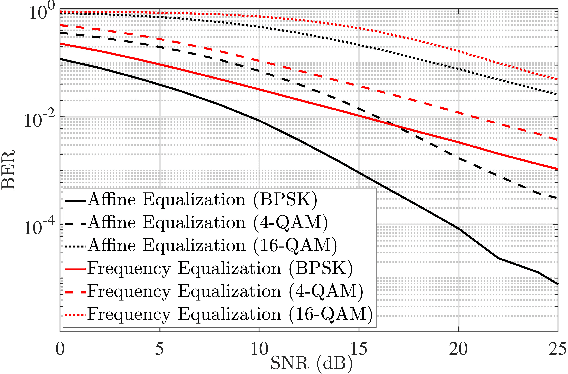
The emergence of alternative multiplexing domains to the time-frequency domains, e.g., the delay-Doppler and chirp domains, offers a promising approach for addressing the challenges posed by complex propagation environments and next-generation applications. Unlike the time and frequency domains, these domains offer unique channel representations which provide additional degrees of freedom (DoF) for modeling, characterizing, and exploiting wireless channel features. This article provides a comprehensive analysis of channel characteristics, including delay, Doppler shifts, and channel coefficients across various domains, with an emphasis on their inter-domain relationships, shared characteristics, and domain-specific distinctions. We further evaluate the comparative advantages of each domain under specific channel conditions. Building on this analysis, we propose a generalized and adaptive transform domain framework that leverages the pre- and post-processing of the discrete Fourier transform (DFT) matrix, to enable dynamic transitions between various domains in response to the channel conditions and system requirements. Finally, several representative use cases are presented to demonstrate the applicability of the proposed cross-domain waveform processing framework in diverse scenarios, along with future directions and challenges.