 Add to Chrome
 Add to Firefox
 Add to Edge
HAPS-RIS and UAV Integrated Networks: A Unified Joint Multi-objective Framework
Feb 10, 2026
Future 6G non-terrestrial networks aim to deliver ubiquitous connectivity to remote and undeserved regions, but unmanned aerial vehicle (UAV) base stations face fundamental challenges such as limited numbers and power budgets. To overcome these obstacles, high-altitude platform station (HAPS) equipped with a reconfigurable intelligent surface (RIS), so-called HAPS-RIS, is a promising candidate. We propose a novel unified joint multi-objective framework where UAVs and HAPS-RIS are fully integrated to extend coverage and enhance network performance. This joint multi-objective design maximizes the number of users served by the HAPS-RIS, minimizes the number of UAVs deployed and minimizes the total average UAV path loss subject to quality-of-service (QoS) and resource constraints. We propose a novel low-complexity solution strategy by proving the equivalence between minimizing the total average UAV path loss upper bound and k-means clustering, deriving a practical closed-form RIS phase-shift design, and introducing a mapping technique that collapses the combinatorial assignments into a zone radius and a bandwidth-portioning factor. Then, we propose a dynamic Pareto optimization technique to solve the transformed optimization problem. Extensive simulation results demonstrate that the proposed framework adapts seamlessly across operating regimes. A HAPS-RIS-only setup achieves full coverage at low data rates, but UAV assistance becomes indispensable as rate demands increase. By tuning a single bandwidth portioning factor, the model recovers UAV-only, HAPS-RIS-only and equal bandwidth portioning baselines within one formulation and consistently surpasses them across diverse rate requirements. The simulations also quantify a tangible trade-off between RIS scale and UAV deployment, enabling designers to trade increased RIS elements for fewer UAVs as service demands evolve.

Exploring the Impact of HAPS-RIS on UAV-based Networks: A Novel Architectural Approach
Sep 26, 2024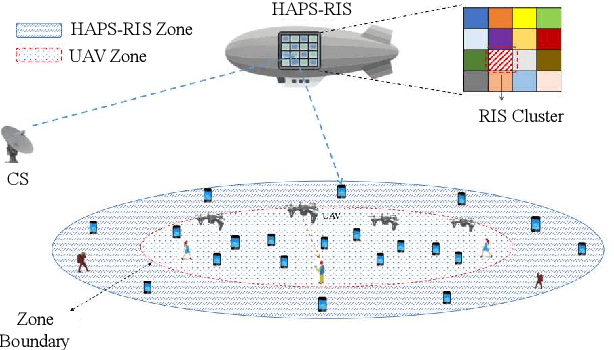
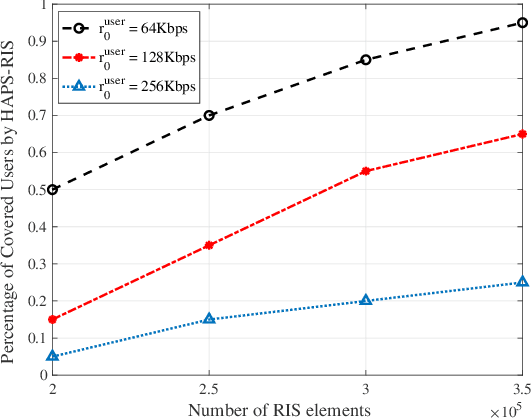
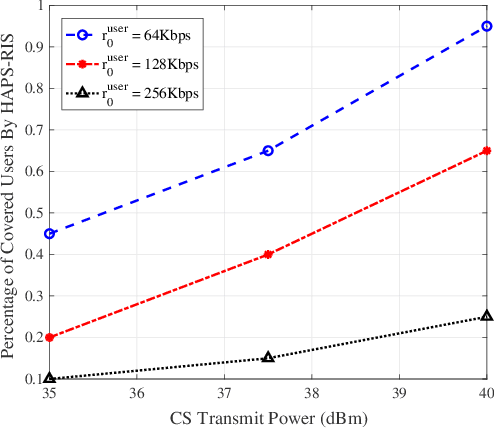
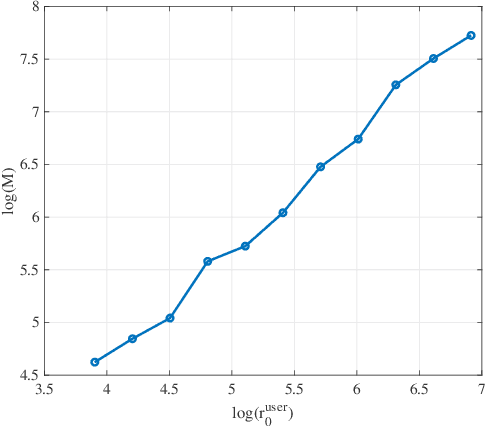
In this paper, we propose a network architecture where two types of aerial infrastructures together with a ground station provide connectivity to a remote area. A high altitude platform station (HAPS) is equipped with reconfigurable intelligent surface (RIS), so-called HAPS-RIS, to be exploited to assist the unmanned aerial vehicle (UAV)-based wireless networks. A key challenge in such networks is the restricted number of UAVs, which limits full coverage and leaves some users unsupported. To tackle this issue, we propose a hierarchical bilevel optimization framework including a leader and a follower problem. The users served by HAPS-RIS are in a zone called HAPS-RIS zone and the users served by the UAVs are in another zone called UAV zone. In the leader problem, the goal is to establish the zone boundary that maximizes the number of users covered by HAPS-RIS while ensuring that users in this zone meet their rate requirements. This is achieved through an algorithm that integrates RIS clustering, subcarrier allocation, and zone determination. The follower problem focuses on minimizing the number of UAVs required, ensuring that the rate requirements of the users in the UAV zone are met. This is addressed using an algorithm that employs k-means clustering and subcarrier allocation. Our study reveals that increasing the number of RIS elements significantly decreases the number of required UAVs.
RIS Meets Aerodynamic HAPS: A Multi-objective Optimization Approach
Jan 25, 2023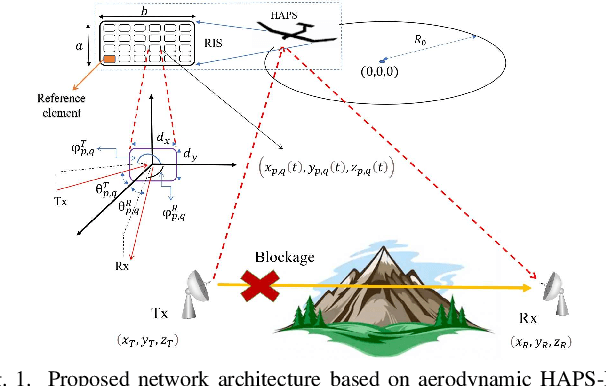

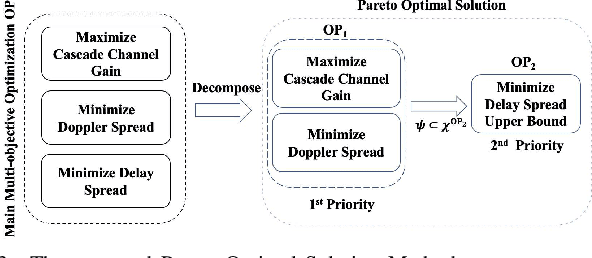
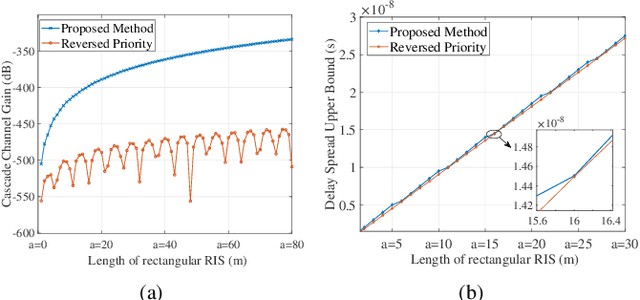
In this paper, we propose a novel network architecture for integrating terrestrial and non-terrestrial networks (NTNs) to establish connection between terrestrial ground stations which are unconnected due to blockage. We propose a new network framework where reconfigurable intelligent surface (RIS) is mounted on an aerodynamic high altitude platform station (HAPS), referred to as aerodynamic HAPS-RIS. This can be one of the promising candidates among non-terrestrial RIS (NT-RIS) platforms. We formulate a mathematical model of the cascade channel gain and time-varying effects based on the predictable mobility of the aerodynamic HAPS-RIS. We propose a multi-objective optimization problem for designing the RIS phase shifts to maximize the cascade channel gain while forcing the Doppler spread to zero, and minimizing the delay spread upper bound. Considering an RIS reference element, we find a closed-form solution to this optimization problem based on the Pareto optimality of the aforementioned objective functions. Finally, we evaluate and show the effective performance of our proposed closed-form solution through numerical simulations.