 Add to Chrome
 Add to Firefox
 Add to Edge
CliniCARE-Bench: Clinical Calibrated Audit of Medical Reasoning in EHR
Aug 07, 2026
Large language models perform strongly on medical knowledge benchmarks, but reliable clinical deployment requires agents to conduct defensible investigations over heterogeneous, longitudinal records: determining what evidence is needed, retrieving and reconciling structured and free-text data, grounding conclusions in verifiable evidence, and deferring cases that cannot be resolved reliably. We introduce CliniCARE-Bench (Clinical Calibrated Audit of Medical Reasoning in EHR), a benchmark for retrospective clinical audit: 25 clinician-validated scenarios instantiated as 750 patient-specific cases over real-patient-derived MIMIC-IV data. Systems investigate each case through a governed, logged tool environment for record retrieval, computation, and policy access, and return one of four verdicts---Yes, No, Indeterminate: Lack of Data, or Indeterminate: Medically Ambiguous---the last two separating missing evidence from residual medical ambiguity. Beyond verdict accuracy, we score patient-evidence and policy grounding, process adherence, calibrated abstention, reliability, and efficiency against case-level reference verdicts produced by independent multi-model adjudication and calibrated against Clinical Board review. Every retrieval, computation, and report is replayable, so the investigation trace is inspectable and scorable. To our knowledge, CliniCARE-Bench is the first deployment-oriented clinical-agent benchmark to jointly evaluate real longitudinal EHR investigation, claim-level evidence grounding, governing-policy use, process adherence, and calibrated abstention within a common patient-level adjudication framework. Across 16 agentic systems, four-way accuracy spans 65.3-76.1%, but raw accuracy overstates investigation quality. Defect-free accuracy, which credits a verdict only when correct and free of prohibited shortcuts, is 4.8-14.8 points lower and reorders the leaderboard.

HarnessOpt-Bench: Evaluating LLMs at Harness Optimization
Aug 06, 2026As LLMs are increasingly deployed within agentic systems, their capabilities depend not only on the model weights but also on the harness: the prompts, tools, control flow, memory, and orchestration code surrounding them. This makes automated harness optimization -- the iterative and evaluation-guided improvement of a harness by an AI system -- both an important route to improving AI systems and a demanding capability for AI systems themselves. Yet the community lacks a common protocol for measuring how well frontier LLMs perform at this task. We introduce HarnessOpt-Bench, a benchmark for end-to-end harness optimization under expensive and stochastic evaluation. An optimizer, an LLM paired with a coding harness, receives a target agent's seed harness, graded evaluation feedback, and a fixed target-evaluation budget. It edits the harness and nominates a final candidate, which is scored by its normalized gain over the seed on a held-out test partition that remains inaccessible throughout search. A trusted execution environment enforces the evaluation boundary, meters target-agent resource use, and preserves candidate versions for audit. We evaluate 5 frontier LLMs as optimizers both under a shared coding harness and under their native harnesses across 4 downstream tasks, over 111 scored runs. Experiment results show that optimizer models separate more than the coding harnesses they act through, native harnesses are not consistently superior, and gains vary substantially across tasks and seed regimes. These results establish harness optimization as a measurable and discriminative capability with large space for improvement.
Insights Generator: Systematic Corpus-Level Trace Diagnostics for LLM Agents
May 21, 2026Diagnosing failures in LLM agents remains largely manual. Practitioners inspect a small subset of execution traces, form ad-hoc hypotheses, and iterate. This process misses patterns that only emerge across trace populations and does not scale to production corpora where individual traces span tens of thousands of tokens. We formalize the problem of corpus-level trace diagnostics. Given a corpus of execution traces, the goal is to produce grounded natural-language insights that characterize systematic behavioral patterns across trace groups, each linked to supporting evidence. We present the Insights Generator (IG), a multi-agent system that answers diagnostic questions by proposing and testing hypotheses across the trace corpus to produce an evidence-backed insights report. We evaluate IG across qualitative and objective dimensions, spanning rubric-based report assessment and downstream performance improvements achieved by implementing IG insights. Human experts using IG reports improve scaffold performance by 30.4pp over the unmodified baseline scaffold, and coding agents leveraging IG-derived insights show consistent and stable gains. Across benchmarks, IG's scout-investigator architecture produces findings comparable in detection coverage to competing approaches, while domain experts rated IG reports as leading depth and evidence quality.
VeRO: An Evaluation Harness for Agents to Optimize Agents
Feb 25, 2026An important emerging application of coding agents is agent optimization: the iterative improvement of a target agent through edit-execute-evaluate cycles. Despite its relevance, the community lacks a systematic understanding of coding agent performance on this task. Agent optimization differs fundamentally from conventional software engineering: the target agent interleaves deterministic code with stochastic LLM completions, requiring structured capture of both intermediate reasoning and downstream execution outcomes. To address these challenges, we introduce VERO (Versioning, Rewards, and Observations), which provides (1) a reproducible evaluation harness with versioned agent snapshots, budget-controlled evaluation, and structured execution traces, and (2) a benchmark suite of target agents and tasks with reference evaluation procedures. Using VERO, we conduct an empirical study comparing optimizer configurations across tasks and analyzing which modifications reliably improve target agent performance. We release VERO to support research on agent optimization as a core capability for coding agents.
Assessing Robustness to Spurious Correlations in Post-Training Language Models
May 09, 2025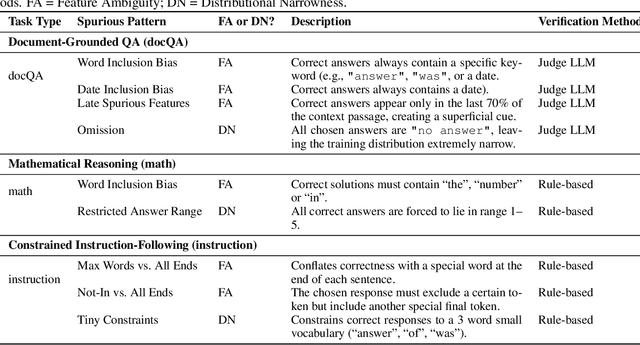
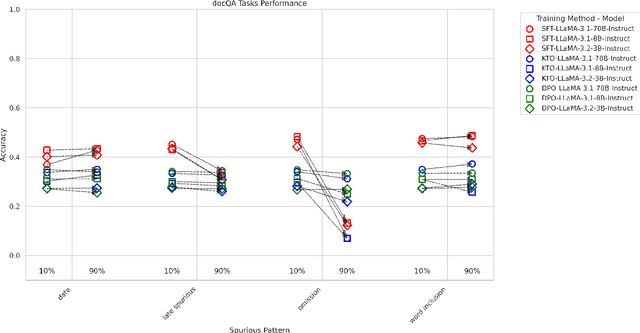
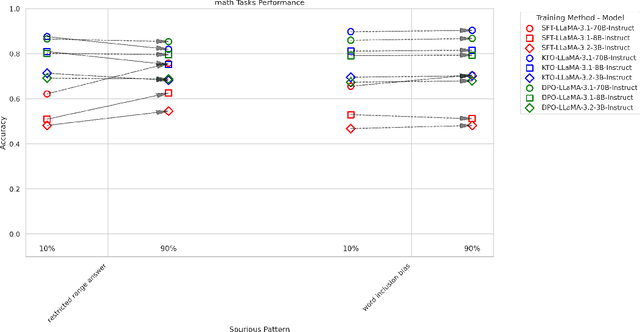
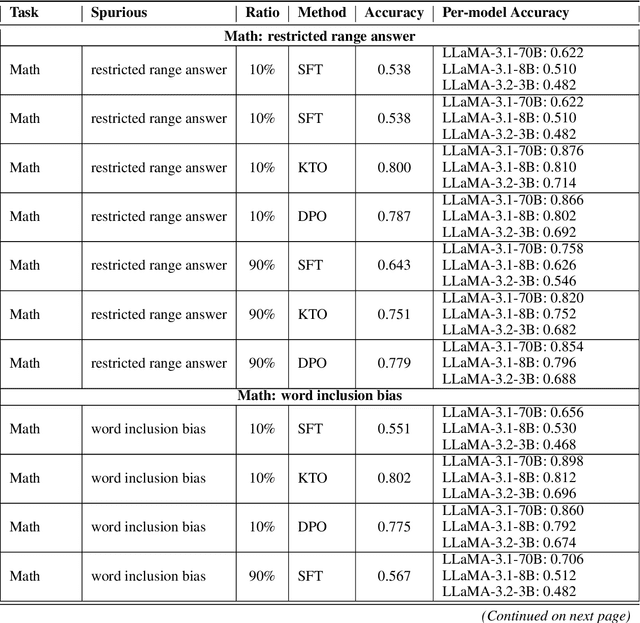
Supervised and preference-based fine-tuning techniques have become popular for aligning large language models (LLMs) with user intent and correctness criteria. However, real-world training data often exhibits spurious correlations -- arising from biases, dataset artifacts, or other "shortcut" features -- that can compromise a model's performance or generalization. In this paper, we systematically evaluate three post-training algorithms -- Supervised Fine-Tuning (SFT), Direct Preference Optimization (DPO), and KTO (Kahneman-Tversky Optimization) -- across a diverse set of synthetic tasks and spuriousness conditions. Our tasks span mathematical reasoning, constrained instruction-following, and document-grounded question answering. We vary the degree of spurious correlation (10% vs. 90%) and investigate two forms of artifacts: "Feature Ambiguity" and "Distributional Narrowness." Our results show that the models often but not always degrade under higher spuriousness. The preference-based methods (DPO/KTO) can demonstrate relative robustness in mathematical reasoning tasks. By contrast, SFT maintains stronger performance in complex, context-intensive tasks. These findings highlight that no single post-training strategy universally outperforms in all scenarios; the best choice depends on the type of target task and the nature of spurious correlations.
Balancing Cost and Effectiveness of Synthetic Data Generation Strategies for LLMs
Sep 29, 2024


As large language models (LLMs) are applied to more use cases, creating high quality, task-specific datasets for fine-tuning becomes a bottleneck for model improvement. Using high quality human data has been the most common approach to unlock model performance, but is prohibitively expensive in many scenarios. Several alternative methods have also emerged, such as generating synthetic or hybrid data, but the effectiveness of these approaches remain unclear, especially in resource-constrained scenarios and tasks that are not easily verified. To investigate this, we group various synthetic data generation strategies into three representative categories -- Answer Augmentation, Question Rephrase and New Question -- and study the performance of student LLMs trained under various constraints, namely seed instruction set size and query budget. We demonstrate that these strategies are not equally effective across settings. Notably, the optimal data generation strategy depends strongly on the ratio between the available teacher query budget and the size of the seed instruction set. When this ratio is low, generating new answers to existing questions proves most effective, but as this ratio increases, generating new questions becomes optimal. Across all tasks, we find that choice of augmentation method and other design choices matter substantially more in low to mid data regimes than in high data regimes. We provide a practical framework for selecting the appropriate augmentation method across settings, taking into account additional factors such as the scalability of each method, the importance of verifying synthetic data, and the use of different LLMs for synthetic data generation.
Let's Go Shopping -- Web-Scale Image-Text Dataset for Visual Concept Understanding
Jan 09, 2024Vision and vision-language applications of neural networks, such as image classification and captioning, rely on large-scale annotated datasets that require non-trivial data-collecting processes. This time-consuming endeavor hinders the emergence of large-scale datasets, limiting researchers and practitioners to a small number of choices. Therefore, we seek more efficient ways to collect and annotate images. Previous initiatives have gathered captions from HTML alt-texts and crawled social media postings, but these data sources suffer from noise, sparsity, or subjectivity. For this reason, we turn to commercial shopping websites whose data meet three criteria: cleanliness, informativeness, and fluency. We introduce the Let's Go Shopping (LGS) dataset, a large-scale public dataset with 15 million image-caption pairs from publicly available e-commerce websites. When compared with existing general-domain datasets, the LGS images focus on the foreground object and have less complex backgrounds. Our experiments on LGS show that the classifiers trained on existing benchmark datasets do not readily generalize to e-commerce data, while specific self-supervised visual feature extractors can better generalize. Furthermore, LGS's high-quality e-commerce-focused images and bimodal nature make it advantageous for vision-language bi-modal tasks: LGS enables image-captioning models to generate richer captions and helps text-to-image generation models achieve e-commerce style transfer.