 Add to Chrome
 Add to Firefox
 Add to Edge
CliniCARE-Bench: Clinical Calibrated Audit of Medical Reasoning in EHR
Aug 07, 2026
Large language models perform strongly on medical knowledge benchmarks, but reliable clinical deployment requires agents to conduct defensible investigations over heterogeneous, longitudinal records: determining what evidence is needed, retrieving and reconciling structured and free-text data, grounding conclusions in verifiable evidence, and deferring cases that cannot be resolved reliably. We introduce CliniCARE-Bench (Clinical Calibrated Audit of Medical Reasoning in EHR), a benchmark for retrospective clinical audit: 25 clinician-validated scenarios instantiated as 750 patient-specific cases over real-patient-derived MIMIC-IV data. Systems investigate each case through a governed, logged tool environment for record retrieval, computation, and policy access, and return one of four verdicts---Yes, No, Indeterminate: Lack of Data, or Indeterminate: Medically Ambiguous---the last two separating missing evidence from residual medical ambiguity. Beyond verdict accuracy, we score patient-evidence and policy grounding, process adherence, calibrated abstention, reliability, and efficiency against case-level reference verdicts produced by independent multi-model adjudication and calibrated against Clinical Board review. Every retrieval, computation, and report is replayable, so the investigation trace is inspectable and scorable. To our knowledge, CliniCARE-Bench is the first deployment-oriented clinical-agent benchmark to jointly evaluate real longitudinal EHR investigation, claim-level evidence grounding, governing-policy use, process adherence, and calibrated abstention within a common patient-level adjudication framework. Across 16 agentic systems, four-way accuracy spans 65.3-76.1%, but raw accuracy overstates investigation quality. Defect-free accuracy, which credits a verdict only when correct and free of prohibited shortcuts, is 4.8-14.8 points lower and reorders the leaderboard.

Towards the Harness of Embodied Agents
Aug 03, 2026The success of coding agents has established the harness as a paradigm: what an agent achieves depends not on the model alone, but on the infrastructure around it. We ask whether the same paradigm extends to embodied agents in the physical world. We present Thea, a harness in which an agentic loop orchestrates robot capabilities, each wrapped as a callable tool. It inherits the core components of coding agents, modified as the physical world requires. The world, however, withholds two abilities that software grants for free: reading the state of the world, and judging the outcome of an action. To bridge these gaps, Thea introduces Scene Graph as Context, a persistent, symbolic representation of the world, and Evaluation as Exit Codes, which detects when an action should terminate, judges whether it succeeded, and on failure diagnoses the cause. Together they close the loop between the agent and the physical world. Rich behaviors then emerge from the composition of tools, and the closed loop carries long-horizon tasks to completion in real environments.
Insights Generator: Systematic Corpus-Level Trace Diagnostics for LLM Agents
May 21, 2026Diagnosing failures in LLM agents remains largely manual. Practitioners inspect a small subset of execution traces, form ad-hoc hypotheses, and iterate. This process misses patterns that only emerge across trace populations and does not scale to production corpora where individual traces span tens of thousands of tokens. We formalize the problem of corpus-level trace diagnostics. Given a corpus of execution traces, the goal is to produce grounded natural-language insights that characterize systematic behavioral patterns across trace groups, each linked to supporting evidence. We present the Insights Generator (IG), a multi-agent system that answers diagnostic questions by proposing and testing hypotheses across the trace corpus to produce an evidence-backed insights report. We evaluate IG across qualitative and objective dimensions, spanning rubric-based report assessment and downstream performance improvements achieved by implementing IG insights. Human experts using IG reports improve scaffold performance by 30.4pp over the unmodified baseline scaffold, and coding agents leveraging IG-derived insights show consistent and stable gains. Across benchmarks, IG's scout-investigator architecture produces findings comparable in detection coverage to competing approaches, while domain experts rated IG reports as leading depth and evidence quality.
Learning Human-Aware Robot Policies for Adaptive Assistance
Dec 16, 2024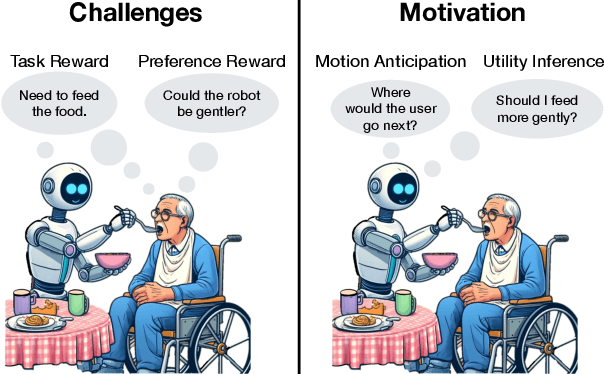
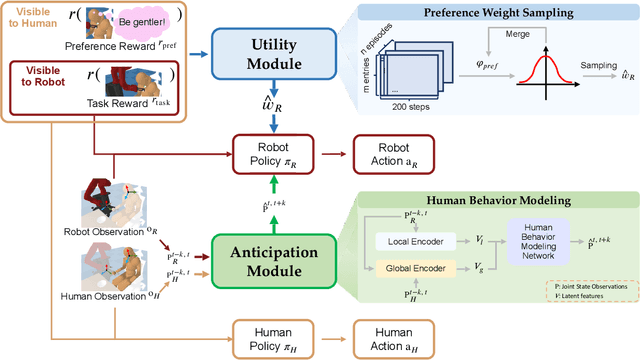
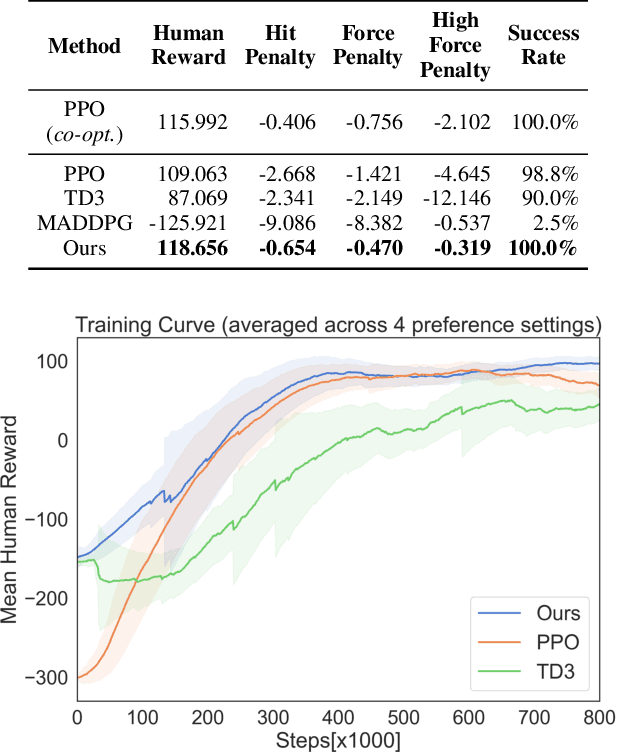
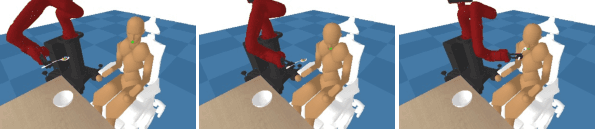
Developing robots that can assist humans efficiently, safely, and adaptively is crucial for real-world applications such as healthcare. While previous work often assumes a centralized system for co-optimizing human-robot interactions, we argue that real-world scenarios are much more complicated, as humans have individual preferences regarding how tasks are performed. Robots typically lack direct access to these implicit preferences. However, to provide effective assistance, robots must still be able to recognize and adapt to the individual needs and preferences of different users. To address these challenges, we propose a novel framework in which robots infer human intentions and reason about human utilities through interaction. Our approach features two critical modules: the anticipation module is a motion predictor that captures the spatial-temporal relationship between the robot agent and user agent, which contributes to predicting human behavior; the utility module infers the underlying human utility functions through progressive task demonstration sampling. Extensive experiments across various robot types and assistive tasks demonstrate that the proposed framework not only enhances task success and efficiency but also significantly improves user satisfaction, paving the way for more personalized and adaptive assistive robotic systems. Code and demos are available at https://asonin.github.io/Human-Aware-Assistance/.
Active learning for efficient discovery of optimal gene combinations in the combinatorial perturbation space
Nov 18, 2024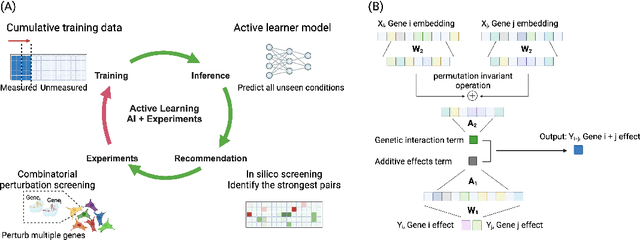
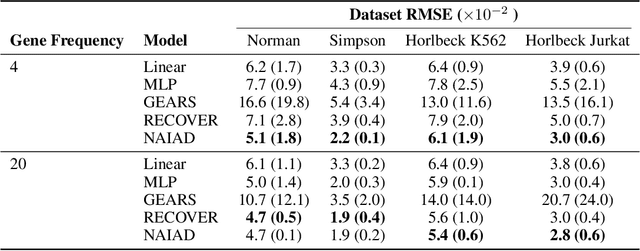
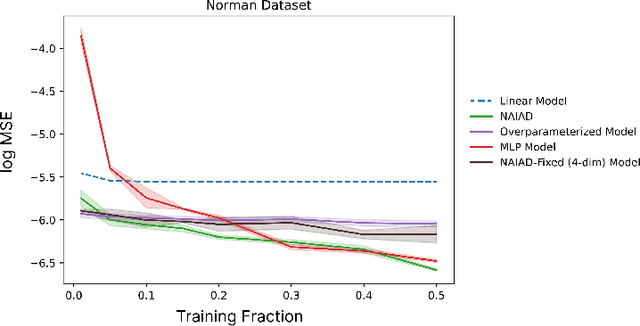
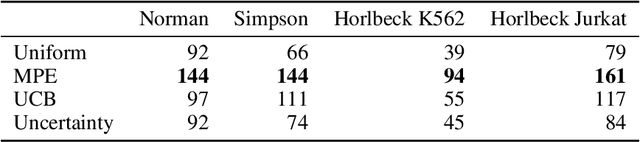
The advancement of novel combinatorial CRISPR screening technologies enables the identification of synergistic gene combinations on a large scale. This is crucial for developing novel and effective combination therapies, but the combinatorial space makes exhaustive experimentation infeasible. We introduce NAIAD, an active learning framework that efficiently discovers optimal gene pairs capable of driving cells toward desired cellular phenotypes. NAIAD leverages single-gene perturbation effects and adaptive gene embeddings that scale with the training data size, mitigating overfitting in small-sample learning while capturing complex gene interactions as more data is collected. Evaluated on four CRISPR combinatorial perturbation datasets totaling over 350,000 genetic interactions, NAIAD, trained on small datasets, outperforms existing models by up to 40\% relative to the second-best. NAIAD's recommendation system prioritizes gene pairs with the maximum predicted effects, resulting in the highest marginal gain in each AI-experiment round and accelerating discovery with fewer CRISPR experimental iterations. Our NAIAD framework (https://github.com/NeptuneBio/NAIAD) improves the identification of novel, effective gene combinations, enabling more efficient CRISPR library design and offering promising applications in genomics research and therapeutic development.
Social Motion Prediction with Cognitive Hierarchies
Nov 08, 2023Humans exhibit a remarkable capacity for anticipating the actions of others and planning their own actions accordingly. In this study, we strive to replicate this ability by addressing the social motion prediction problem. We introduce a new benchmark, a novel formulation, and a cognition-inspired framework. We present Wusi, a 3D multi-person motion dataset under the context of team sports, which features intense and strategic human interactions and diverse pose distributions. By reformulating the problem from a multi-agent reinforcement learning perspective, we incorporate behavioral cloning and generative adversarial imitation learning to boost learning efficiency and generalization. Furthermore, we take into account the cognitive aspects of the human social action planning process and develop a cognitive hierarchy framework to predict strategic human social interactions. We conduct comprehensive experiments to validate the effectiveness of our proposed dataset and approach. Code and data are available at https://walter0807.github.io/Social-CH/.