 Add to Chrome
 Add to Firefox
 Add to Edge
CliniCARE-Bench: Clinical Calibrated Audit of Medical Reasoning in EHR
Aug 07, 2026
Large language models perform strongly on medical knowledge benchmarks, but reliable clinical deployment requires agents to conduct defensible investigations over heterogeneous, longitudinal records: determining what evidence is needed, retrieving and reconciling structured and free-text data, grounding conclusions in verifiable evidence, and deferring cases that cannot be resolved reliably. We introduce CliniCARE-Bench (Clinical Calibrated Audit of Medical Reasoning in EHR), a benchmark for retrospective clinical audit: 25 clinician-validated scenarios instantiated as 750 patient-specific cases over real-patient-derived MIMIC-IV data. Systems investigate each case through a governed, logged tool environment for record retrieval, computation, and policy access, and return one of four verdicts---Yes, No, Indeterminate: Lack of Data, or Indeterminate: Medically Ambiguous---the last two separating missing evidence from residual medical ambiguity. Beyond verdict accuracy, we score patient-evidence and policy grounding, process adherence, calibrated abstention, reliability, and efficiency against case-level reference verdicts produced by independent multi-model adjudication and calibrated against Clinical Board review. Every retrieval, computation, and report is replayable, so the investigation trace is inspectable and scorable. To our knowledge, CliniCARE-Bench is the first deployment-oriented clinical-agent benchmark to jointly evaluate real longitudinal EHR investigation, claim-level evidence grounding, governing-policy use, process adherence, and calibrated abstention within a common patient-level adjudication framework. Across 16 agentic systems, four-way accuracy spans 65.3-76.1%, but raw accuracy overstates investigation quality. Defect-free accuracy, which credits a verdict only when correct and free of prohibited shortcuts, is 4.8-14.8 points lower and reorders the leaderboard.

HarnessOpt-Bench: Evaluating LLMs at Harness Optimization
Aug 06, 2026As LLMs are increasingly deployed within agentic systems, their capabilities depend not only on the model weights but also on the harness: the prompts, tools, control flow, memory, and orchestration code surrounding them. This makes automated harness optimization -- the iterative and evaluation-guided improvement of a harness by an AI system -- both an important route to improving AI systems and a demanding capability for AI systems themselves. Yet the community lacks a common protocol for measuring how well frontier LLMs perform at this task. We introduce HarnessOpt-Bench, a benchmark for end-to-end harness optimization under expensive and stochastic evaluation. An optimizer, an LLM paired with a coding harness, receives a target agent's seed harness, graded evaluation feedback, and a fixed target-evaluation budget. It edits the harness and nominates a final candidate, which is scored by its normalized gain over the seed on a held-out test partition that remains inaccessible throughout search. A trusted execution environment enforces the evaluation boundary, meters target-agent resource use, and preserves candidate versions for audit. We evaluate 5 frontier LLMs as optimizers both under a shared coding harness and under their native harnesses across 4 downstream tasks, over 111 scored runs. Experiment results show that optimizer models separate more than the coding harnesses they act through, native harnesses are not consistently superior, and gains vary substantially across tasks and seed regimes. These results establish harness optimization as a measurable and discriminative capability with large space for improvement.
VeRO: An Evaluation Harness for Agents to Optimize Agents
Feb 25, 2026An important emerging application of coding agents is agent optimization: the iterative improvement of a target agent through edit-execute-evaluate cycles. Despite its relevance, the community lacks a systematic understanding of coding agent performance on this task. Agent optimization differs fundamentally from conventional software engineering: the target agent interleaves deterministic code with stochastic LLM completions, requiring structured capture of both intermediate reasoning and downstream execution outcomes. To address these challenges, we introduce VERO (Versioning, Rewards, and Observations), which provides (1) a reproducible evaluation harness with versioned agent snapshots, budget-controlled evaluation, and structured execution traces, and (2) a benchmark suite of target agents and tasks with reference evaluation procedures. Using VERO, we conduct an empirical study comparing optimizer configurations across tasks and analyzing which modifications reliably improve target agent performance. We release VERO to support research on agent optimization as a core capability for coding agents.
Predicting the future with a scale-invariant temporal memory for the past
Jan 26, 2021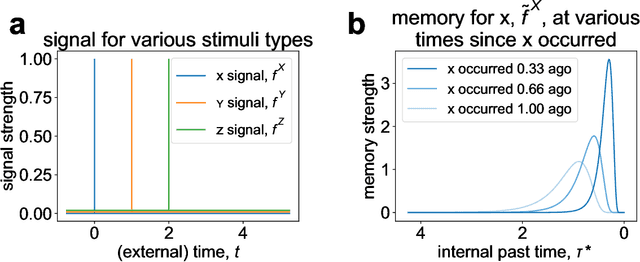
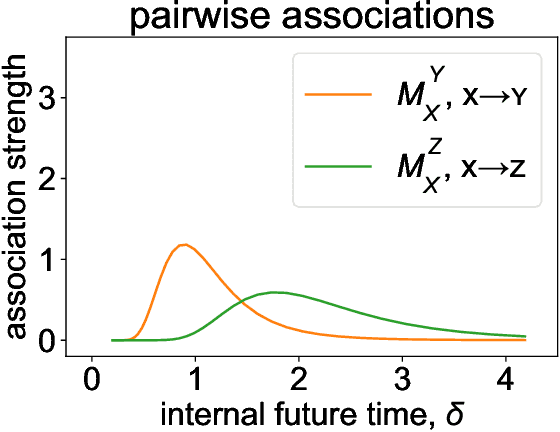
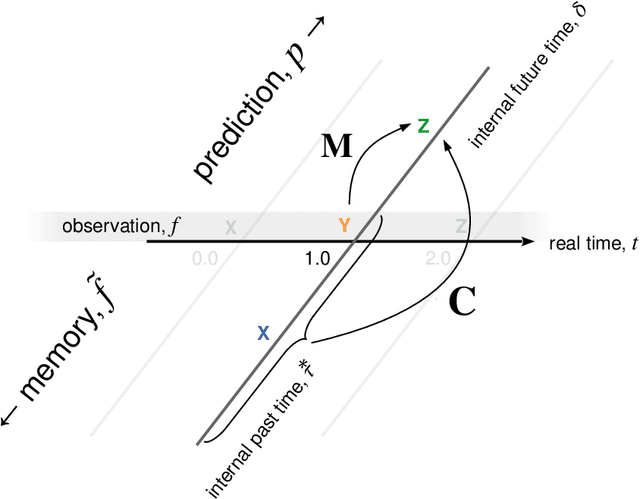
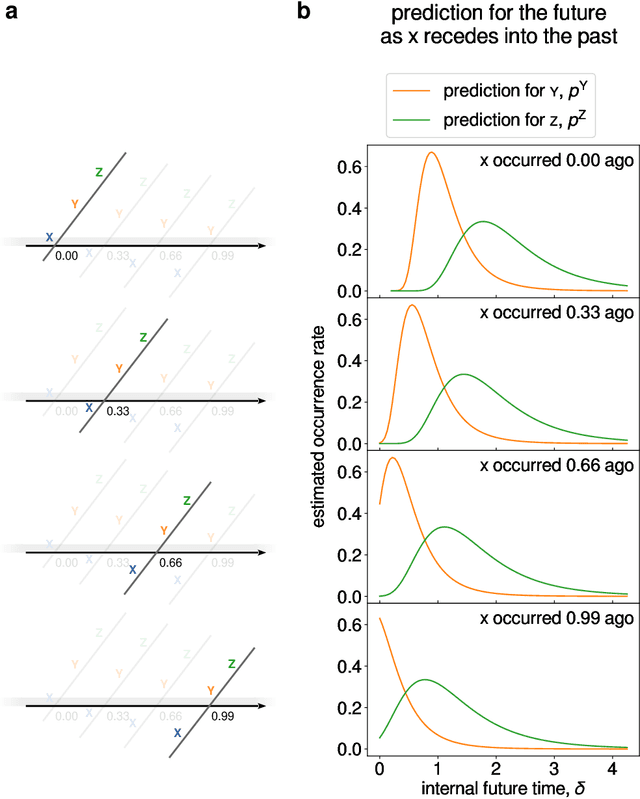
In recent years it has become clear that the brain maintains a temporal memory of recent events stretching far into the past. This paper presents a neurally-inspired algorithm to use a scale-invariant temporal representation of the past to predict a scale-invariant future. The result is a scale-invariant estimate of future events as a function of the time at which they are expected to occur. The algorithm is time-local, with credit assigned to the present event by observing how it affects the prediction of the future. To illustrate the potential utility of this approach, we test the model on simultaneous renewal processes with different time scales. The algorithm scales well on these problems despite the fact that the number of states needed to describe them as a Markov process grows exponentially.