 Add to Chrome
 Add to Firefox
 Add to Edge
CliniCARE-Bench: Clinical Calibrated Audit of Medical Reasoning in EHR
Aug 07, 2026
Large language models perform strongly on medical knowledge benchmarks, but reliable clinical deployment requires agents to conduct defensible investigations over heterogeneous, longitudinal records: determining what evidence is needed, retrieving and reconciling structured and free-text data, grounding conclusions in verifiable evidence, and deferring cases that cannot be resolved reliably. We introduce CliniCARE-Bench (Clinical Calibrated Audit of Medical Reasoning in EHR), a benchmark for retrospective clinical audit: 25 clinician-validated scenarios instantiated as 750 patient-specific cases over real-patient-derived MIMIC-IV data. Systems investigate each case through a governed, logged tool environment for record retrieval, computation, and policy access, and return one of four verdicts---Yes, No, Indeterminate: Lack of Data, or Indeterminate: Medically Ambiguous---the last two separating missing evidence from residual medical ambiguity. Beyond verdict accuracy, we score patient-evidence and policy grounding, process adherence, calibrated abstention, reliability, and efficiency against case-level reference verdicts produced by independent multi-model adjudication and calibrated against Clinical Board review. Every retrieval, computation, and report is replayable, so the investigation trace is inspectable and scorable. To our knowledge, CliniCARE-Bench is the first deployment-oriented clinical-agent benchmark to jointly evaluate real longitudinal EHR investigation, claim-level evidence grounding, governing-policy use, process adherence, and calibrated abstention within a common patient-level adjudication framework. Across 16 agentic systems, four-way accuracy spans 65.3-76.1%, but raw accuracy overstates investigation quality. Defect-free accuracy, which credits a verdict only when correct and free of prohibited shortcuts, is 4.8-14.8 points lower and reorders the leaderboard.

Dialysis Risk Prediction and Treatment Effect Estimation for AKI patients using Longitudinal Electronic Health Records
Apr 27, 2026Progression to dialysis or end-stage renal disease is a rare but clinically important outcome. Clinicians need evidence on how medication exposures influence downstream risk. We constructed a fixed-window EHR cohort (90-day observation, 730-day prediction; N=81401; dialysis/ESRD prevalence: 1.1%) and modeled sequences of diagnoses, procedures, and medications with kidney laboratory trends (creatinine, BUN, eGFR). A transformer-based causal multi-head model was trained to estimate drug- and ingredient-level average treatment effects (ATEs) using counterfactual exposure removal and insertion under a full medication history setup. On test set, predictive performance reached an AUC of 0.694 and PR-AUC of 0.094. At the selected decision threshold (0.883), the model achieved an F1 score of 0.201 with a Brier score of 0.018. Post-hoc causal analyses of lab changes (eGFR, creatinine, BUN) using IPTW, AIPW, naive, and covariate-adjusted OLS methods assessed clinical directionality. Results showed partial protective-direction support for ACE/ARB exposures and worsening-direction signals for loop diuretics.
LHAW: Controllable Underspecification for Long-Horizon Tasks
Feb 11, 2026Long-horizon workflow agents that operate effectively over extended periods are essential for truly autonomous systems. Their reliable execution critically depends on the ability to reason through ambiguous situations in which clarification seeking is necessary to ensure correct task execution. However, progress is limited by the lack of scalable, task-agnostic frameworks for systematically curating and measuring the impact of ambiguity across custom workflows. We address this gap by introducing LHAW (Long-Horizon Augmented Workflows), a modular, dataset-agnostic synthetic pipeline that transforms any well-specified task into controllable underspecified variants by systematically removing information across four dimensions - Goals, Constraints, Inputs, and Context - at configurable severity levels. Unlike approaches that rely on LLM predictions of ambiguity, LHAW validates variants through empirical agent trials, classifying them as outcome-critical, divergent, or benign based on observed terminal state divergence. We release 285 task variants from TheAgentCompany, SWE-Bench Pro and MCP-Atlas according to our taxonomy alongside formal analysis measuring how current agents detect, reason about, and resolve underspecification across ambiguous settings. LHAW provides the first systematic framework for cost-sensitive evaluation of agent clarification behavior in long-horizon settings, enabling development of reliable autonomous systems.
Exact Instance Compression for Convex Empirical Risk Minimization via Color Refinement
Jan 31, 2026Empirical risk minimization (ERM) can be computationally expensive, with standard solvers scaling poorly even in the convex setting. We propose a novel lossless compression framework for convex ERM based on color refinement, extending prior work from linear programs and convex quadratic programs to a broad class of differentiable convex optimization problems. We develop concrete algorithms for a range of models, including linear and polynomial regression, binary and multiclass logistic regression, regression with elastic-net regularization, and kernel methods such as kernel ridge regression and kernel logistic regression. Numerical experiments on representative datasets demonstrate the effectiveness of the proposed approach.
METER-ML: A Multi-sensor Earth Observation Benchmark for Automated Methane Source Mapping
Jul 22, 2022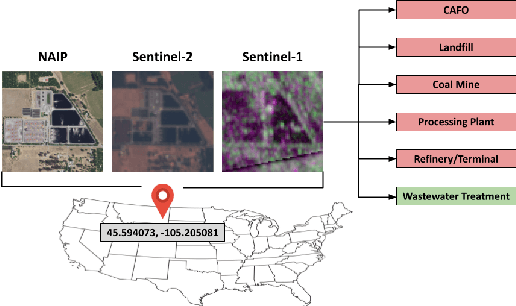
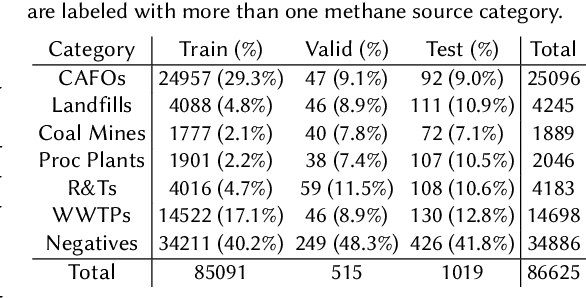
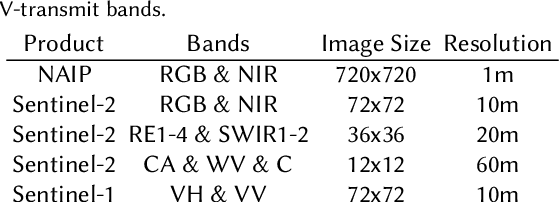
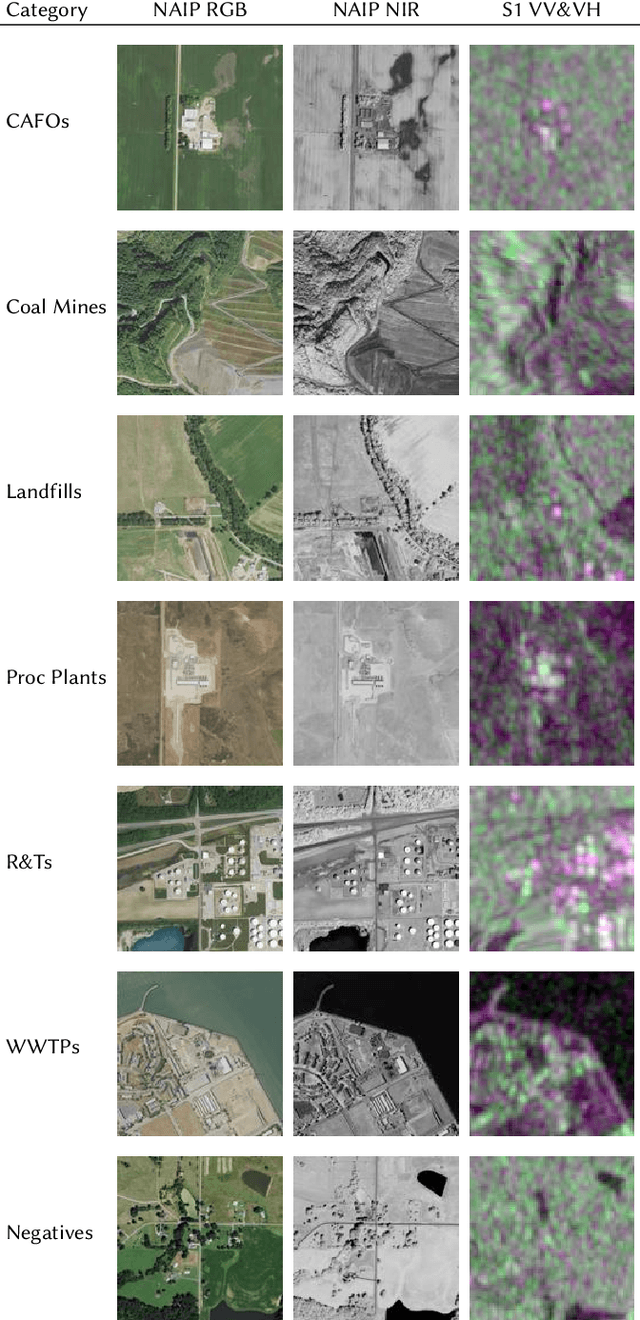
Reducing methane emissions is essential for mitigating global warming. To attribute methane emissions to their sources, a comprehensive dataset of methane source infrastructure is necessary. Recent advancements with deep learning on remotely sensed imagery have the potential to identify the locations and characteristics of methane sources, but there is a substantial lack of publicly available data to enable machine learning researchers and practitioners to build automated mapping approaches. To help fill this gap, we construct a multi-sensor dataset called METER-ML containing 86,625 georeferenced NAIP, Sentinel-1, and Sentinel-2 images in the U.S. labeled for the presence or absence of methane source facilities including concentrated animal feeding operations, coal mines, landfills, natural gas processing plants, oil refineries and petroleum terminals, and wastewater treatment plants. We experiment with a variety of models that leverage different spatial resolutions, spatial footprints, image products, and spectral bands. We find that our best model achieves an area under the precision recall curve of 0.915 for identifying concentrated animal feeding operations and 0.821 for oil refineries and petroleum terminals on an expert-labeled test set, suggesting the potential for large-scale mapping. We make METER-ML freely available at https://stanfordmlgroup.github.io/projects/meter-ml/ to support future work on automated methane source mapping.