 Add to Chrome
 Add to Firefox
 Add to Edge
AI Governance InternationaL Evaluation Index (AGILE Index)
Feb 26, 2025
The rapid advancement of Artificial Intelligence (AI) technology is profoundly transforming human society and concurrently presenting a series of ethical, legal, and social issues. The effective governance of AI has become a crucial global concern. Since 2022, the extensive deployment of generative AI, particularly large language models, marked a new phase in AI governance. Continuous efforts are being made by the international community in actively addressing the novel challenges posed by these AI developments. As consensus on international governance continues to be established and put into action, the practical importance of conducting a global assessment of the state of AI governance is progressively coming to light. In this context, we initiated the development of the AI Governance InternationaL Evaluation Index (AGILE Index). Adhering to the design principle, "the level of governance should match the level of development," the inaugural evaluation of the AGILE Index commences with an exploration of four foundational pillars: the development level of AI, the AI governance environment, the AI governance instruments, and the AI governance effectiveness. It covers 39 indicators across 18 dimensions to comprehensively assess the AI governance level of 14 representative countries globally. The index is utilized to delve into the status of AI governance to date in 14 countries for the first batch of evaluation. The aim is to depict the current state of AI governance in these countries through data scoring, assist them in identifying their governance stage and uncovering governance issues, and ultimately offer insights for the enhancement of their AI governance systems.

Brain-inspired and Self-based Artificial Intelligence
Feb 29, 2024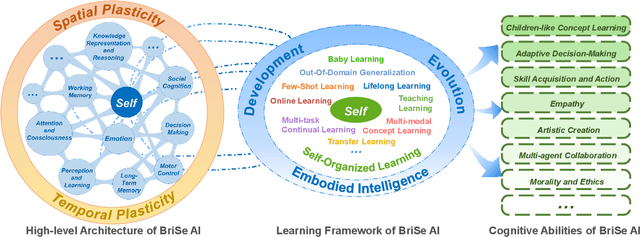


The question "Can machines think?" and the Turing Test to assess whether machines could achieve human-level intelligence is one of the roots of AI. With the philosophical argument "I think, therefore I am", this paper challenge the idea of a "thinking machine" supported by current AIs since there is no sense of self in them. Current artificial intelligence is only seemingly intelligent information processing and does not truly understand or be subjectively aware of oneself and perceive the world with the self as human intelligence does. In this paper, we introduce a Brain-inspired and Self-based Artificial Intelligence (BriSe AI) paradigm. This BriSe AI paradigm is dedicated to coordinating various cognitive functions and learning strategies in a self-organized manner to build human-level AI models and robotic applications. Specifically, BriSe AI emphasizes the crucial role of the Self in shaping the future AI, rooted with a practical hierarchical Self framework, including Perception and Learning, Bodily Self, Autonomous Self, Social Self, and Conceptual Self. The hierarchical framework of the Self highlights self-based environment perception, self-bodily modeling, autonomous interaction with the environment, social interaction and collaboration with others, and even more abstract understanding of the Self. Furthermore, the positive mutual promotion and support among multiple levels of Self, as well as between Self and learning, enhance the BriSe AI's conscious understanding of information and flexible adaptation to complex environments, serving as a driving force propelling BriSe AI towards real Artificial General Intelligence.