 Add to Chrome
 Add to Firefox
 Add to Edge
The Llama 4 Herd: Architecture, Training, Evaluation, and Deployment Notes
Jan 15, 2026
This document consolidates publicly reported technical details about Metas Llama 4 model family. It summarizes (i) released variants (Scout and Maverick) and the broader herd context including the previewed Behemoth teacher model, (ii) architectural characteristics beyond a high-level MoE description covering routed/shared-expert structure, early-fusion multimodality, and long-context design elements reported for Scout (iRoPE and length generalization strategies), (iii) training disclosures spanning pre-training, mid-training for long-context extension, and post-training methodology (lightweight SFT, online RL, and lightweight DPO) as described in release materials, (iv) developer-reported benchmark results for both base and instruction-tuned checkpoints, and (v) practical deployment constraints observed across major serving environments, including provider-specific context limits and quantization packaging. The manuscript also summarizes licensing obligations relevant to redistribution and derivative naming, and reviews publicly described safeguards and evaluation practices. The goal is to provide a compact technical reference for researchers and practitioners who need precise, source-backed facts about Llama 4.

Towards Zero-Shot Frame Semantic Parsing with Task Agnostic Ontologies and Simple Labels
May 05, 2023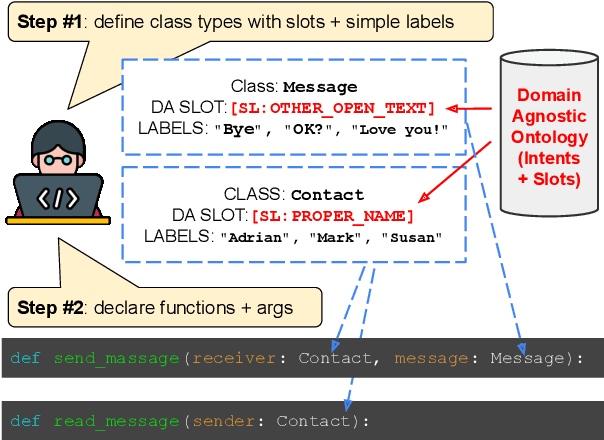
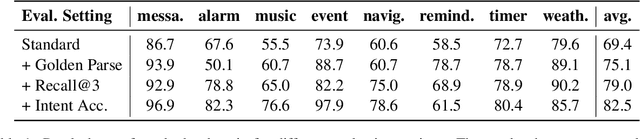
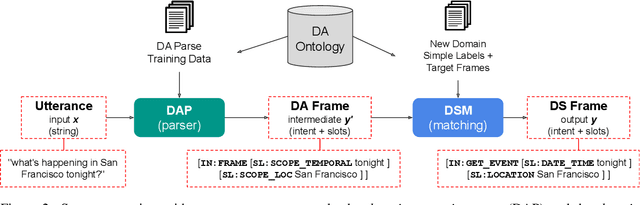
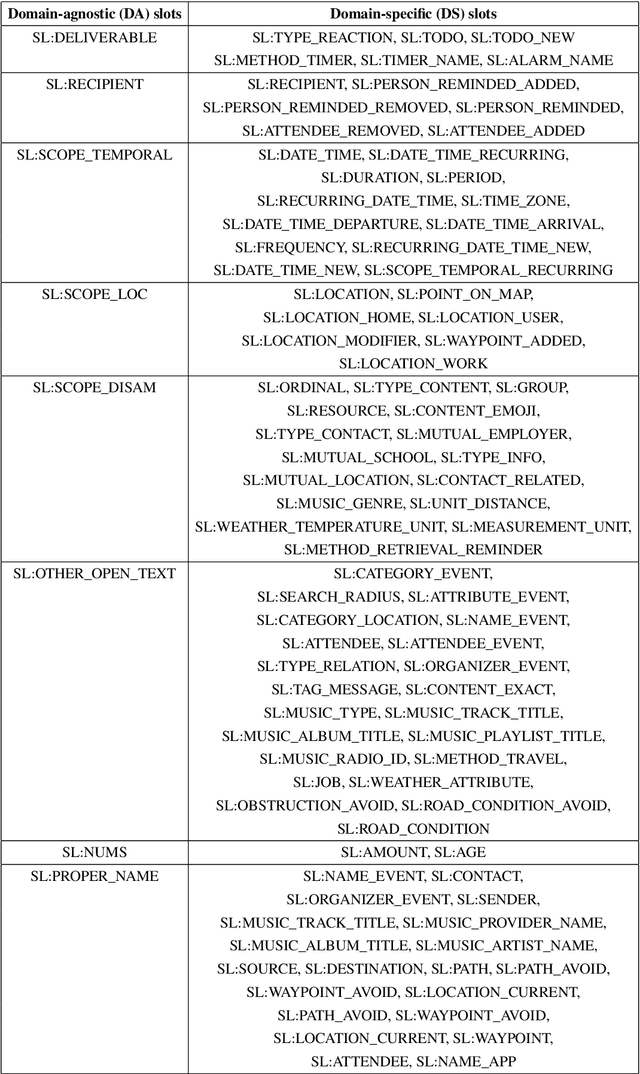
Frame semantic parsing is an important component of task-oriented dialogue systems. Current models rely on a significant amount training data to successfully identify the intent and slots in the user's input utterance. This creates a significant barrier for adding new domains to virtual assistant capabilities, as creation of this data requires highly specialized NLP expertise. In this work we propose OpenFSP, a framework that allows for easy creation of new domains from a handful of simple labels that can be generated without specific NLP knowledge. Our approach relies on creating a small, but expressive, set of domain agnostic slot types that enables easy annotation of new domains. Given such annotation, a matching algorithm relying on sentence encoders predicts the intent and slots for domains defined by end-users. Extensive experiments on the TopV2 dataset shows that our model outperforms strong baselines in this simple labels setting.
SUPERB @ SLT 2022: Challenge on Generalization and Efficiency of Self-Supervised Speech Representation Learning
Oct 16, 2022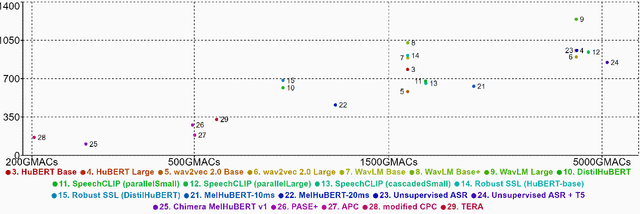
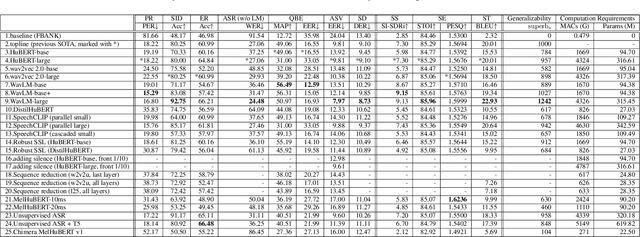
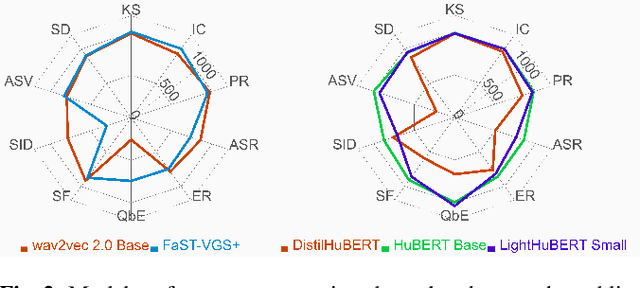
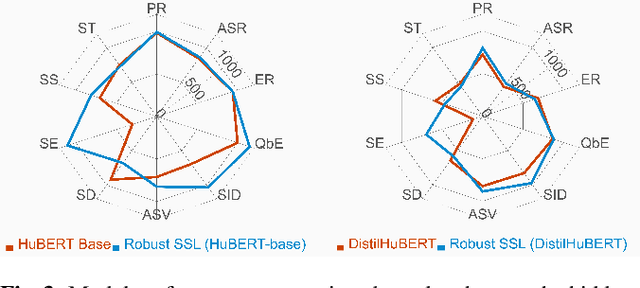
We present the SUPERB challenge at SLT 2022, which aims at learning self-supervised speech representation for better performance, generalization, and efficiency. The challenge builds upon the SUPERB benchmark and implements metrics to measure the computation requirements of self-supervised learning (SSL) representation and to evaluate its generalizability and performance across the diverse SUPERB tasks. The SUPERB benchmark provides comprehensive coverage of popular speech processing tasks, from speech and speaker recognition to audio generation and semantic understanding. As SSL has gained interest in the speech community and showed promising outcomes, we envision the challenge to uplevel the impact of SSL techniques by motivating more practical designs of techniques beyond task performance. We summarize the results of 14 submitted models in this paper. We also discuss the main findings from those submissions and the future directions of SSL research.