 Add to Chrome
 Add to Firefox
 Add to Edge
Video Object Segmentation with Language Referring Expressions
May 09, 2018

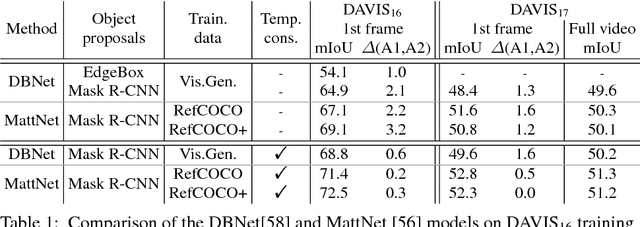
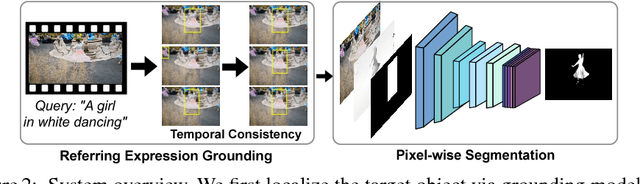
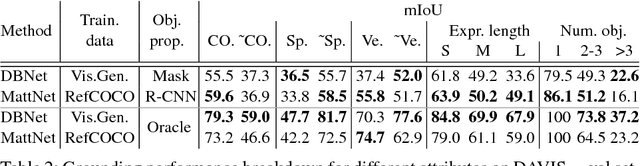
Most state-of-the-art semi-supervised video object segmentation methods rely on a pixel-accurate mask of a target object provided for the first frame of a video. However, obtaining a detailed segmentation mask is expensive and time-consuming. In this work we explore an alternative way of identifying a target object, namely by employing language referring expressions. Besides being a more practical and natural way of pointing out a target object, using language specifications can help to avoid drift as well as make the system more robust to complex dynamics and appearance variations. Leveraging recent advances of language grounding models designed for images, we propose an approach to extend them to video data, ensuring temporally coherent predictions. To evaluate our method we augment the popular video object segmentation benchmarks, DAVIS'16 and DAVIS'17 with language descriptions of target objects. We show that our approach performs on par with the methods which have access to a pixel-level mask of the target object on DAVIS'16 and is competitive to methods using scribbles on the challenging DAVIS'17 dataset.

Fooling Vision and Language Models Despite Localization and Attention Mechanism
Apr 06, 2018
Adversarial attacks are known to succeed on classifiers, but it has been an open question whether more complex vision systems are vulnerable. In this paper, we study adversarial examples for vision and language models, which incorporate natural language understanding and complex structures such as attention, localization, and modular architectures. In particular, we investigate attacks on a dense captioning model and on two visual question answering (VQA) models. Our evaluation shows that we can generate adversarial examples with a high success rate (i.e., > 90%) for these models. Our work sheds new light on understanding adversarial attacks on vision systems which have a language component and shows that attention, bounding box localization, and compositional internal structures are vulnerable to adversarial attacks. These observations will inform future work towards building effective defenses.
Multimodal Explanations: Justifying Decisions and Pointing to the Evidence
Feb 15, 2018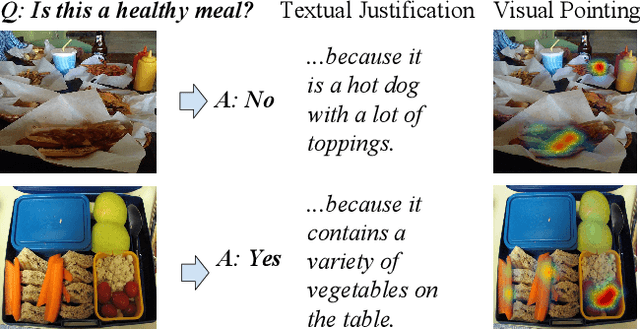
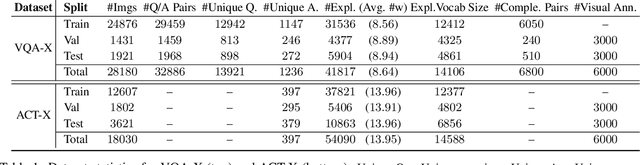
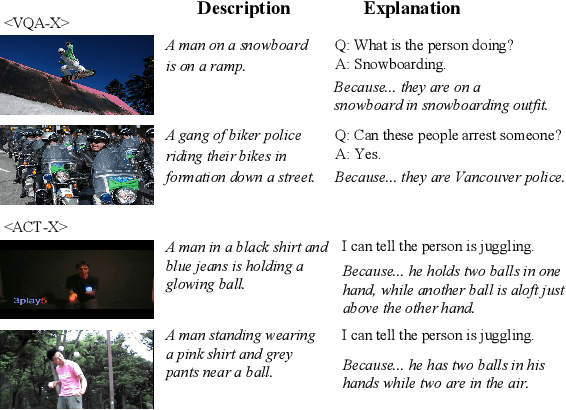
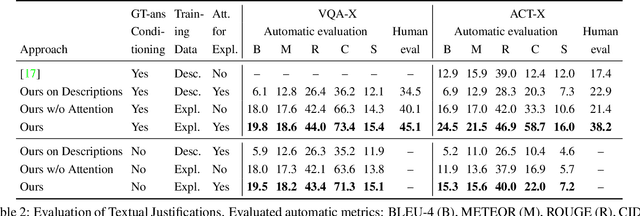
Deep models that are both effective and explainable are desirable in many settings; prior explainable models have been unimodal, offering either image-based visualization of attention weights or text-based generation of post-hoc justifications. We propose a multimodal approach to explanation, and argue that the two modalities provide complementary explanatory strengths. We collect two new datasets to define and evaluate this task, and propose a novel model which can provide joint textual rationale generation and attention visualization. Our datasets define visual and textual justifications of a classification decision for activity recognition tasks (ACT-X) and for visual question answering tasks (VQA-X). We quantitatively show that training with the textual explanations not only yields better textual justification models, but also better localizes the evidence that supports the decision. We also qualitatively show cases where visual explanation is more insightful than textual explanation, and vice versa, supporting our thesis that multimodal explanation models offer significant benefits over unimodal approaches.
Attentive Explanations: Justifying Decisions and Pointing to the Evidence (Extended Abstract)
Nov 17, 2017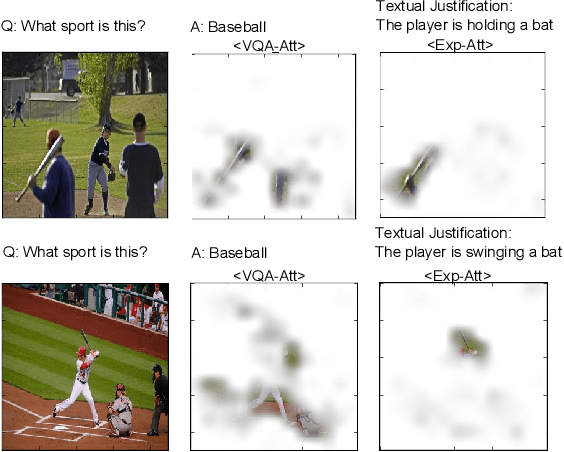
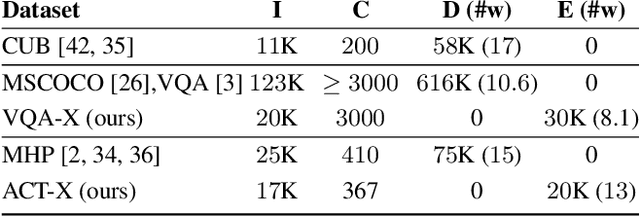
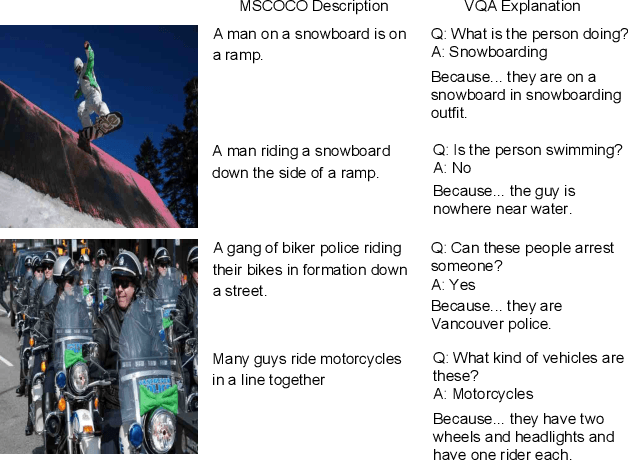
Deep models are the defacto standard in visual decision problems due to their impressive performance on a wide array of visual tasks. On the other hand, their opaqueness has led to a surge of interest in explainable systems. In this work, we emphasize the importance of model explanation in various forms such as visual pointing and textual justification. The lack of data with justification annotations is one of the bottlenecks of generating multimodal explanations. Thus, we propose two large-scale datasets with annotations that visually and textually justify a classification decision for various activities, i.e. ACT-X, and for question answering, i.e. VQA-X. We also introduce a multimodal methodology for generating visual and textual explanations simultaneously. We quantitatively show that training with the textual explanations not only yields better textual justification models, but also models that better localize the evidence that support their decision.
Gradient-free Policy Architecture Search and Adaptation
Oct 16, 2017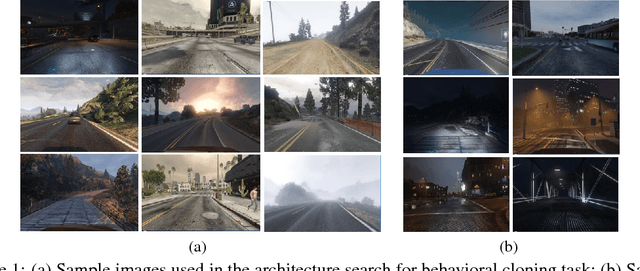
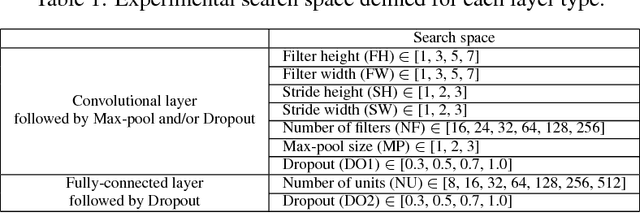
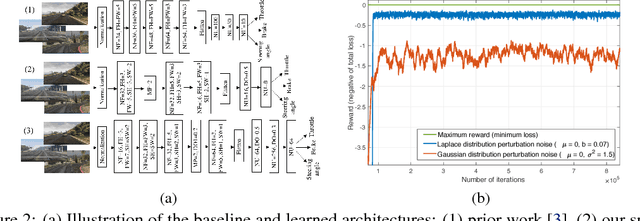

We develop a method for policy architecture search and adaptation via gradient-free optimization which can learn to perform autonomous driving tasks. By learning from both demonstration and environmental reward we develop a model that can learn with relatively few early catastrophic failures. We first learn an architecture of appropriate complexity to perceive aspects of world state relevant to the expert demonstration, and then mitigate the effect of domain-shift during deployment by adapting a policy demonstrated in a source domain to rewards obtained in a target environment. We show that our approach allows safer learning than baseline methods, offering a reduced cumulative crash metric over the agent's lifetime as it learns to drive in a realistic simulated environment.
Generating Descriptions with Grounded and Co-Referenced People
Apr 05, 2017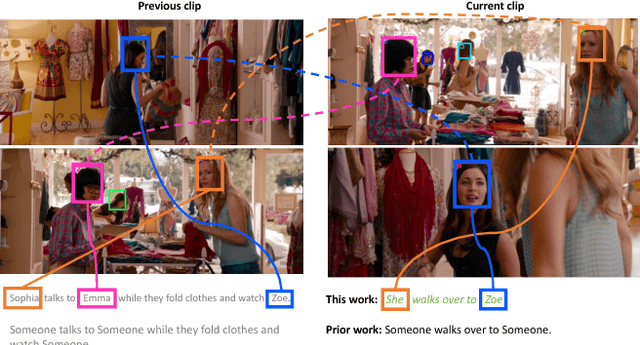
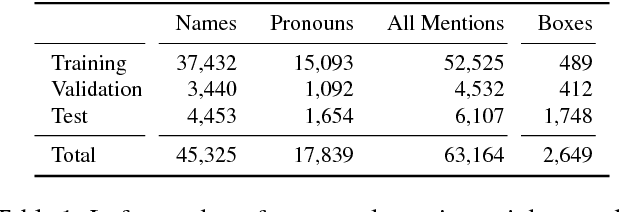
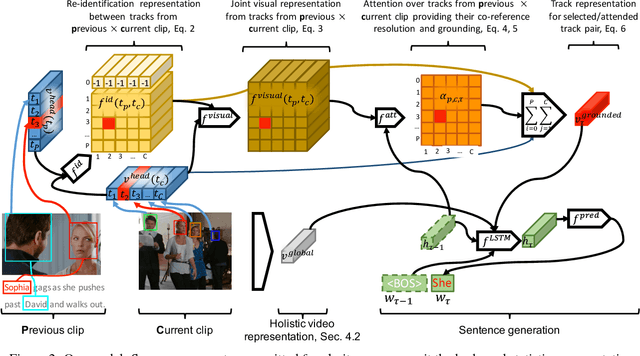
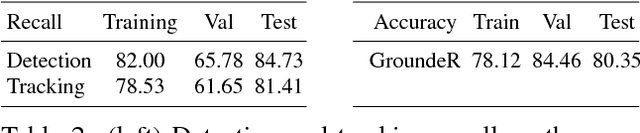
Learning how to generate descriptions of images or videos received major interest both in the Computer Vision and Natural Language Processing communities. While a few works have proposed to learn a grounding during the generation process in an unsupervised way (via an attention mechanism), it remains unclear how good the quality of the grounding is and whether it benefits the description quality. In this work we propose a movie description model which learns to generate description and jointly ground (localize) the mentioned characters as well as do visual co-reference resolution between pairs of consecutive sentences/clips. We also propose to use weak localization supervision through character mentions provided in movie descriptions to learn the character grounding. At training time, we first learn how to localize characters by relating their visual appearance to mentions in the descriptions via a semi-supervised approach. We then provide this (noisy) supervision into our description model which greatly improves its performance. Our proposed description model improves over prior work w.r.t. generated description quality and additionally provides grounding and local co-reference resolution. We evaluate it on the MPII Movie Description dataset using automatic and human evaluation measures and using our newly collected grounding and co-reference data for characters.
Grounding of Textual Phrases in Images by Reconstruction
Feb 17, 2017Grounding (i.e. localizing) arbitrary, free-form textual phrases in visual content is a challenging problem with many applications for human-computer interaction and image-text reference resolution. Few datasets provide the ground truth spatial localization of phrases, thus it is desirable to learn from data with no or little grounding supervision. We propose a novel approach which learns grounding by reconstructing a given phrase using an attention mechanism, which can be either latent or optimized directly. During training our approach encodes the phrase using a recurrent network language model and then learns to attend to the relevant image region in order to reconstruct the input phrase. At test time, the correct attention, i.e., the grounding, is evaluated. If grounding supervision is available it can be directly applied via a loss over the attention mechanism. We demonstrate the effectiveness of our approach on the Flickr 30k Entities and ReferItGame datasets with different levels of supervision, ranging from no supervision over partial supervision to full supervision. Our supervised variant improves by a large margin over the state-of-the-art on both datasets.
A dataset and exploration of models for understanding video data through fill-in-the-blank question-answering
Feb 05, 2017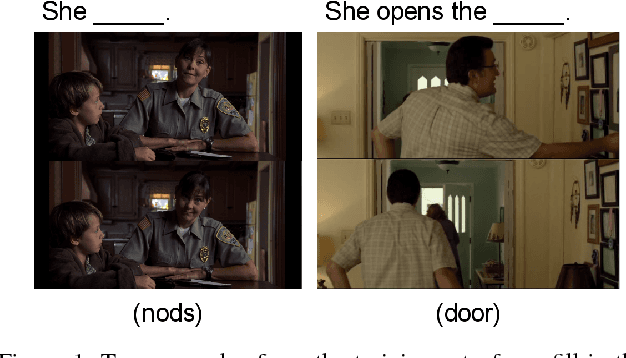
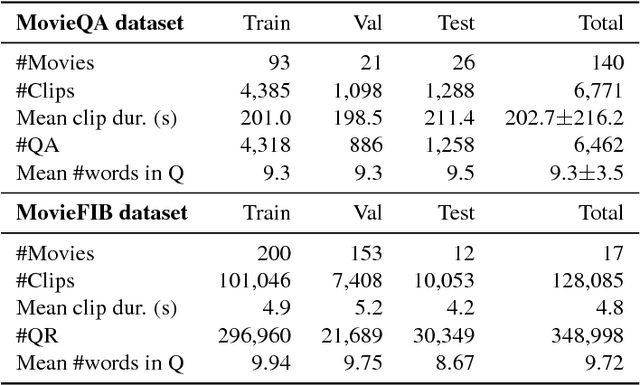
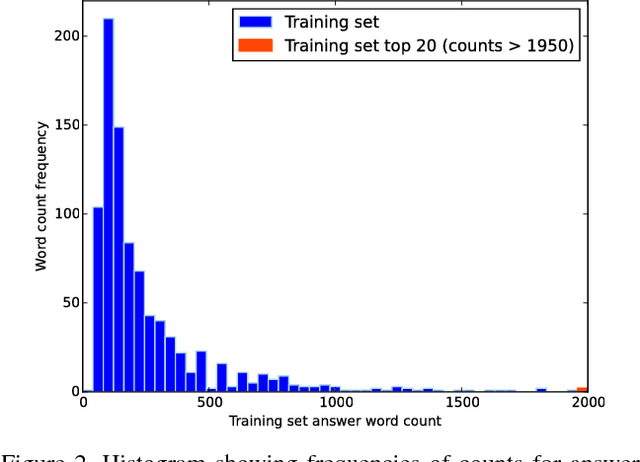
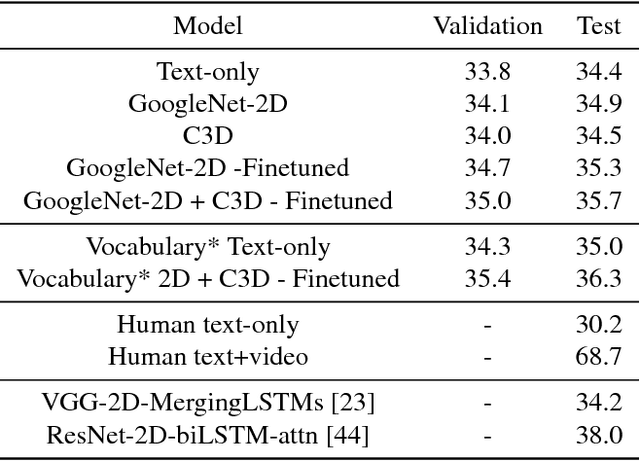
While deep convolutional neural networks frequently approach or exceed human-level performance at benchmark tasks involving static images, extending this success to moving images is not straightforward. Having models which can learn to understand video is of interest for many applications, including content recommendation, prediction, summarization, event/object detection and understanding human visual perception, but many domains lack sufficient data to explore and perfect video models. In order to address the need for a simple, quantitative benchmark for developing and understanding video, we present MovieFIB, a fill-in-the-blank question-answering dataset with over 300,000 examples, based on descriptive video annotations for the visually impaired. In addition to presenting statistics and a description of the dataset, we perform a detailed analysis of 5 different models' predictions, and compare these with human performance. We investigate the relative importance of language, static (2D) visual features, and moving (3D) visual features; the effects of increasing dataset size, the number of frames sampled; and of vocabulary size. We illustrate that: this task is not solvable by a language model alone; our model combining 2D and 3D visual information indeed provides the best result; all models perform significantly worse than human-level. We provide human evaluations for responses given by different models and find that accuracy on the MovieFIB evaluation corresponds well with human judgement. We suggest avenues for improving video models, and hope that the proposed dataset can be useful for measuring and encouraging progress in this very interesting field.
Multimodal Compact Bilinear Pooling for Visual Question Answering and Visual Grounding
Sep 24, 2016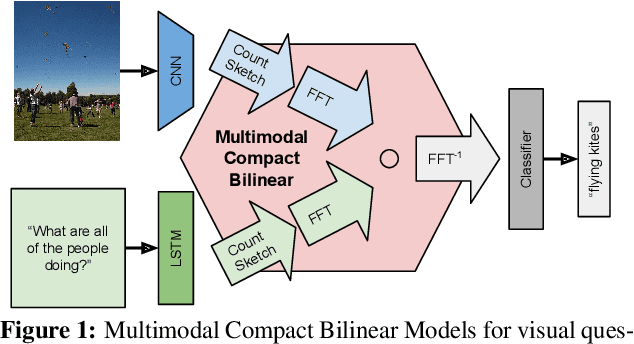
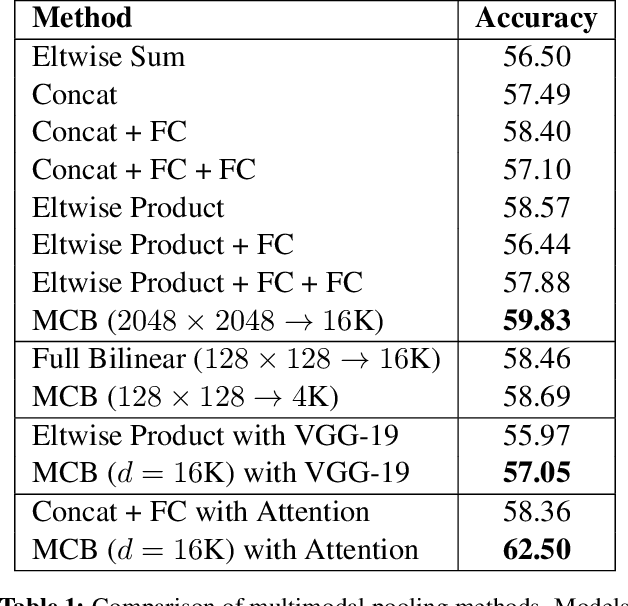
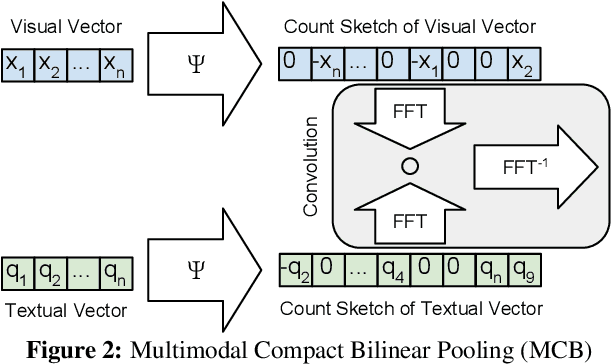
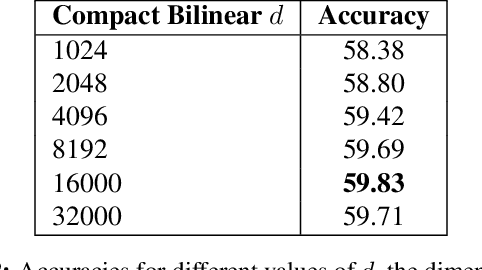
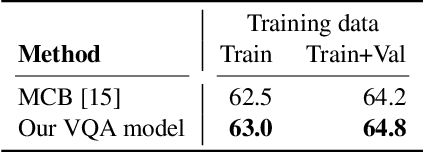
Modeling textual or visual information with vector representations trained from large language or visual datasets has been successfully explored in recent years. However, tasks such as visual question answering require combining these vector representations with each other. Approaches to multimodal pooling include element-wise product or sum, as well as concatenation of the visual and textual representations. We hypothesize that these methods are not as expressive as an outer product of the visual and textual vectors. As the outer product is typically infeasible due to its high dimensionality, we instead propose utilizing Multimodal Compact Bilinear pooling (MCB) to efficiently and expressively combine multimodal features. We extensively evaluate MCB on the visual question answering and grounding tasks. We consistently show the benefit of MCB over ablations without MCB. For visual question answering, we present an architecture which uses MCB twice, once for predicting attention over spatial features and again to combine the attended representation with the question representation. This model outperforms the state-of-the-art on the Visual7W dataset and the VQA challenge.
Movie Description
May 12, 2016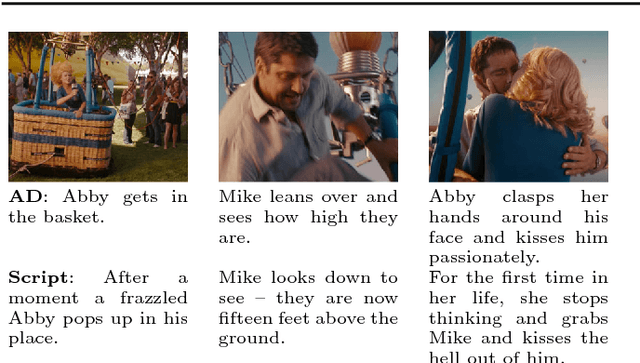
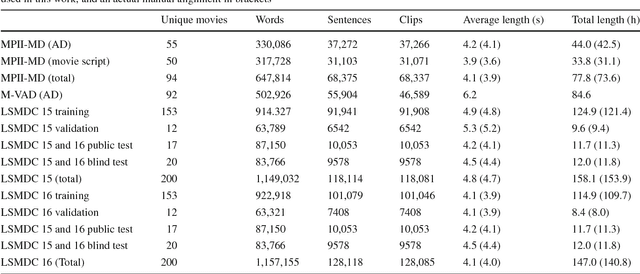
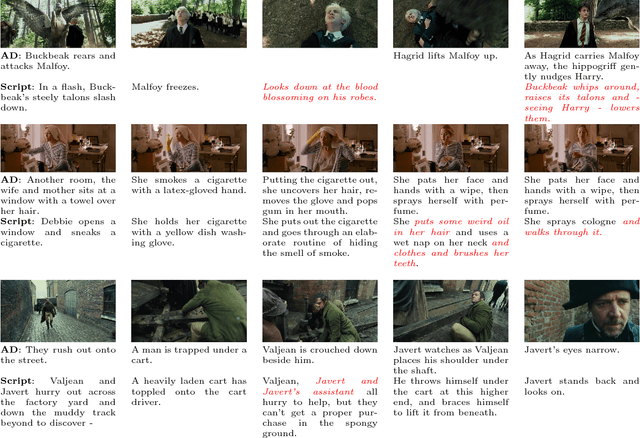
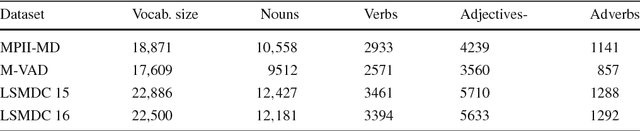
Audio Description (AD) provides linguistic descriptions of movies and allows visually impaired people to follow a movie along with their peers. Such descriptions are by design mainly visual and thus naturally form an interesting data source for computer vision and computational linguistics. In this work we propose a novel dataset which contains transcribed ADs, which are temporally aligned to full length movies. In addition we also collected and aligned movie scripts used in prior work and compare the two sources of descriptions. In total the Large Scale Movie Description Challenge (LSMDC) contains a parallel corpus of 118,114 sentences and video clips from 202 movies. First we characterize the dataset by benchmarking different approaches for generating video descriptions. Comparing ADs to scripts, we find that ADs are indeed more visual and describe precisely what is shown rather than what should happen according to the scripts created prior to movie production. Furthermore, we present and compare the results of several teams who participated in a challenge organized in the context of the workshop "Describing and Understanding Video & The Large Scale Movie Description Challenge (LSMDC)", at ICCV 2015.