 Add to Chrome
 Add to Firefox
 Add to Edge
GlitchBench: Can large multimodal models detect video game glitches?
Dec 08, 2023
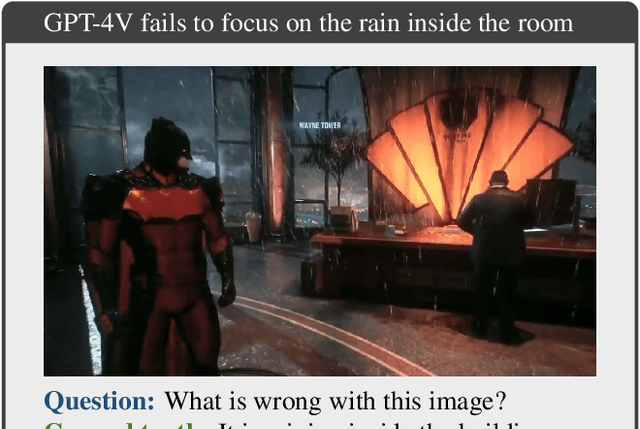
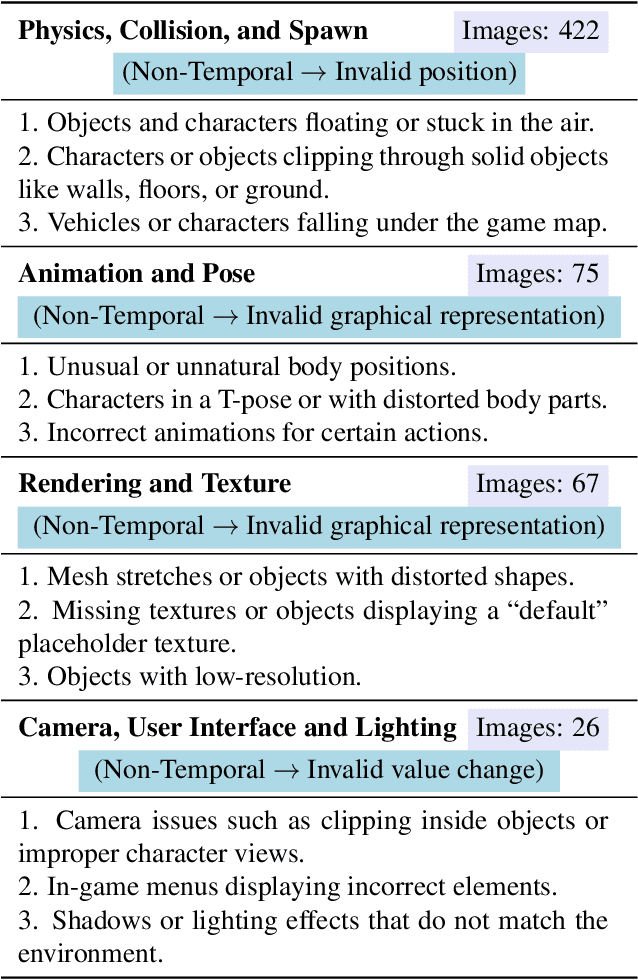
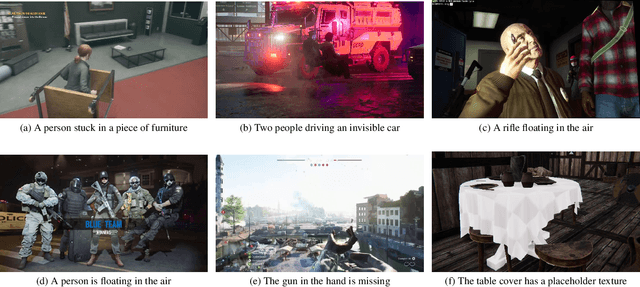

Large multimodal models (LMMs) have evolved from large language models (LLMs) to integrate multiple input modalities, such as visual inputs. This integration augments the capacity of LLMs for tasks requiring visual comprehension and reasoning. However, the extent and limitations of their enhanced abilities are not fully understood, especially when it comes to real-world tasks. To address this gap, we introduce GlitchBench, a novel benchmark derived from video game quality assurance tasks, to test and evaluate the reasoning capabilities of LMMs. Our benchmark is curated from a variety of unusual and glitched scenarios from video games and aims to challenge both the visual and linguistic reasoning powers of LMMs in detecting and interpreting out-of-the-ordinary events. We evaluate multiple state-of-the-art LMMs, and we show that GlitchBench presents a new challenge for these models. Code and data are available at: https://glitchbench.github.io/

Generating Valid and Natural Adversarial Examples with Large Language Models
Nov 20, 2023Deep learning-based natural language processing (NLP) models, particularly pre-trained language models (PLMs), have been revealed to be vulnerable to adversarial attacks. However, the adversarial examples generated by many mainstream word-level adversarial attack models are neither valid nor natural, leading to the loss of semantic maintenance, grammaticality, and human imperceptibility. Based on the exceptional capacity of language understanding and generation of large language models (LLMs), we propose LLM-Attack, which aims at generating both valid and natural adversarial examples with LLMs. The method consists of two stages: word importance ranking (which searches for the most vulnerable words) and word synonym replacement (which substitutes them with their synonyms obtained from LLMs). Experimental results on the Movie Review (MR), IMDB, and Yelp Review Polarity datasets against the baseline adversarial attack models illustrate the effectiveness of LLM-Attack, and it outperforms the baselines in human and GPT-4 evaluation by a significant margin. The model can generate adversarial examples that are typically valid and natural, with the preservation of semantic meaning, grammaticality, and human imperceptibility.
Shape-Sensitive Loss for Catheter and Guidewire Segmentation
Nov 19, 2023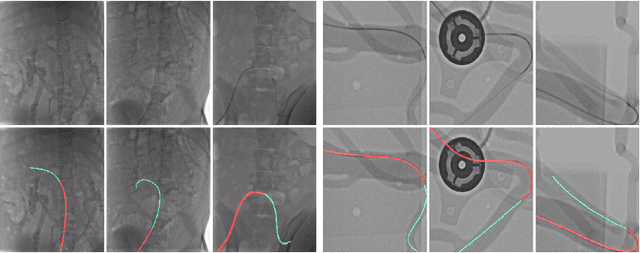
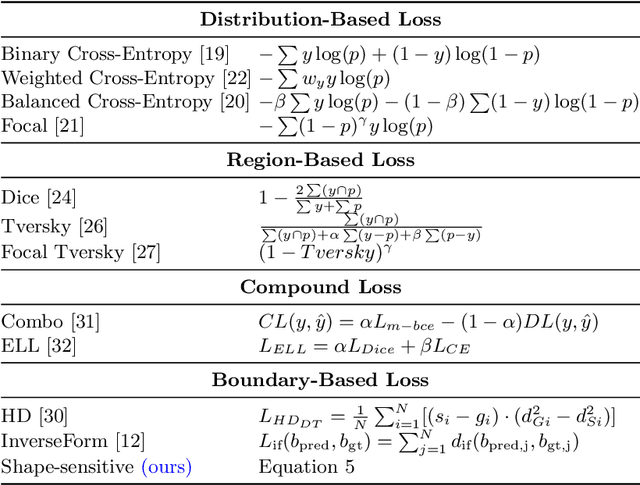
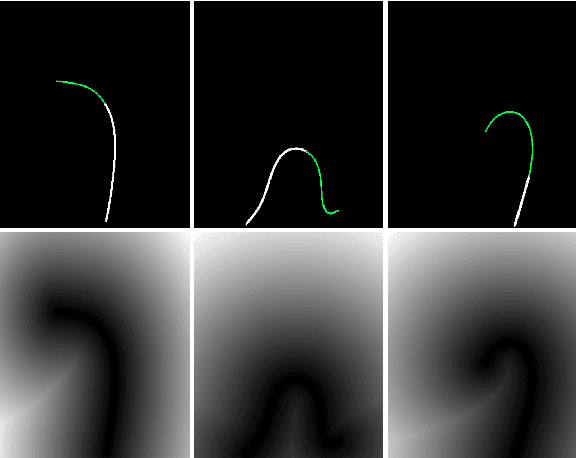
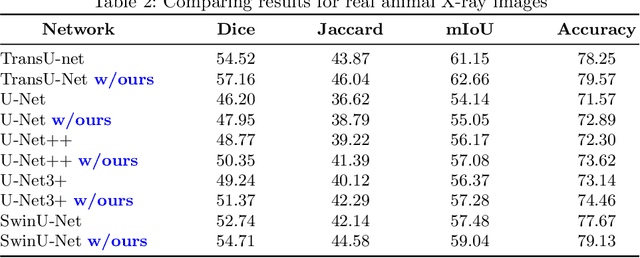
We introduce a shape-sensitive loss function for catheter and guidewire segmentation and utilize it in a vision transformer network to establish a new state-of-the-art result on a large-scale X-ray images dataset. We transform network-derived predictions and their corresponding ground truths into signed distance maps, thereby enabling any networks to concentrate on the essential boundaries rather than merely the overall contours. These SDMs are subjected to the vision transformer, efficiently producing high-dimensional feature vectors encapsulating critical image attributes. By computing the cosine similarity between these feature vectors, we gain a nuanced understanding of image similarity that goes beyond the limitations of traditional overlap-based measures. The advantages of our approach are manifold, ranging from scale and translation invariance to superior detection of subtle differences, thus ensuring precise localization and delineation of the medical instruments within the images. Comprehensive quantitative and qualitative analyses substantiate the significant enhancement in performance over existing baselines, demonstrating the promise held by our new shape-sensitive loss function for improving catheter and guidewire segmentation.
3D Guidewire Shape Reconstruction from Monoplane Fluoroscopic Images
Nov 19, 2023Endovascular navigation, essential for diagnosing and treating endovascular diseases, predominantly hinges on fluoroscopic images due to the constraints in sensory feedback. Current shape reconstruction techniques for endovascular intervention often rely on either a priori information or specialized equipment, potentially subjecting patients to heightened radiation exposure. While deep learning holds potential, it typically demands extensive data. In this paper, we propose a new method to reconstruct the 3D guidewire by utilizing CathSim, a state-of-the-art endovascular simulator, and a 3D Fluoroscopy Guidewire Reconstruction Network (3D-FGRN). Our 3D-FGRN delivers results on par with conventional triangulation from simulated monoplane fluoroscopic images. Our experiments accentuate the efficiency of the proposed network, demonstrating it as a promising alternative to traditional methods.
Controllable Group Choreography using Contrastive Diffusion
Nov 03, 2023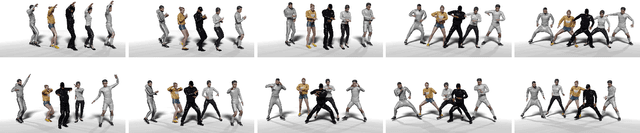
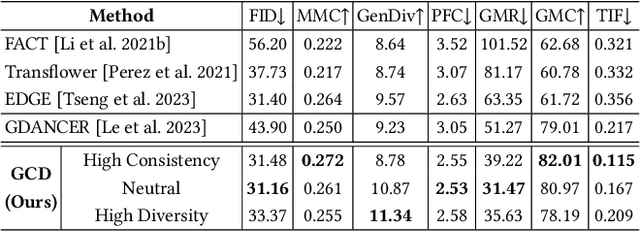
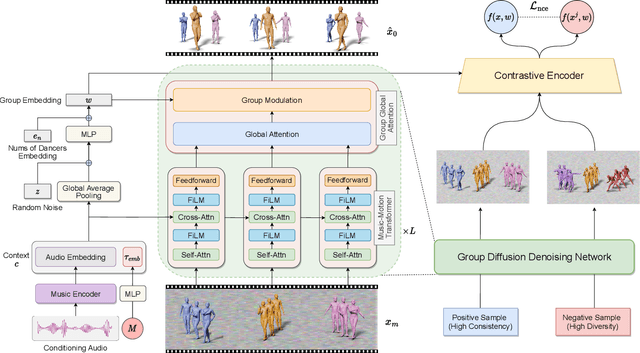
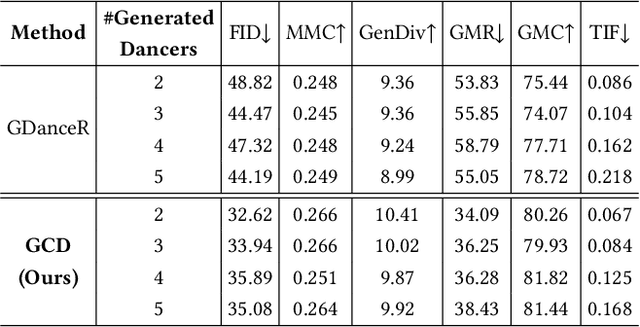
Music-driven group choreography poses a considerable challenge but holds significant potential for a wide range of industrial applications. The ability to generate synchronized and visually appealing group dance motions that are aligned with music opens up opportunities in many fields such as entertainment, advertising, and virtual performances. However, most of the recent works are not able to generate high-fidelity long-term motions, or fail to enable controllable experience. In this work, we aim to address the demand for high-quality and customizable group dance generation by effectively governing the consistency and diversity of group choreographies. In particular, we utilize a diffusion-based generative approach to enable the synthesis of flexible number of dancers and long-term group dances, while ensuring coherence to the input music. Ultimately, we introduce a Group Contrastive Diffusion (GCD) strategy to enhance the connection between dancers and their group, presenting the ability to control the consistency or diversity level of the synthesized group animation via the classifier-guidance sampling technique. Through intensive experiments and evaluation, we demonstrate the effectiveness of our approach in producing visually captivating and consistent group dance motions. The experimental results show the capability of our method to achieve the desired levels of consistency and diversity, while maintaining the overall quality of the generated group choreography. The source code can be found at https://aioz-ai.github.io/GCD
Zero-Shot Medical Information Retrieval via Knowledge Graph Embedding
Oct 31, 2023In the era of the Internet of Things (IoT), the retrieval of relevant medical information has become essential for efficient clinical decision-making. This paper introduces MedFusionRank, a novel approach to zero-shot medical information retrieval (MIR) that combines the strengths of pre-trained language models and statistical methods while addressing their limitations. The proposed approach leverages a pre-trained BERT-style model to extract compact yet informative keywords. These keywords are then enriched with domain knowledge by linking them to conceptual entities within a medical knowledge graph. Experimental evaluations on medical datasets demonstrate MedFusion Rank's superior performance over existing methods, with promising results with a variety of evaluation metrics. MedFusionRank demonstrates efficacy in retrieving relevant information, even from short or single-term queries.
Language-driven Scene Synthesis using Multi-conditional Diffusion Model
Oct 24, 2023Scene synthesis is a challenging problem with several industrial applications. Recently, substantial efforts have been directed to synthesize the scene using human motions, room layouts, or spatial graphs as the input. However, few studies have addressed this problem from multiple modalities, especially combining text prompts. In this paper, we propose a language-driven scene synthesis task, which is a new task that integrates text prompts, human motion, and existing objects for scene synthesis. Unlike other single-condition synthesis tasks, our problem involves multiple conditions and requires a strategy for processing and encoding them into a unified space. To address the challenge, we present a multi-conditional diffusion model, which differs from the implicit unification approach of other diffusion literature by explicitly predicting the guiding points for the original data distribution. We demonstrate that our approach is theoretically supportive. The intensive experiment results illustrate that our method outperforms state-of-the-art benchmarks and enables natural scene editing applications. The source code and dataset can be accessed at https://lang-scene-synth.github.io/.
Open-Fusion: Real-time Open-Vocabulary 3D Mapping and Queryable Scene Representation
Oct 05, 2023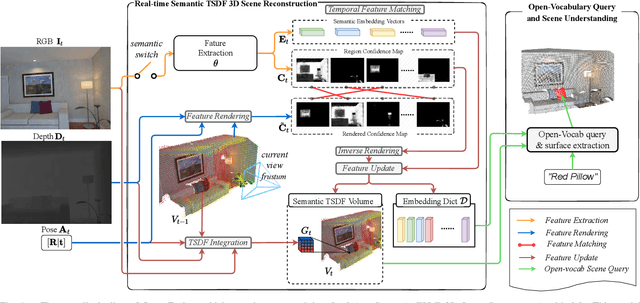
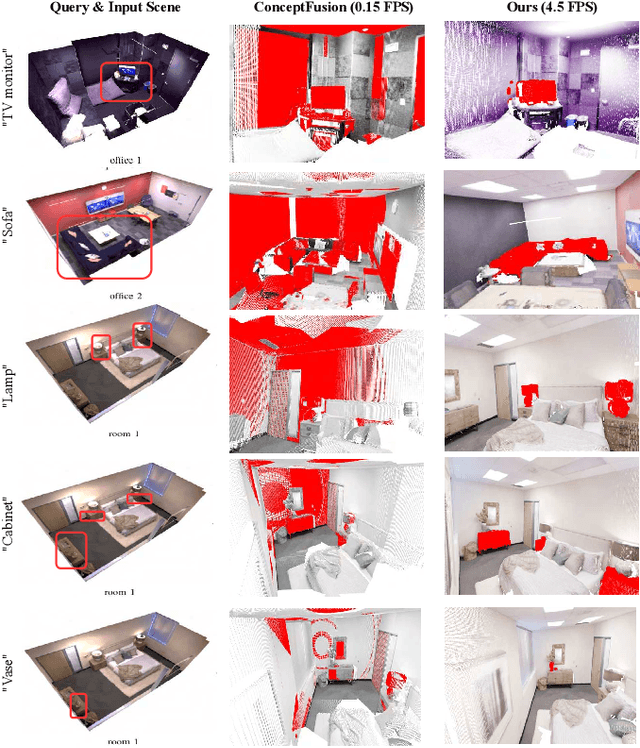
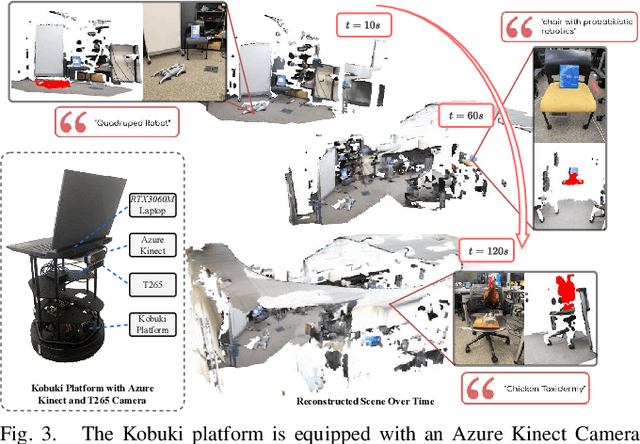

Precise 3D environmental mapping is pivotal in robotics. Existing methods often rely on predefined concepts during training or are time-intensive when generating semantic maps. This paper presents Open-Fusion, a groundbreaking approach for real-time open-vocabulary 3D mapping and queryable scene representation using RGB-D data. Open-Fusion harnesses the power of a pre-trained vision-language foundation model (VLFM) for open-set semantic comprehension and employs the Truncated Signed Distance Function (TSDF) for swift 3D scene reconstruction. By leveraging the VLFM, we extract region-based embeddings and their associated confidence maps. These are then integrated with 3D knowledge from TSDF using an enhanced Hungarian-based feature-matching mechanism. Notably, Open-Fusion delivers outstanding annotation-free 3D segmentation for open-vocabulary without necessitating additional 3D training. Benchmark tests on the ScanNet dataset against leading zero-shot methods highlight Open-Fusion's superiority. Furthermore, it seamlessly combines the strengths of region-based VLFM and TSDF, facilitating real-time 3D scene comprehension that includes object concepts and open-world semantics. We encourage the readers to view the demos on our project page: https://uark-aicv.github.io/OpenFusion
Learning to Terminate in Object Navigation
Sep 28, 2023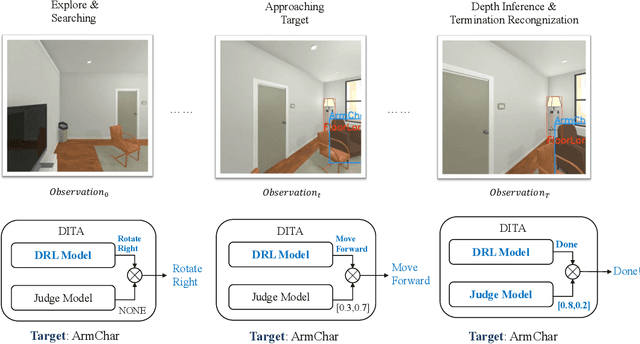
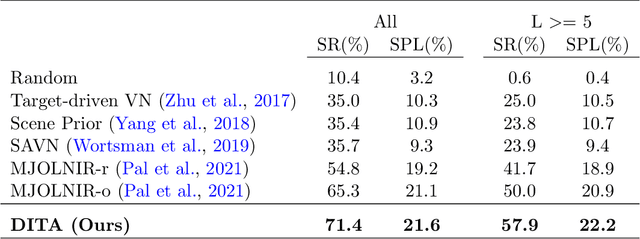
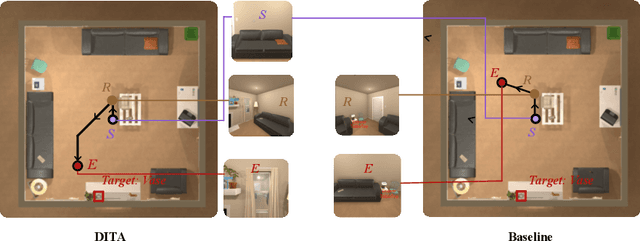
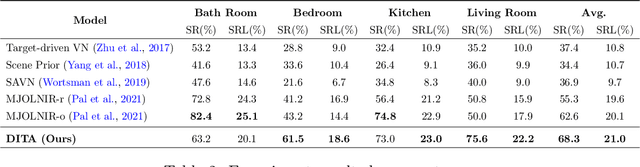
This paper tackles the critical challenge of object navigation in autonomous navigation systems, particularly focusing on the problem of target approach and episode termination in environments with long optimal episode length in Deep Reinforcement Learning (DRL) based methods. While effective in environment exploration and object localization, conventional DRL methods often struggle with optimal path planning and termination recognition due to a lack of depth information. To overcome these limitations, we propose a novel approach, namely the Depth-Inference Termination Agent (DITA), which incorporates a supervised model called the Judge Model to implicitly infer object-wise depth and decide termination jointly with reinforcement learning. We train our judge model along with reinforcement learning in parallel and supervise the former efficiently by reward signal. Our evaluation shows the method is demonstrating superior performance, we achieve a 9.3% gain on success rate than our baseline method across all room types and gain 51.2% improvements on long episodes environment while maintaining slightly better Success Weighted by Path Length (SPL). Code and resources, visualization are available at: https://github.com/HuskyKingdom/DITA_acml2023
Decoding Radiologists Intense Focus for Accurate CXR Diagnoses: A Controllable and Interpretable AI System
Sep 26, 2023
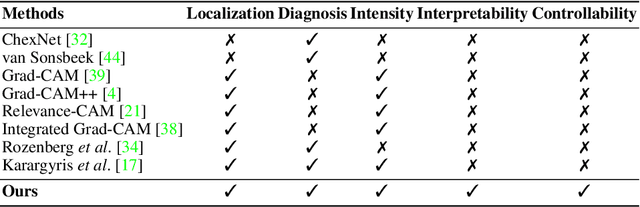
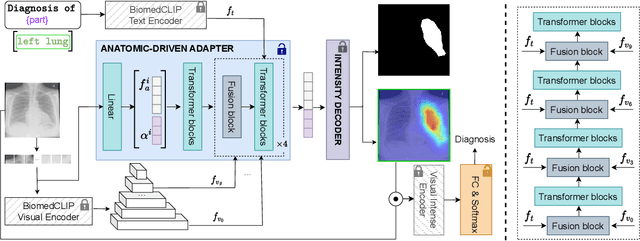
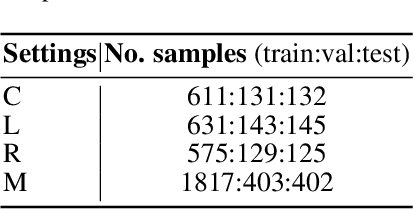
In the field of chest X-ray (CXR) diagnosis, existing works often focus solely on determining where a radiologist looks, typically through tasks such as detection, segmentation, or classification. However, these approaches are often designed as black-box models, lacking interpretability. In this paper, we introduce a novel and unified controllable interpretable pipeline for decoding the intense focus of radiologists in CXR diagnosis. Our approach addresses three key questions: where a radiologist looks, how long they focus on specific areas, and what findings they diagnose. By capturing the intensity of the radiologist's gaze, we provide a unified solution that offers insights into the cognitive process underlying radiological interpretation. Unlike current methods that rely on black-box machine learning models, which can be prone to extracting erroneous information from the entire input image during the diagnosis process, we tackle this issue by effectively masking out irrelevant information. Our approach leverages a vision-language model, allowing for precise control over the interpretation process while ensuring the exclusion of irrelevant features. To train our model, we utilize an eye gaze dataset to extract anatomical gaze information and generate ground truth heatmaps. Through extensive experimentation, we demonstrate the efficacy of our method. We showcase that the attention heatmaps, designed to mimic radiologists' focus, encode sufficient and relevant information, enabling accurate classification tasks using only a portion of CXR.