 Add to Chrome
 Add to Firefox
 Add to Edge
Workspace Topology as an Attack Vector in Agentic Coding Assistants
Aug 14, 2026
Agentic coding assistants are finding widespread use, not just in new code development but in quickly ingesting and leveraging third-party code. This opens up a risk of malicious code being ingested as these coding tools operate with broad filesystem access inside developer workspaces. In this paper, we extensively study the impact of different dimensions of a novel attack surface we term workspace topology -- defined via directory depth, codebase modularity, in-file injection position and context framing -- on the attack success rate of adversarial prompt injection attempts. We perform an empirical study of indirect prompt injection (IPI) across a diverse set of open-source repositories spanning 10 languages and 6 engineering domains, evaluating three IPI entry points against open-weight models operating open source code harnesses. We find that workspace topology measurably affects IPI success. Specifically, changes in codebase modularity can significantly alter the Attack Success Rate (ASR), with highly modular environments demonstrating significantly lower attack success rates. Furthermore, context framing and introduction of security-cues in the workspace can also alter the ASR. Our findings offer practical value for the evaluation and security testing of coding agents across diverse settings, while underscoring the importance of an uncontaminated testing environment to obtain reliable results and conclusions.

Adaptive Instruction Composition for Automated LLM Red-Teaming
Apr 22, 2026Many approaches to LLM red-teaming leverage an attacker LLM to discover jailbreaks against a target. Several of them task the attacker with identifying effective strategies through trial and error, resulting in a semantically limited range of successes. Another approach discovers diverse attacks by combining crowdsourced harmful queries and tactics into instructions for the attacker, but does so at random, limiting effectiveness. This article introduces a novel framework, Adaptive Instruction Composition, that combines crowdsourced texts according to an adaptive mechanism trained to jointly optimize effectiveness with diversity. We use reinforcement learning to balance exploration with exploitation in a combinatorial space of instructions to guide the attacker toward diverse generations tailored to target vulnerabilities. We demonstrate that our approach substantially outperforms random combination on a set of effectiveness and diversity metrics, even under model transfer. Further, we show that it surpasses a host of recent adaptive approaches on Harmbench. We employ a lightweight neural contextual bandit that adapts to contrastive embedding inputs, and provide ablations suggesting that the contrastive pretraining enables the network to rapidly generalize and scale to the massive space as it learns.
Dual-Pool Token-Budget Routing for Cost-Efficient and Reliable LLM Serving
Apr 09, 2026Production vLLM fleets typically provision each instance for the worst-case context length, leading to substantial KV-cache over-allocation and under-utilized concurrency. In practice, 80-95% of requests are short, yet are served under configurations optimized for long contexts, wasting 4-8$\times$ throughput capacity and triggering reliability issues such as OOM crashes, preemption, and request rejections. We identify a common root cause for these inefficiencies: configuration-traffic mismatch. We propose dual-pool token-budget routing, a lightweight dispatch mechanism that partitions a homogeneous fleet into two specialized pools: a high-throughput short-context pool and a high-capacity long-context pool. Each request is routed based on its estimated total token budget, computed using a per-category bytes-to-token ratio that is learned online via exponential moving average from usage.prompt_tokens feedback, eliminating the need for a tokenizer. We also develop a simple analytical model that predicts fleet-level cost savings from workload characteristics and measured throughput differences, enabling practitioners to estimate benefits prior to deployment. Evaluations on real-world traces from the Azure LLM Inference Dataset and LMSYS-Chat-1M, serving Llama-3-70B on A100 GPUs, show that our approach reduces GPU-hours by 31-42%, corresponding to \$2.86M annual savings at fleet scale, while lowering preemption rates by 5.4$\times$ and improving P99 TTFT by 6%. A case study with Qwen3-235B-A22B on AMD MI300X at 10,000 req/s projects \$15.4M in annual savings. The method incurs only O(1) dispatch overhead, adapts automatically to heterogeneous workloads, and composes seamlessly with existing optimizations such as PagedAttention, continuous batching, and prefill-decode disaggregation.
Knowledge Access Beats Model Size: Memory Augmented Routing for Persistent AI Agents
Mar 24, 2026Production AI agents frequently receive user-specific queries that are highly repetitive, with up to 47\% being semantically similar to prior interactions, yet each query is typically processed with the same computational cost. We argue that this redundancy can be exploited through conversational memory, transforming repetition from a cost burden into an efficiency advantage. We propose a memory-augmented inference framework in which a lightweight 8B-parameter model leverages retrieved conversational context to answer all queries via a low-cost inference path. Without any additional training or labeled data, this approach achieves 30.5\% F1, recovering 69\% of the performance of a full-context 235B model while reducing effective cost by 96\%. Notably, a 235B model without memory (13.7\% F1) underperforms even the standalone 8B model (15.4\% F1), indicating that for user-specific queries, access to relevant knowledge outweighs model scale. We further analyze the role of routing and confidence. At practical confidence thresholds, routing alone already directs 96\% of queries to the small model, but yields poor accuracy (13.0\% F1) due to confident hallucinations. Memory does not substantially alter routing decisions; instead, it improves correctness by grounding responses in retrieved user-specific information. As conversational memory accumulates over time, coverage of recurring topics increases, further narrowing the performance gap. We evaluate on 152 LoCoMo questions (Qwen3-8B/235B) and 500 LongMemEval questions. Incorporating hybrid retrieval (BM25 + cosine similarity) improves performance by an additional +7.7 F1, demonstrating that retrieval quality directly enhances end-to-end system performance. Overall, our results highlight that memory, rather than model size, is the primary driver of accuracy and efficiency in persistent AI agents.
Visual Confused Deputy: Exploiting and Defending Perception Failures in Computer-Using Agents
Mar 16, 2026Computer-using agents (CUAs) act directly on graphical user interfaces, yet their perception of the screen is often unreliable. Existing work largely treats these failures as performance limitations, asking whether an action succeeds, rather than whether the agent is acting on the correct object at all. We argue that this is fundamentally a security problem. We formalize the visual confused deputy: a failure mode in which an agent authorizes an action based on a misperceived screen state, due to grounding errors, adversarial screenshot manipulation, or time-of-check-to-time-of-use (TOCTOU) races. This gap is practically exploitable: even simple screen-level manipulations can redirect routine clicks into privileged actions while remaining indistinguishable from ordinary agent mistakes. To mitigate this threat, we propose the first guardrail that operates outside the agent's perceptual loop. Our method, dual-channel contrastive classification, independently evaluates (1) the visual click target and (2) the agent's reasoning about the action against deployment-specific knowledge bases, and blocks execution if either channel indicates risk. The key insight is that these two channels capture complementary failure modes: visual evidence detects target-level mismatches, while textual reasoning reveals dangerous intent behind visually innocuous controls. Across controlled attacks, real GUI screenshots, and agent traces, the combined guardrail consistently outperforms either channel alone. Our results suggest that CUA safety requires not only better action generation, but independent verification of what the agent believes it is clicking and why. Materials are provided\footnote{Model, benchmark, and code: https://github.com/vllm-project/semantic-router}.
Adaptive Vision-Language Model Routing for Computer Use Agents
Mar 13, 2026Computer Use Agents (CUAs) translate natural-language instructions into Graphical User Interface (GUI) actions such as clicks, keystrokes, and scrolls by relying on a Vision-Language Model (VLM) to interpret screenshots and predict grounded tool calls. However, grounding accuracy varies dramatically across VLMs, while current CUA systems typically route every action to a single fixed model regardless of difficulty. We propose \textbf{Adaptive VLM Routing} (AVR), a framework that inserts a lightweight semantic routing layer between the CUA orchestrator and a pool of VLMs. For each tool call, AVR estimates action difficulty from multimodal embeddings, probes a small VLM to measure confidence, and routes the action to the cheapest model whose predicted accuracy satisfies a target reliability threshold. For \textit{warm} agents with memory of prior UI interactions, retrieved context further narrows the capability gap between small and large models, allowing many actions to be handled without escalation. We formalize routing as a cost--accuracy trade-off, derive a threshold-based policy for model selection, and evaluate AVR using ScreenSpot-Pro grounding data together with the OpenClaw agent routing benchmark. Across these settings, AVR projects inference cost reductions of up to 78\% while staying within 2 percentage points of an all-large-model baseline. When combined with the Visual Confused Deputy guardrail, AVR also escalates high-risk actions directly to the strongest available model, unifying efficiency and safety within a single routing framework. Materials are also provided Model, benchmark, and code: https://github.com/vllm-project/semantic-router.
98$\times$ Faster LLM Routing Without a Dedicated GPU: Flash Attention, Prompt Compression, and Near-Streaming for the vLLM Semantic Router
Mar 13, 2026System-level routers that intercept LLM requests for safety classification, domain routing, and PII detection must be both fast and operationally lightweight: they should add minimal latency to every request, yet not require a dedicated GPU -- an expensive resource better used for LLM inference itself. When the router co-locates on the same GPU as vLLM serving instances, standard attention's $O(n^2)$ memory makes long-context classification (8K--32K tokens) impossible: at 8K tokens, three concurrent classifiers need ${\sim}$4.5\,GB for attention masks alone, far exceeding the memory left by vLLM. We present three staged optimizations for the vLLM Semantic Router, benchmarked on AMD Instinct MI300X, that solve both the latency and the memory problem. \emph{Stage~1}: a custom CK Flash Attention operator for ONNX Runtime on ROCm reduces attention memory from $O(n^2)$ to $O(n)$ and end-to-end (E2E) latency from 4{,}918\,ms to 127\,ms (\textbf{38.7$\times$}), enabling 8K--32K tokens where SDPA OOMs. \emph{Stage~2}: classical NLP prompt compression (TextRank, position weighting, TF-IDF, and novelty scoring) reduces all inputs to ${\sim}$512 tokens without neural inference, capping both latency and GPU memory at a constant regardless of original prompt length (E2E 127$\to$62\,ms, \textbf{2.0$\times$}). \emph{Stage~3}: near-streaming body processing with adaptive chunking and zero-copy JSON eliminates serialization overhead (E2E 62$\to$50\,ms, \textbf{1.2$\times$}). Cumulatively: \textbf{98$\times$} improvement (4{,}918\,ms to 50\,ms), 16K-token routing in 108\,ms, and a total router GPU footprint under 800\,MB -- small enough to share a GPU with LLM serving and removing the need for a dedicated accelerator. Stage~1 targets AMD ROCm (NVIDIA GPUs already have FlashAttention via cuDNN); Stages~2 and~3 are hardware-agnostic.
Beyond Fixed Rounds: Data-Free Early Stopping for Practical Federated Learning
Jan 30, 2026Federated Learning (FL) facilitates decentralized collaborative learning without transmitting raw data. However, reliance on fixed global rounds or validation data for hyperparameter tuning hinders practical deployment by incurring high computational costs and privacy risks. To address this, we propose a data-free early stopping framework that determines the optimal stopping point by monitoring the task vector's growth rate using solely server-side parameters. The numerical results on skin lesion/blood cell classification demonstrate that our approach is comparable to validation-based early stopping across various state-of-the-art FL methods. In particular, the proposed framework spends an average of 47/20 (skin lesion/blood cell) rounds to achieve over 12.5%/10.3% higher performance than early stopping based on validation data. To the best of our knowledge, this is the first work to propose an early stopping framework for FL methods without using any validation data.
Building Safe GenAI Applications: An End-to-End Overview of Red Teaming for Large Language Models
Mar 05, 2025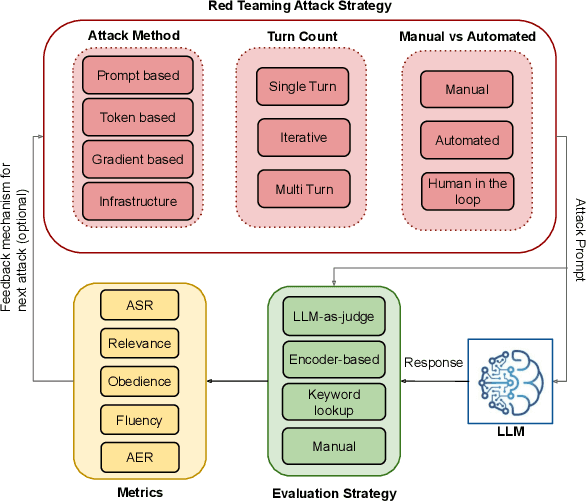
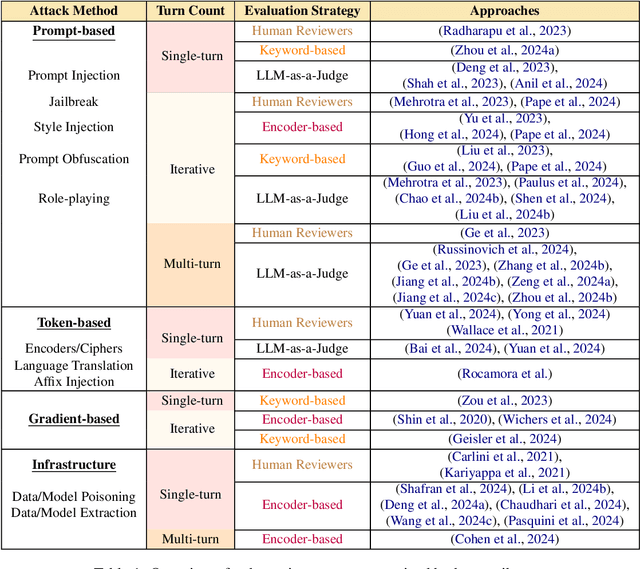
The rapid growth of Large Language Models (LLMs) presents significant privacy, security, and ethical concerns. While much research has proposed methods for defending LLM systems against misuse by malicious actors, researchers have recently complemented these efforts with an offensive approach that involves red teaming, i.e., proactively attacking LLMs with the purpose of identifying their vulnerabilities. This paper provides a concise and practical overview of the LLM red teaming literature, structured so as to describe a multi-component system end-to-end. To motivate red teaming we survey the initial safety needs of some high-profile LLMs, and then dive into the different components of a red teaming system as well as software packages for implementing them. We cover various attack methods, strategies for attack-success evaluation, metrics for assessing experiment outcomes, as well as a host of other considerations. Our survey will be useful for any reader who wants to rapidly obtain a grasp of the major red teaming concepts for their own use in practical applications.