 Add to Chrome
 Add to Firefox
 Add to Edge
Adaptive Instruction Composition for Automated LLM Red-Teaming
Apr 22, 2026
Many approaches to LLM red-teaming leverage an attacker LLM to discover jailbreaks against a target. Several of them task the attacker with identifying effective strategies through trial and error, resulting in a semantically limited range of successes. Another approach discovers diverse attacks by combining crowdsourced harmful queries and tactics into instructions for the attacker, but does so at random, limiting effectiveness. This article introduces a novel framework, Adaptive Instruction Composition, that combines crowdsourced texts according to an adaptive mechanism trained to jointly optimize effectiveness with diversity. We use reinforcement learning to balance exploration with exploitation in a combinatorial space of instructions to guide the attacker toward diverse generations tailored to target vulnerabilities. We demonstrate that our approach substantially outperforms random combination on a set of effectiveness and diversity metrics, even under model transfer. Further, we show that it surpasses a host of recent adaptive approaches on Harmbench. We employ a lightweight neural contextual bandit that adapts to contrastive embedding inputs, and provide ablations suggesting that the contrastive pretraining enables the network to rapidly generalize and scale to the massive space as it learns.

Building Safe GenAI Applications: An End-to-End Overview of Red Teaming for Large Language Models
Mar 05, 2025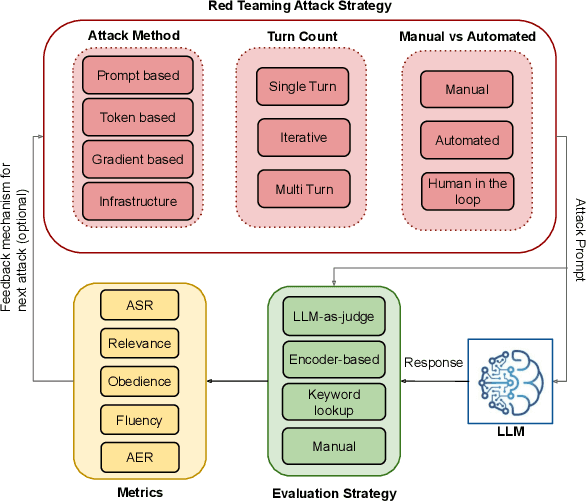
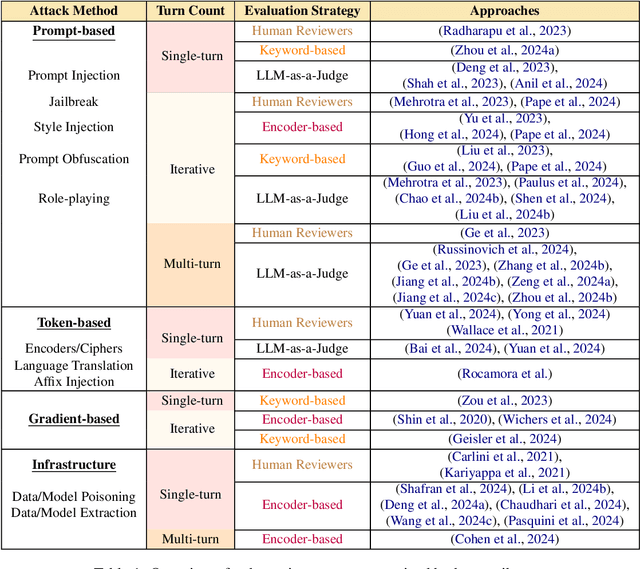
The rapid growth of Large Language Models (LLMs) presents significant privacy, security, and ethical concerns. While much research has proposed methods for defending LLM systems against misuse by malicious actors, researchers have recently complemented these efforts with an offensive approach that involves red teaming, i.e., proactively attacking LLMs with the purpose of identifying their vulnerabilities. This paper provides a concise and practical overview of the LLM red teaming literature, structured so as to describe a multi-component system end-to-end. To motivate red teaming we survey the initial safety needs of some high-profile LLMs, and then dive into the different components of a red teaming system as well as software packages for implementing them. We cover various attack methods, strategies for attack-success evaluation, metrics for assessing experiment outcomes, as well as a host of other considerations. Our survey will be useful for any reader who wants to rapidly obtain a grasp of the major red teaming concepts for their own use in practical applications.