 Add to Chrome
 Add to Firefox
 Add to Edge
Breaking the $T^{3/4}$ Barrier for Regret Minimization With Bi-Dimensional CDFs
Jul 22, 2026
We study regret minimization for learning CDF-related objectives of the form \[ g(x)\cdot\mathbb{P}_{X\sim\mathcal{D}}(X\le x), \] over $[0,1]^2$, where $g$ is a known Lipschitz function and $\mathcal{D}$ is an unknown distribution. At each round $t$, the learner selects a point $x_t$ and observes the binary feedback $\mathbb{I}(X_t\le x_t)$, where $X_t\sim\mathcal{D}$. We design an algorithm achieving regret $\widetilde{\mathcal{O}}(T^{7/10})$, improving over the previous best-known bound of $\widetilde{\mathcal{O}}(T^{3/4})$ and showing that the curse of dimensionality can be at least partially lifted for this class of objectives, though a gap remains with the $Ω(T^{2/3})$ lower bound. As an application, our techniques yield the same $\widetilde{\mathcal{O}}(T^{7/10})$ regret bound for profit maximization in repeated bilateral trade with fixed prices.

The Complexity of Min-Max Optimization for Quadratic Polynomials
Jun 15, 2026We prove that computing approximate stationary points of min-max optimization over the hypercube is PPAD-hard for quadratic polynomials. This holds even when the polynomials are multilinear, each variable appears in at most three monomials, and the approximation factor is inverse polynomial. As a direct consequence, we obtain the first PPAD-hardness results for two-team zero-sum polymatrix games.
Min-Max Optimization Requires Exponentially Many Queries
May 13, 2026We study the query complexity of min-max optimization of a nonconvex-nonconcave function $f$ over $[0,1]^d \times [0,1]^d$. We show that, given oracle access to $f$ and to its gradient $\nabla f$, any algorithm that finds an $\varepsilon$-approximate stationary point must make a number of queries that is exponential in $1/\varepsilon$ or $d$.
Regret Minimization in Bilateral Trade With Perturbed Markets
May 11, 2026We address the problem of maximizing Gain from Trade (GFT) in repeated buyer-seller exchanges subject to global budget balance constraints. While this problem is well-understood in purely adversarial and stochastic settings, these environments exhibit a sharp dichotomy: adversarial environments allow for no-regret learning against the best fixed-price mechanism, whereas stochastic environments allow for no-regret learning against the best distribution over prices that is budget balanced in expectation. This gap is significant, as policies balanced in expectation can increase the GFT by a multiplicative factor of two. In this work, we bridge these extremes by studying perturbed markets, where an underlying stochastic distribution is subject to an adversarial corruption $C$. We design an algorithm that adaptively scales with the level of corruption, achieving an $\tilde{\mathcal{O}}(T^{3/4}) + \mathcal{O}(C\log(T))$ regret bound against the best budget-balanced distribution over prices. Simultaneously, our algorithm maintains the worst-case $\tilde{\mathcal{O}}(T^{3/4})$ regret bound relative to a per-round budget-balanced baseline, ensuring optimality even in fully adversarial environments.
Truly Adapting to Adversarial Constraints in Constrained MABs
Feb 16, 2026We study the constrained variant of the \emph{multi-armed bandit} (MAB) problem, in which the learner aims not only at minimizing the total loss incurred during the learning dynamic, but also at controlling the violation of multiple \emph{unknown} constraints, under both \emph{full} and \emph{bandit feedback}. We consider a non-stationary environment that subsumes both stochastic and adversarial models and where, at each round, both losses and constraints are drawn from distributions that may change arbitrarily over time. In such a setting, it is provably not possible to guarantee both sublinear regret and sublinear violation. Accordingly, prior work has mainly focused either on settings with stochastic constraints or on relaxing the benchmark with fully adversarial constraints (\emph{e.g.}, via competitive ratios with respect to the optimum). We provide the first algorithms that achieve optimal rates of regret and \emph{positive} constraint violation when the constraints are stochastic while the losses may vary arbitrarily, and that simultaneously yield guarantees that degrade smoothly with the degree of adversariality of the constraints. Specifically, under \emph{full feedback} we propose an algorithm attaining $\widetilde{\mathcal{O}}(\sqrt{T}+C)$ regret and $\widetilde{\mathcal{O}}(\sqrt{T}+C)$ {positive} violation, where $C$ quantifies the amount of non-stationarity in the constraints. We then show how to extend these guarantees when only bandit feedback is available for the losses. Finally, when \emph{bandit feedback} is available for the constraints, we design an algorithm achieving $\widetilde{\mathcal{O}}(\sqrt{T}+C)$ {positive} violation and $\widetilde{\mathcal{O}}(\sqrt{T}+C\sqrt{T})$ regret.
Replicable Constrained Bandits
Feb 16, 2026Algorithmic \emph{replicability} has recently been introduced to address the need for reproducible experiments in machine learning. A \emph{replicable online learning} algorithm is one that takes the same sequence of decisions across different executions in the same environment, with high probability. We initiate the study of algorithmic replicability in \emph{constrained} MAB problems, where a learner interacts with an unknown stochastic environment for $T$ rounds, seeking not only to maximize reward but also to satisfy multiple constraints. Our main result is that replicability can be achieved in constrained MABs. Specifically, we design replicable algorithms whose regret and constraint violation match those of non-replicable ones in terms of $T$. As a key step toward these guarantees, we develop the first replicable UCB-like algorithm for \emph{unconstrained} MABs, showing that algorithms that employ the optimism in-the-face-of-uncertainty principle can be replicable, a result that we believe is of independent interest.
The Sample Complexity of Uniform Approximation for Multi-Dimensional CDFs and Fixed-Price Mechanisms
Feb 11, 2026We study the sample complexity of learning a uniform approximation of an $n$-dimensional cumulative distribution function (CDF) within an error $ε> 0$, when observations are restricted to a minimal one-bit feedback. This serves as a counterpart to the multivariate DKW inequality under ''full feedback'', extending it to the setting of ''bandit feedback''. Our main result shows a near-dimensional-invariance in the sample complexity: we get a uniform $ε$-approximation with a sample complexity $\frac{1}{ε^3}{\log\left(\frac 1 ε\right)^{\mathcal{O}(n)}}$ over a arbitrary fine grid, where the dimensionality $n$ only affects logarithmic terms. As direct corollaries, we provide tight sample complexity bounds and novel regret guarantees for learning fixed-price mechanisms in small markets, such as bilateral trade settings.
Learning in Bayesian Stackelberg Games With Unknown Follower's Types
Jan 31, 2026We study online learning in Bayesian Stackelberg games, where a leader repeatedly interacts with a follower whose unknown private type is independently drawn at each round from an unknown probability distribution. The goal is to design algorithms that minimize the leader's regret with respect to always playing an optimal commitment computed with knowledge of the game. We consider, for the first time to the best of our knowledge, the most realistic case in which the leader does not know anything about the follower's types, i.e., the possible follower payoffs. This raises considerable additional challenges compared to the commonly studied case in which the payoffs of follower types are known. First, we prove a strong negative result: no-regret is unattainable under action feedback, i.e., when the leader only observes the follower's best response at the end of each round. Thus, we focus on the easier type feedback model, where the follower's type is also revealed. In such a setting, we propose a no-regret algorithm that achieves a regret of $\widetilde{O}(\sqrt{T})$, when ignoring the dependence on other parameters.
Better Regret Rates in Bilateral Trade via Sublinear Budget Violation
Jul 15, 2025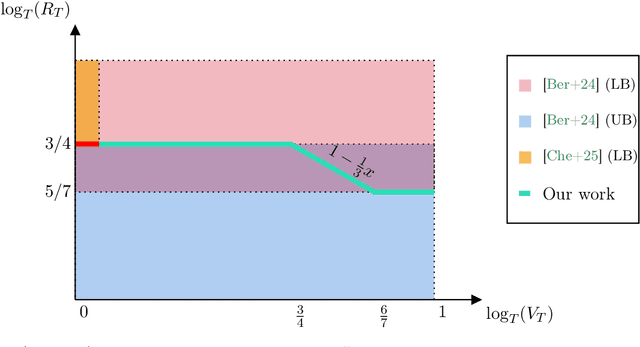


Bilateral trade is a central problem in algorithmic economics, and recent work has explored how to design trading mechanisms using no-regret learning algorithms. However, no-regret learning is impossible when budget balance has to be enforced at each time step. Bernasconi et al. [Ber+24] show how this impossibility can be circumvented by relaxing the budget balance constraint to hold only globally over all time steps. In particular, they design an algorithm achieving regret of the order of $\tilde O(T^{3/4})$ and provide a lower bound of $\Omega(T^{5/7})$. In this work, we interpolate between these two extremes by studying how the optimal regret rate varies with the allowed violation of the global budget balance constraint. Specifically, we design an algorithm that, by violating the constraint by at most $T^{\beta}$ for any given $\beta \in [\frac{3}{4}, \frac{6}{7}]$, attains regret $\tilde O(T^{1 - \beta/3})$. We complement this result with a matching lower bound, thus fully characterizing the trade-off between regret and budget violation. Our results show that both the $\tilde O(T^{3/4})$ upper bound in the global budget balance case and the $\Omega(T^{5/7})$ lower bound under unconstrained budget balance violation obtained by Bernasconi et al. [Ber+24] are tight.
No-Regret Learning Under Adversarial Resource Constraints: A Spending Plan Is All You Need!
Jun 16, 2025We study online decision making problems under resource constraints, where both reward and cost functions are drawn from distributions that may change adversarially over time. We focus on two canonical settings: $(i)$ online resource allocation where rewards and costs are observed before action selection, and $(ii)$ online learning with resource constraints where they are observed after action selection, under full feedback or bandit feedback. It is well known that achieving sublinear regret in these settings is impossible when reward and cost distributions may change arbitrarily over time. To address this challenge, we analyze a framework in which the learner is guided by a spending plan--a sequence prescribing expected resource usage across rounds. We design general (primal-)dual methods that achieve sublinear regret with respect to baselines that follow the spending plan. Crucially, the performance of our algorithms improves when the spending plan ensures a well-balanced distribution of the budget across rounds. We additionally provide a robust variant of our methods to handle worst-case scenarios where the spending plan is highly imbalanced. To conclude, we study the regret of our algorithms when competing against benchmarks that deviate from the prescribed spending plan.