 Add to Chrome
 Add to Firefox
 Add to Edge
A Scalable 256-Antenna Distributed MIMO Testbed with Real-Time Fully Digital Beamforming
May 04, 2026
Distributed massive MIMO (D-MIMO) is a promising technology for future generation wireless systems as it takes advantage of both an increased array aperture and a decentralized processing architecture and topology. In order to truly understand the possibilities and limitations of these approaches in real scenarios, practical realization of testbeds is an essential step in the technology advancement. This work presents the Lund University Large Intelligent Surface testbed -- LuLIS, that can operate up to 256 coherent radio frequency (RF) chains using 16 AMD Zynq UltraScale RFSoC ZCU216 evaluation boards acting as distributed processing nodes. Real-time processing is facilitated by acceleration and distribution of MIMO processing algorithms on the FPGA fabric of the boards. The system is easily scalable, as increasing the number of antennas is done in multiples of 16 by adding more RFSoCs, which also implies addition of another processing node. The design allows up-scaling without hardware redesign, introduction of large latencies or data transfer overhead. The testbed is flexible in terms of deployment, with options of fully distributing the nodes (as in D-MIMO) or co-locating them (as in more traditional Massive MIMO). A detailed description of the implementation of the testbed is presented and initial results are shown for an uplink (UL) transmission from four single-antenna user equipments (UEs) to 64, 128 and 256 base-station antennas.

A Wideband Distributed Massive MIMO Channel Sounder for Communication and Sensing
Mar 18, 2024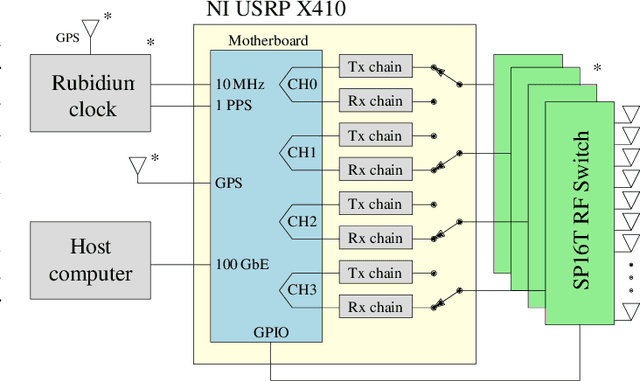
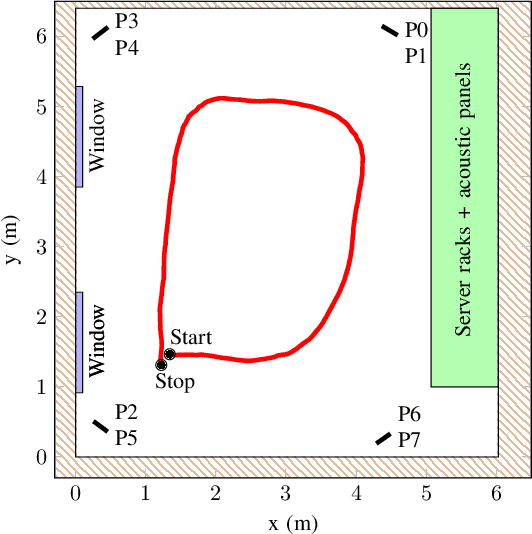
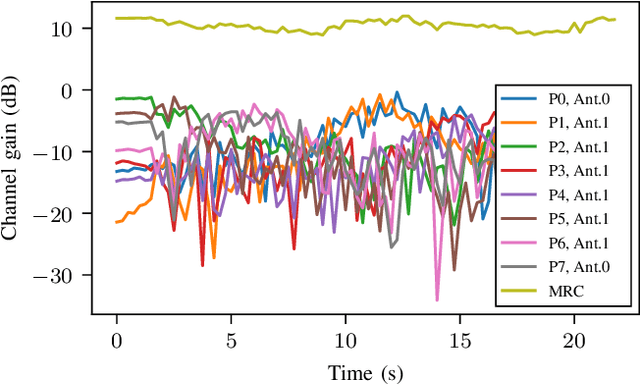
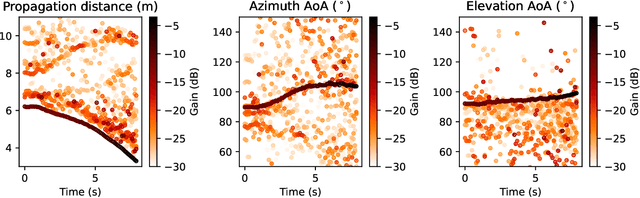
Channel sounding is a vital step in understanding wireless channels for the design and deployment of wireless communication systems. In this paper, we present the design and implementation of a coherent distributed massive MIMO channel sounder operating at 5-6 GHz with a bandwidth of 400 MHz based on the NI USRP X410. Through the integration of transceiver chains and RF switches, the design facilitates the use of a larger number of antennas without significant compromise in dynamic capability. Our current implementation is capable of measuring thousands of antenna combinations within tens of milliseconds. Every radio frequency switch is seamlessly integrated with a 16-element antenna array, making the antennas more practical to be transported and flexibly distributed. In addition, the channel sounder features real-time processing to reduce the data stream to the host computer and increase the signal-to-noise ratio. The design and implementation are verified through two measurements in an indoor laboratory environment. The first measurement entails a single-antenna robot as transmitter and 128 distributed receiving antennas. The second measurement demonstrates a passive sensing scenario with a walking person. We evaluate the results of both measurements using the super-resolution algorithm SAGE. The results demonstrate the great potential of the presented sounding system for providing high-quality radio channel measurements, contributing to high-resolution channel estimation, characterization, and active and passive sensing in realistic and dynamic scenarios.
Experimental Exploration of Unlicensed Sub-GHz Massive MIMO for Massive Internet-of-Things
May 26, 2021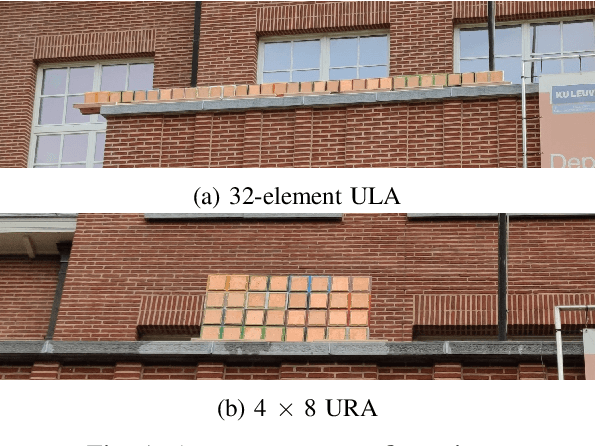
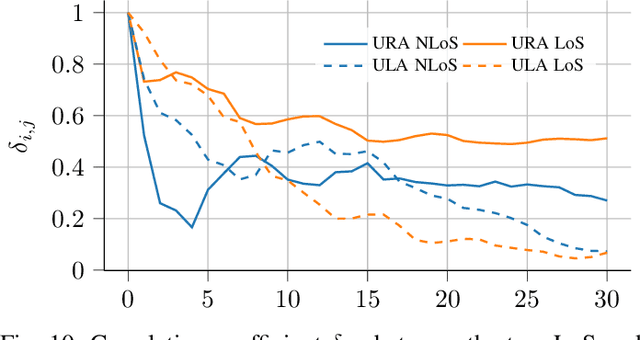
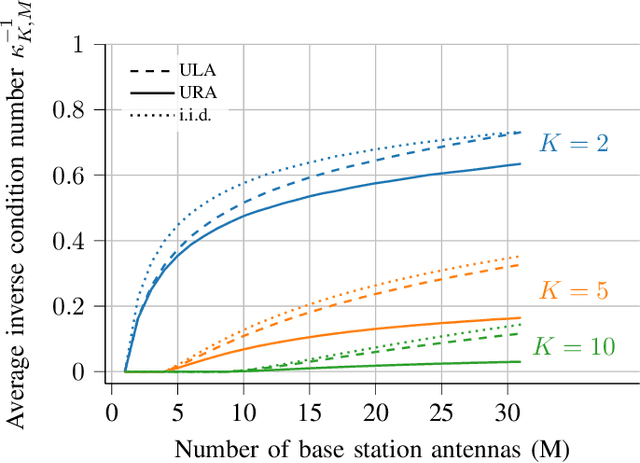
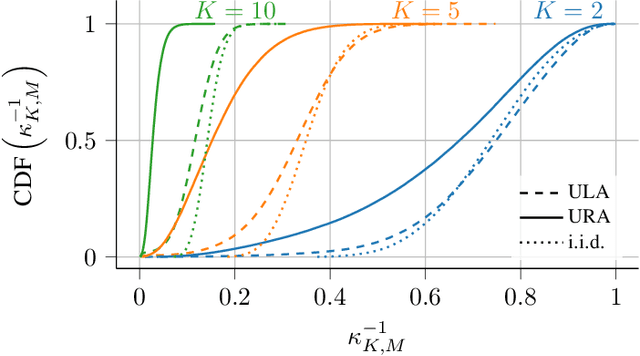
Due to the increase of Internet-of-Things (IoT) devices, IoT networks are getting overcrowded. Networks can be extended with more gateways, increasing the number of supported devices. However, as investigated in this work, massive MIMO has the potential to increase the number of simultaneous connections, while also lowering the energy expenditure of these devices. We present a study of the channel characteristics of massive MIMO in the unlicensed sub-GHz band. The goal is to support IoT applications with strict requirements in terms of number of devices, power consumption, and reliability. The assessment is based on experimental measurements using both a uniform linear and a rectangular array. Our study demonstrates and validates the advantages of deploying massive MIMO gateways to serve IoT nodes. While the results are general, here we specifically focus on static nodes. The array gain and channel hardening effect yield opportunities to lower the transmit-power of IoT nodes while also increasing reliability. The exploration confirms that exploiting large arrays brings great opportunities to connect a massive number of IoT devices by separating the nodes in the spatial domain. In addition, we give an outlook on how static IoT nodes could be scheduled based on partial channel state information.