 Add to Chrome
 Add to Firefox
 Add to Edge
A Scalable 256-Antenna Distributed MIMO Testbed with Real-Time Fully Digital Beamforming
May 04, 2026
Distributed massive MIMO (D-MIMO) is a promising technology for future generation wireless systems as it takes advantage of both an increased array aperture and a decentralized processing architecture and topology. In order to truly understand the possibilities and limitations of these approaches in real scenarios, practical realization of testbeds is an essential step in the technology advancement. This work presents the Lund University Large Intelligent Surface testbed -- LuLIS, that can operate up to 256 coherent radio frequency (RF) chains using 16 AMD Zynq UltraScale RFSoC ZCU216 evaluation boards acting as distributed processing nodes. Real-time processing is facilitated by acceleration and distribution of MIMO processing algorithms on the FPGA fabric of the boards. The system is easily scalable, as increasing the number of antennas is done in multiples of 16 by adding more RFSoCs, which also implies addition of another processing node. The design allows up-scaling without hardware redesign, introduction of large latencies or data transfer overhead. The testbed is flexible in terms of deployment, with options of fully distributing the nodes (as in D-MIMO) or co-locating them (as in more traditional Massive MIMO). A detailed description of the implementation of the testbed is presented and initial results are shown for an uplink (UL) transmission from four single-antenna user equipments (UEs) to 64, 128 and 256 base-station antennas.

Spectrum Efficiency and Processing Latency Trade-offs in Panel-Based LIS
Nov 28, 2024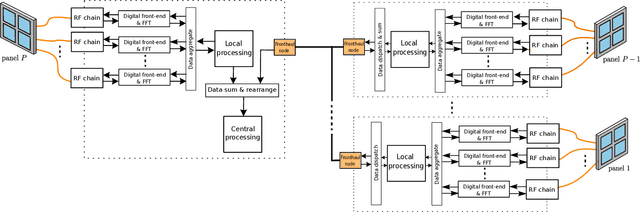
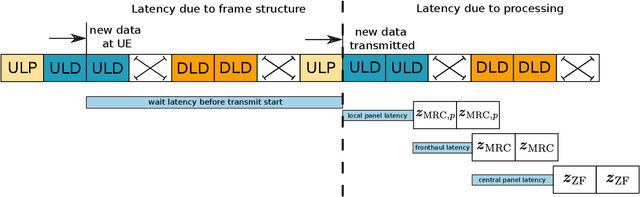
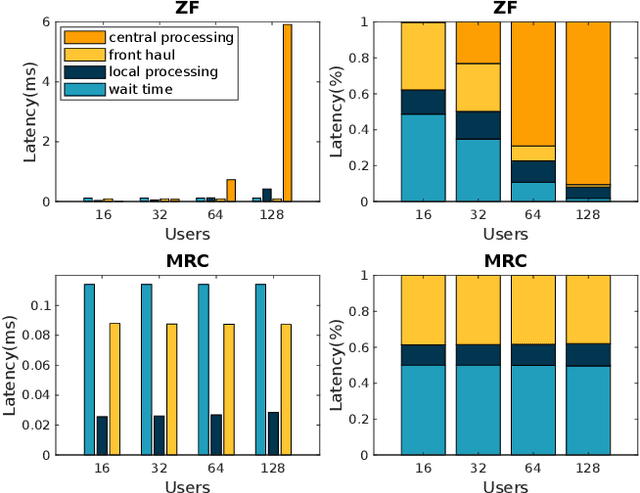
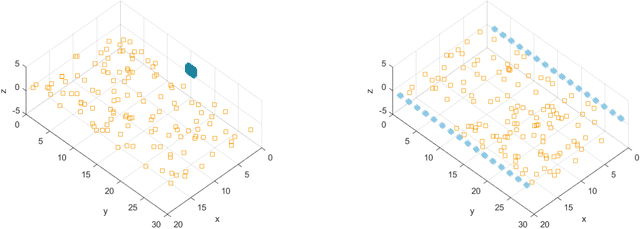
The next generation wireless systems will face stringent new requirements, including ultra-low latency, high data rates and enhanced reliability. Large Intelligent Surfaces, is one proposed solution that has the potential to solve these high demands. The real-life deployment of such systems involves different design considerations with non-trivial trade-offs. This paper investigates the trade-off between spectral efficiency and processing latency, considering different antenna distribution schemes and detection algorithms. A latency model for the physical layer processing has been developed with realistic hardware parameters. The simulation results using an in-door environment show that distributing the antennas throughout the scenario improves the overall reliability, while the impact on the latency is limited when zero-forcing (ZF) detection is used. On the other hand, changing the detection algorithm to maximum-ratio combining (MRC) may reduce the latency significantly, even if a larger number of antennas are needed to achieve a similar spectrum efficiency as ZF detection.