 Add to Chrome
 Add to Firefox
 Add to Edge
Online Learning on Hidden-Convex Losses via Algorithmic Equivalence: Optimal Regret, Geometric Barrier, and Bandit Feedback
May 25, 2026
We study adversarial online learning with hidden-convex losses, i.e., nonconvex losses that become convex after a nonlinear reparameterization. Ghai, Lu and Hazan (2022) proved that, under geometric and smoothness assumptions, online gradient descent (OGD) on such nonconvex losses approximately simulates online mirror descent (OMD) on the underlying convex losses with a suitable regularizer, yielding $\mathcal{O}(T^{2/3})$ regret. They left open whether the optimal $Θ(\sqrt{T})$ regret from online convex optimization can be recovered in this hidden-convex setting. We answer this question affirmatively. More specifically, via a sharper discrete-time algorithmic equivalence argument, we prove that OGD achieves $\mathcal{O}(\sqrt{T})$ regret under the same assumptions, matching the optimal worst-case rate for adversarial online convex optimization. We also address another open question of Ghai, Lu and Hazan (2022) by clarifying the geometry required for this algorithmic equivalence. We replace the diagonal-Jacobian sufficient condition with a necessary-and-sufficient Hessian compatibility condition, thereby expanding the class of admissible reparameterizations. We complement our tight regret bound with a lower bound showing that the Hessian compatibility assumption is essential for OGD; when it fails, we construct a smooth reparameterization and an adversarial sequence of hidden-convex losses for which OGD suffers $Ω(T)$ regret. Finally, we extend our analysis to one-point bandit feedback and prove a $\mathcal{O}(T^{3/4})$ expected regret bound for bandit OGD with spherical smoothing, matching its classical rate on convex losses.

When and Why is Optimistic Multiplicative Weights Slow? The Geometry of Energy Dissipation
May 13, 2026This paper studies the convergence of the Optimistic Multiplicative Weights Update algorithm (OMWU) in two player zero-sum games. Recent works have identified instances on which the last-iterate of OMWU can converge arbitrarily slowly, but understanding when and why this slow convergence occurs has remained open. In this work, we develop a new analysis framework that gives sharp, quantitative explanations for this behavior. Our analysis is based on viewing the algorithm's dual iterates as an optimistic skew-gradient descent with respect to an energy function. We prove over the dual iterates that energy is dissipative, and by establishing tight bounds on the magnitude of dissipation, our analysis quantifies the geometric bottlenecks that arise when the corresponding primal iterates are close to the simplex boundary. This further translates into a new linear last-iterate convergence rate in KL divergence on games with a unique and interior Nash equilibrium. Compared to prior work, this new rate contains a much sharper dependence on game-specific constants, and we prove this dependence is optimal. Moreover, these geometric insights further translate into new separations on uniform convergence rates for OMWU. On the one hand, we prove constant lower bounds on the uniform best-iterate convergence rate in KL divergence and total variation distance from Nash. On the other hand, we establish for the $2\times 2$ setting a new ${\widetilde O}(T^{-1/2})$ best-iterate rate in duality gap, improving substantially over prior work. Together, this shows in general that uniform convergence rate guarantees do not transfer across different measures of distance to Nash.
Why Pass@k Optimization Can Degrade Pass@1: Prompt Interference in LLM Post-training
Feb 26, 2026Pass@k is a widely used performance metric for verifiable large language model tasks, including mathematical reasoning, code generation, and short-answer reasoning. It defines success if any of $k$ independently sampled solutions passes a verifier. This multi-sample inference metric has motivated inference-aware fine-tuning methods that directly optimize pass@$k$. However, prior work reports a recurring trade-off: pass@k improves while pass@1 degrades under such methods. This trade-off is practically important because pass@1 often remains a hard operational constraint due to latency and cost budgets, imperfect verifier coverage, and the need for a reliable single-shot fallback. We study the origin of this trade-off and provide a theoretical characterization of when pass@k policy optimization can reduce pass@1 through gradient conflict induced by prompt interference. We show that pass@$k$ policy gradients can conflict with pass@1 gradients because pass@$k$ optimization implicitly reweights prompts toward low-success prompts; when these prompts are what we term negatively interfering, their upweighting can rotate the pass@k update direction away from the pass@1 direction. We illustrate our theoretical findings with large language model experiments on verifiable mathematical reasoning tasks.
Convex Markov Games and Beyond: New Proof of Existence, Characterization and Learning Algorithms for Nash Equilibria
Feb 12, 2026Convex Markov Games (cMGs) were recently introduced as a broad class of multi-agent learning problems that generalize Markov games to settings where strategic agents optimize general utilities beyond additive rewards. While cMGs expand the modeling frontier, their theoretical foundations, particularly the structure of Nash equilibria (NE) and guarantees for learning algorithms, are not yet well understood. In this work, we address these gaps for an extension of cMGs, which we term General Utility Markov Games (GUMGs), capturing new applications requiring coupling between agents' occupancy measures. We prove that in GUMGs, Nash equilibria coincide with the fixed points of projected pseudo-gradient dynamics (i.e., first-order stationary points), enabled by a novel agent-wise gradient domination property. This insight also yields a simple proof of NE existence using Brouwer's fixed-point theorem. We further show the existence of Markov perfect equilibria. Building on this characterization, we establish a policy gradient theorem for GUMGs and design a model-free policy gradient algorithm. For potential GUMGs, we establish iteration complexity guarantees for computing approximate-NE under exact gradients and provide sample complexity bounds in both the generative model and on-policy settings. Our results extend beyond prior work restricted to zero-sum cMGs, providing the first theoretical analysis of common-interest cMGs.
Multi-Agent Online Control with Adversarial Disturbances
Jun 23, 2025Multi-agent control problems involving a large number of agents with competing and time-varying objectives are increasingly prevalent in applications across robotics, economics, and energy systems. In this paper, we study online control in multi-agent linear dynamical systems with disturbances. In contrast to most prior work in multi-agent control, we consider an online setting where disturbances are adversarial and where each agent seeks to minimize its own, adversarial sequence of convex losses. In this setting, we investigate the robustness of gradient-based controllers from single-agent online control, with a particular focus on understanding how individual regret guarantees are influenced by the number of agents in the system. Under minimal communication assumptions, we prove near-optimal sublinear regret bounds that hold uniformly for all agents. Finally, when the objectives of the agents are aligned, we show that the multi-agent control problem induces a time-varying potential game for which we derive equilibrium gap guarantees.
Optimistic Online Learning in Symmetric Cone Games
Apr 04, 2025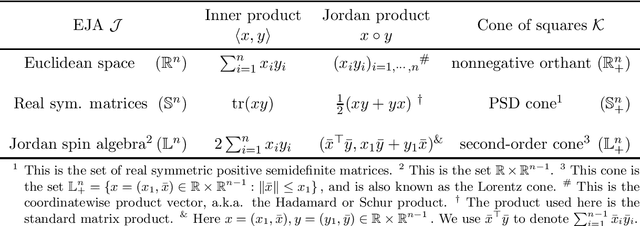
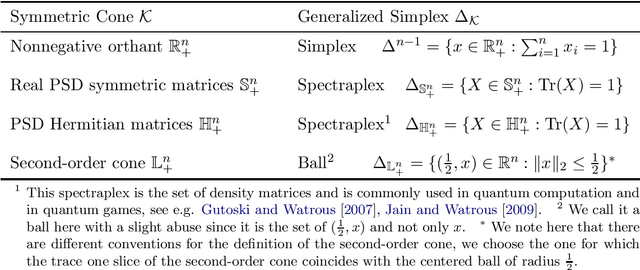
Optimistic online learning algorithms have led to significant advances in equilibrium computation, particularly for two-player zero-sum games, achieving an iteration complexity of $\mathcal{O}(1/\epsilon)$ to reach an $\epsilon$-saddle point. These advances have been established in normal-form games, where strategies are simplex vectors, and quantum games, where strategies are trace-one positive semidefinite matrices. We extend optimistic learning to symmetric cone games (SCGs), a class of two-player zero-sum games where strategy spaces are generalized simplices (trace-one slices of symmetric cones). A symmetric cone is the cone of squares of a Euclidean Jordan Algebra; canonical examples include the nonnegative orthant, the second-order cone, the cone of positive semidefinite matrices, and their products, all fundamental to convex optimization. SCGs unify normal-form and quantum games and, as we show, offer significantly greater modeling flexibility, allowing us to model applications such as distance metric learning problems and the Fermat-Weber problem. To compute approximate saddle points in SCGs, we introduce the Optimistic Symmetric Cone Multiplicative Weights Update algorithm and establish an iteration complexity of $\mathcal{O}(1/\epsilon)$ to reach an $\epsilon$-saddle point. Our analysis builds on the Optimistic Follow-the-Regularized-Leader framework, with a key technical contribution being a new proof of the strong convexity of the symmetric cone negative entropy with respect to the trace-one norm, a result that may be of independent interest.
On the Sample Complexity of a Policy Gradient Algorithm with Occupancy Approximation for General Utility Reinforcement Learning
Oct 05, 2024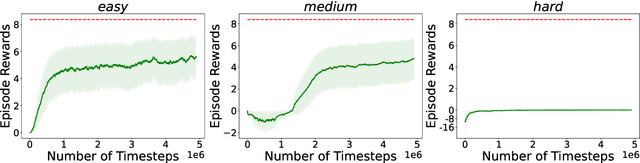
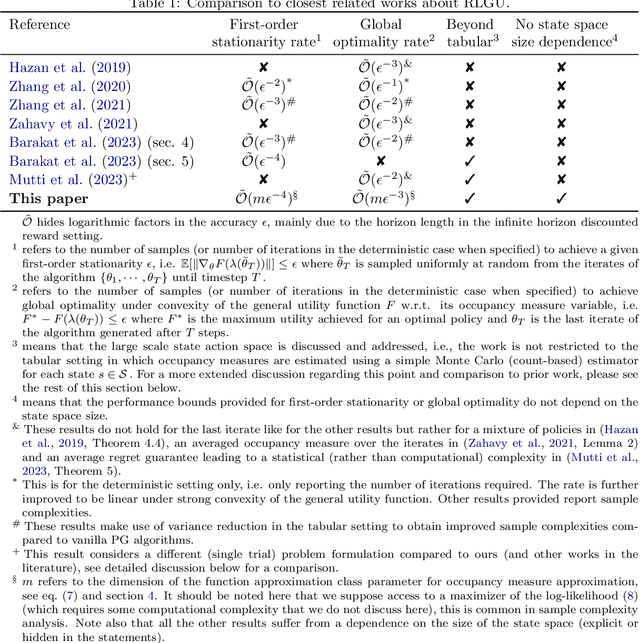
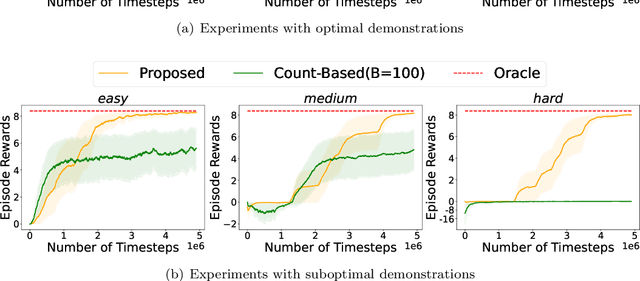
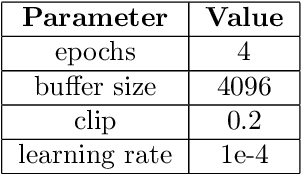
Reinforcement learning with general utilities has recently gained attention thanks to its ability to unify several problems, including imitation learning, pure exploration, and safe RL. However, prior work for solving this general problem in a unified way has mainly focused on the tabular setting. This is restrictive when considering larger state-action spaces because of the need to estimate occupancy measures during policy optimization. In this work, we address this issue and propose to approximate occupancy measures within a function approximation class using maximum likelihood estimation (MLE). We propose a simple policy gradient algorithm (PG-OMA) where an actor updates the policy parameters to maximize the general utility objective whereas a critic approximates the occupancy measure using MLE. We provide a sample complexity analysis of PG-OMA showing that our occupancy measure estimation error only scales with the dimension of our function approximation class rather than the size of the state action space. Under suitable assumptions, we establish first order stationarity and global optimality performance bounds for the proposed PG-OMA algorithm for nonconcave and concave general utilities respectively. We complement our methodological and theoretical findings with promising empirical results showing the scalability potential of our approach compared to existing tabular count-based approaches.
Beyond Expected Returns: A Policy Gradient Algorithm for Cumulative Prospect Theoretic Reinforcement Learning
Oct 03, 2024


The widely used expected utility theory has been shown to be empirically inconsistent with human preferences in the psychology and behavioral economy literatures. Cumulative Prospect Theory (CPT) has been developed to fill in this gap and provide a better model for human-based decision-making supported by empirical evidence. It allows to express a wide range of attitudes and perceptions towards risk, gains and losses. A few years ago, CPT has been combined with Reinforcement Learning (RL) to formulate a CPT policy optimization problem where the goal of the agent is to search for a policy generating long-term returns which are aligned with their preferences. In this work, we revisit this policy optimization problem and provide new insights on optimal policies and their nature depending on the utility function under consideration. We further derive a novel policy gradient theorem for the CPT policy optimization objective generalizing the seminal corresponding result in standard RL. This result enables us to design a model-free policy gradient algorithm to solve the CPT-RL problem. We illustrate the performance of our algorithm in simple examples motivated by traffic control and electricity management applications. We also demonstrate that our policy gradient algorithm scales better to larger state spaces compared to the existing zeroth order algorithm for solving the same problem.
Independent Policy Mirror Descent for Markov Potential Games: Scaling to Large Number of Players
Aug 15, 2024
Markov Potential Games (MPGs) form an important sub-class of Markov games, which are a common framework to model multi-agent reinforcement learning problems. In particular, MPGs include as a special case the identical-interest setting where all the agents share the same reward function. Scaling the performance of Nash equilibrium learning algorithms to a large number of agents is crucial for multi-agent systems. To address this important challenge, we focus on the independent learning setting where agents can only have access to their local information to update their own policy. In prior work on MPGs, the iteration complexity for obtaining $\epsilon$-Nash regret scales linearly with the number of agents $N$. In this work, we investigate the iteration complexity of an independent policy mirror descent (PMD) algorithm for MPGs. We show that PMD with KL regularization, also known as natural policy gradient, enjoys a better $\sqrt{N}$ dependence on the number of agents, improving over PMD with Euclidean regularization and prior work. Furthermore, the iteration complexity is also independent of the sizes of the agents' action spaces.
* 16 pages, CDC 2024
Policy Mirror Descent with Lookahead
Mar 21, 2024
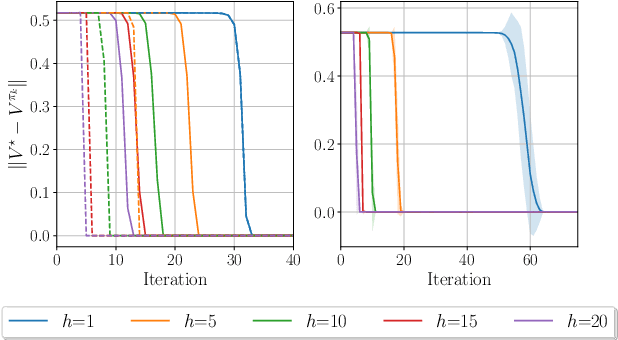
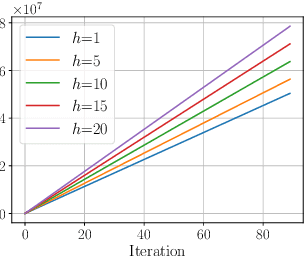
Policy Mirror Descent (PMD) stands as a versatile algorithmic framework encompassing several seminal policy gradient algorithms such as natural policy gradient, with connections with state-of-the-art reinforcement learning (RL) algorithms such as TRPO and PPO. PMD can be seen as a soft Policy Iteration algorithm implementing regularized 1-step greedy policy improvement. However, 1-step greedy policies might not be the best choice and recent remarkable empirical successes in RL such as AlphaGo and AlphaZero have demonstrated that greedy approaches with respect to multiple steps outperform their 1-step counterpart. In this work, we propose a new class of PMD algorithms called $h$-PMD which incorporates multi-step greedy policy improvement with lookahead depth $h$ to the PMD update rule. To solve discounted infinite horizon Markov Decision Processes with discount factor $\gamma$, we show that $h$-PMD which generalizes the standard PMD enjoys a faster dimension-free $\gamma^h$-linear convergence rate, contingent on the computation of multi-step greedy policies. We propose an inexact version of $h$-PMD where lookahead action values are estimated. Under a generative model, we establish a sample complexity for $h$-PMD which improves over prior work. Finally, we extend our result to linear function approximation to scale to large state spaces. Under suitable assumptions, our sample complexity only involves dependence on the dimension of the feature map space instead of the state space size.