 Add to Chrome
 Add to Firefox
 Add to Edge
Active Flow Expansion for Out-of-Distribution Discovery: from Theory to Molecules
Jun 07, 2026
Standard flow and diffusion pre-training matches the distribution of available data (e.g., molecules), which often covers only a small fraction of the valid design space. In generative discovery, however, one aims to sample valid new-to-nature designs, assigned negligible probability under, and thus inaccessible to, standard models fitted to the observed data. To overcome this limitation, we depart from data distribution matching and view a generative model through its generable set: the region it covers with non-negligible probability. This allows to introduce a new learning principle for out-of-distribution flow modeling: enlarging a model's generable set to increase coverage of the valid design space. We propose Active Flow Expansion (ActFlow), a continued pre-training method that employs verifier feedback to expand a pre-trained model over new valid regions by iteratively adapting to synthetic data generated through active exploration in the learned flow representation. Theoretically, we establish to our knowledge first-of-their-kind statistical learning guarantees for out-of-distribution flow modeling, analyzing generable set expansion as a local-to-global reachability process over a learned representation. Empirically, we assess ActFlow with suitable out-of-distribution generative modeling metrics across small organic molecules, mid-sized drug-like molecules, therapeutic peptides, and protein sequence design tasks. Results show that ActFlow expands valid coverage far beyond the region modeled by the initial pre-trained model, significantly outperforming widely adopted synthetic flow pre-training methods.

Verifier-Constrained Flow Expansion for Discovery Beyond the Data
Feb 17, 2026Flow and diffusion models are typically pre-trained on limited available data (e.g., molecular samples), covering only a fraction of the valid design space (e.g., the full molecular space). As a consequence, they tend to generate samples from only a narrow portion of the feasible domain. This is a fundamental limitation for scientific discovery applications, where one typically aims to sample valid designs beyond the available data distribution. To this end, we address the challenge of leveraging access to a verifier (e.g., an atomic bonds checker), to adapt a pre-trained flow model so that its induced density expands beyond regions of high data availability, while preserving samples validity. We introduce formal notions of strong and weak verifiers and propose algorithmic frameworks for global and local flow expansion via probability-space optimization. Then, we present Flow Expander (FE), a scalable mirror descent scheme that provably tackles both problems by verifier-constrained entropy maximization over the flow process noised state space. Next, we provide a thorough theoretical analysis of the proposed method, and state convergence guarantees under both idealized and general assumptions. Ultimately, we empirically evaluate our method on both illustrative, yet visually interpretable settings, and on a molecular design task showcasing the ability of FE to expand a pre-trained flow model increasing conformer diversity while preserving validity.
Policy Mirror Descent with Lookahead
Mar 21, 2024
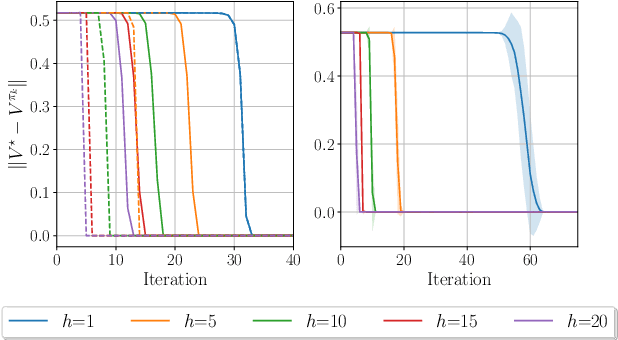
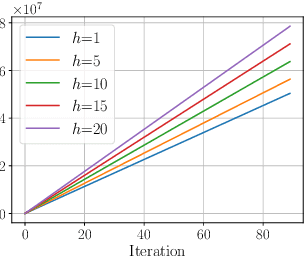
Policy Mirror Descent (PMD) stands as a versatile algorithmic framework encompassing several seminal policy gradient algorithms such as natural policy gradient, with connections with state-of-the-art reinforcement learning (RL) algorithms such as TRPO and PPO. PMD can be seen as a soft Policy Iteration algorithm implementing regularized 1-step greedy policy improvement. However, 1-step greedy policies might not be the best choice and recent remarkable empirical successes in RL such as AlphaGo and AlphaZero have demonstrated that greedy approaches with respect to multiple steps outperform their 1-step counterpart. In this work, we propose a new class of PMD algorithms called $h$-PMD which incorporates multi-step greedy policy improvement with lookahead depth $h$ to the PMD update rule. To solve discounted infinite horizon Markov Decision Processes with discount factor $\gamma$, we show that $h$-PMD which generalizes the standard PMD enjoys a faster dimension-free $\gamma^h$-linear convergence rate, contingent on the computation of multi-step greedy policies. We propose an inexact version of $h$-PMD where lookahead action values are estimated. Under a generative model, we establish a sample complexity for $h$-PMD which improves over prior work. Finally, we extend our result to linear function approximation to scale to large state spaces. Under suitable assumptions, our sample complexity only involves dependence on the dimension of the feature map space instead of the state space size.