 Add to Chrome
 Add to Firefox
 Add to Edge
MiroEval: Benchmarking Multimodal Deep Research Agents in Process and Outcome
Mar 30, 2026
Recent progress in deep research systems has been impressive, but evaluation still lags behind real user needs. Existing benchmarks predominantly assess final reports using fixed rubrics, failing to evaluate the underlying research process. Most also offer limited multimodal coverage, rely on synthetic tasks that do not reflect real-world query complexity, and cannot be refreshed as knowledge evolves. To address these gaps, we introduce MiroEval, a benchmark and evaluation framework for deep research systems. The benchmark comprises 100 tasks (70 text-only, 30 multimodal), all grounded in real user needs and constructed via a dual-path pipeline that supports periodic updates, enabling a live and evolving setting. The proposed evaluation suite assesses deep research systems along three complementary dimensions: adaptive synthesis quality evaluation with task-specific rubrics, agentic factuality verification via active retrieval and reasoning over both web sources and multimodal attachments, and process-centric evaluation audits how the system searches, reasons, and refines throughout its investigation. Evaluation across 13 systems yields three principal findings: the three evaluation dimensions capture complementary aspects of system capability, with each revealing distinct strengths and weaknesses across systems; process quality serves as a reliable predictor of overall outcome while revealing weaknesses invisible to output-level metrics; and multimodal tasks pose substantially greater challenges, with most systems declining by 3 to 10 points. The MiroThinker series achieves the most balanced performance, with MiroThinker-H1 ranking the highest overall in both settings. Human verification and robustness results confirm the reliability of the benchmark and evaluation framework. MiroEval provides a holistic diagnostic tool for the next generation of deep research agents.

Q*: Improving Multi-step Reasoning for LLMs with Deliberative Planning
Jun 20, 2024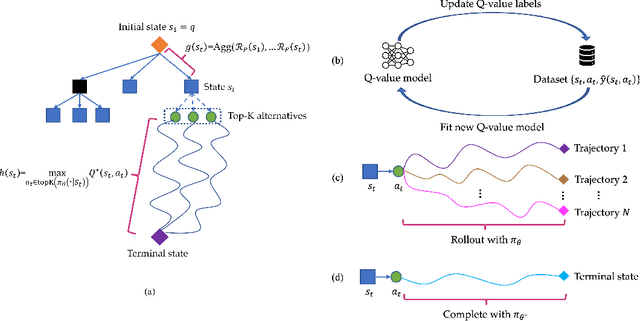
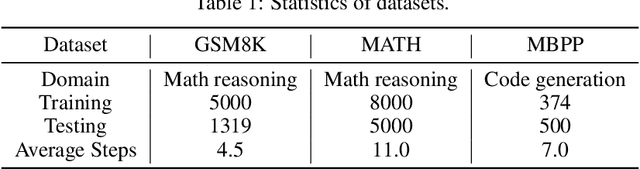
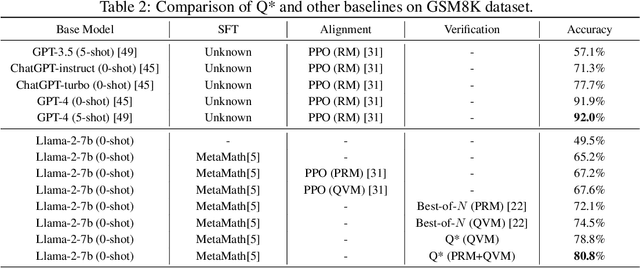
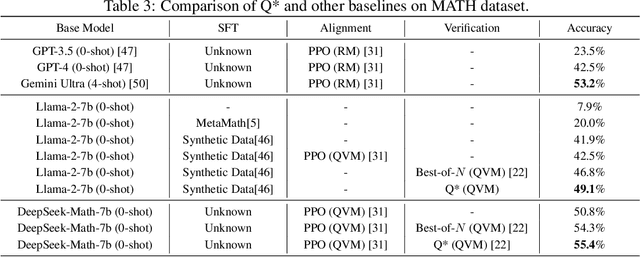
Large Language Models (LLMs) have demonstrated impressive capability in many nature language tasks. However, the auto-regressive generation process makes LLMs prone to produce errors, hallucinations and inconsistent statements when performing multi-step reasoning. In this paper, we aim to alleviate the pathology by introducing Q*, a general, versatile and agile framework for guiding LLMs decoding process with deliberative planning. By learning a plug-and-play Q-value model as heuristic function, our Q* can effectively guide LLMs to select the most promising next step without fine-tuning LLMs for each task, which avoids the significant computational overhead and potential risk of performance degeneration on other tasks. Extensive experiments on GSM8K, MATH and MBPP confirm the superiority of our method.