 Add to Chrome
 Add to Firefox
 Add to Edge
Digitizing Coaching Intelligence: An Agentic Framework for Holistic Athlete Profiling using VLM and RAG
Jun 26, 2026
Athlete assessment is a critical process for tracking physical progress and identifying elite talent. However, during mass recruitment drives, traditional methods rely on manual observation, which is inherently subjective and unscalable, or basic computer vision (CV) systems limited to quantitative repetition counting. These standard approaches lack the "coaching intelligence" required to evaluate qualitative physiological markers such as form degradation, spinal articulation, and fatigue. This paper presents a novel, LLM-based hybrid agentic framework for automated, holistic athlete profiling that strictly aligns with the Sports Authority of India (SAI) assessment protocols. Orchestrated via LangGraph, our dual-pipeline architecture synthesizes the geometric precision of CV (MediaPipe) for kinematic tracking with the semantic reasoning of Vision-Language Models (Llama-4-scout). To overcome the latency and token constraints associated with multimodal video processing, we introduce a 3 X 3 "Smart Grid" temporal chunking strategy, reducing computational overhead by over 88% while preserving critical temporal continuity. To ensure data integrity and mitigate hallucination, the framework pioneers an autonomous "LLM-as-a-Judge" self-correction loop that cross-references quantitative and qualitative metrics before persistence. Finally, we implement a dual-persistence Retrieval-Augmented Generation (RAG) pipeline utilizing a vector search engine (ChromaDB). This enables coaches to bypass rigid SQL databases and perform complex semantic queries (e.g., "Identify athletes with high endurance but poor core rigidity") using natural language. Experimental results demonstrate that this multi-agent approach significantly bridges the gap between raw biometric tracking and actionable coaching insights, offering a scalable, objective solution for national talent identification.

Latent Performance Profiling of Large Language Models
May 28, 2026Large language models (LLMs) frequently achieve impressive scores on standardized benchmarks, yet accuracy alone offers a limited view of their capabilities. Evaluating open-source LLMs through leaderboards faces persistent issues like data contamination, narrow task scope, and weak alignment with real-world reliability. Benchmark-based evaluations such as MMLU PRO, BBH, or IFEval primarily capture \textit{what} a model outputs on fixed test sets, not \textit{how} it processes information, calibrates uncertainty, or structures internal knowledge. In this article, we advocate for a shift from benchmark-centric evaluation toward a complementary, \textit{state-centered intrinsic assessment} of LLMs. To this end, we introduce \textbf{Latent Performance Profiling (LPP)} -- a framework that derives task-agnostic diagnostics from hidden activations and output distributions. LPP defines a set of scalar metrics on a model's latent representations and dynamics, revealing scale-independent traits that enable interpretable comparisons and uncover hidden vulnerabilities. Unlike static accuracy scores, LPP provides stable, architecture-sensitive signatures across models of similar size. With extensive empirical analyses across eight LLMs, spanning a size range of 0.5B-14B, we demonstrate that models with similar benchmark scores can exhibit contrasting latent profiles, such as differences in entropy or adaptability. Guided by these insights, we design synthetic probes for uncertainty and symbolic reasoning that align with intrinsic metrics while decoupling from leaderboard bias. We recommend that reporting LPP alongside benchmarks provides a deeper, interpretable understanding of model behavior, enabling more reliable model selection, safety assessment, and evaluation beyond surface-level accuracy.
Towards Explainability of SLMs by investigating Token Level Activation
May 21, 2026Transformer-based language models such as BERT having 110M+ parameters have revolutionized natural language understanding, yet their internal mechanisms remain largely opaque to researchers and practitioners. Traditional attention-based interpretability methods often emphasize structurally important but semantically weak tokens such as punctuation marks rather than meaningful semantic relationships. This work introduces a lightweight and model-agnostic framework for quantifying token-level representational importance using hidden-state activation strengths at Layer 8 of BERT. The proposed Activation Flow Network (AFN) framework computes Token Activation Strength using the L2 norm of Layer-8 hidden representations, enabling direct ranking of semantically salient tokens. The study further introduces a threshold-based activation bucket formulation that partitions tokens into HIGH-activation and LOW-activation groups using an empirical upper-quartile activation boundary. Experimental observations demonstrate that semantically meaningful content words consistently occupy the HIGH-activation bucket and dominate representational activation shifts, while structurally supportive tokens contribute comparatively less. The results suggest that Layer 8 acts as a critical semantic consolidation zone balancing structural and semantic information processing. By revealing how activation magnitudes concentrate around semantically informative tokens, this work provides an interpretable and computationally efficient alternative to attentioncentric analysis, contributing toward transforming BERT from a "black box" into a more transparent "glass box" model for natural language understanding.
A New Technique for AI Explainability using Feature Association Map
May 14, 2026Lack of transparency in AI systems poses challenges in critical real-life applications. It is important to be able to explain the decisions of an AI system to ensure trust on the system. Explainable AI (XAI) algorithms play a vital role in achieving this objective. In this paper, we are proposing a new algorithm for Explaining AI systems, FAMeX (Feature Association Map based eXplainability). The proposed algorithm is based on a graph-theoretic formulation of the feature set termed as Feature Association Map (FAM). The foundation of the modelling is based on association between features. The proposed FAMeX algorithm has been found to be better than the competing XAI algorithms - Permutation Feature Importance (PFI) and SHapley Additive exPlanations (SHAP). Experiments conducted with eight benchmark algorithms show that FAMeX is able to gauge feature importance in the context of classification better than the competing algorithms. This definitely shows that FAMeX is a promising algorithm in explaining the predictions from an AI system
PHISHREV: A Hybrid Machine Learning and Post-Hoc Non-monotonic Reasoning Framework for Context-Aware Phishing Website Classification
Apr 28, 2026Phishing detection systems are predominantly rely on statistical machine learning models, which often lack contextual reasoning and are vulnerable to adversarial manipulation. In this work, we propose a hybrid framework that integrates machine learning classifiers with non-monotonic reasoning using Answer Set Programming (ASP) to enable context-aware decision refinement. The proposed post-hoc reasoning layer incorporates expert knowledge to revise classifier predictions through formal belief revisions. Experimental results indicate that the reasoning module modifies 5.08\% of classifier outputs, leading to improved decision consistency. A key advantage is that new domain knowledge can be incorporated into the reasoning layer in $\mathcal{O}(n)$ time, eliminating the need for model retraining.
BEExformer: A Fast Inferencing Transformer Architecture via Binarization with Multiple Early Exits
Dec 06, 2024Large Language Models (LLMs) based on transformers achieve cutting-edge results on a variety of applications. However, their enormous size and processing requirements make deployment on devices with constrained resources extremely difficult. Among various efficiency considerations, model binarization and Early Exit (EE) are common effective solutions. However, binarization may lead to performance loss due to reduced precision affecting gradient estimation and parameter updates. Besides, the present early-exit mechanisms are still in the nascent stages of research. To ameliorate these issues, we propose Binarized Early Exit Transformer (BEExformer), the first-ever selective learning transformer architecture to combine early exit with binarization for textual inference. It improves the binarization process through a differentiable second-order approximation to the impulse function. This enables gradient computation concerning both the sign as well as the magnitude of the weights. In contrast to absolute threshold-based EE, the proposed EE mechanism hinges on fractional reduction in entropy among intermediate transformer blocks with soft-routing loss estimation. While binarization results in 18.44 times reduction in model size, early exit reduces the FLOPs during inference by 54.85% and even improves accuracy by 5.98% through resolving the "overthinking" problem inherent in deep networks. Moreover, the proposed BEExformer simplifies training by not requiring knowledge distillation from a full-precision LLM. Extensive evaluation on the GLUE dataset and comparison with the SOTA works showcase its pareto-optimal performance-efficiency trade-off.
A Novel Denoising Technique and Deep Learning Based Hybrid Wind Speed Forecasting Model for Variable Terrain Conditions
Aug 28, 2024
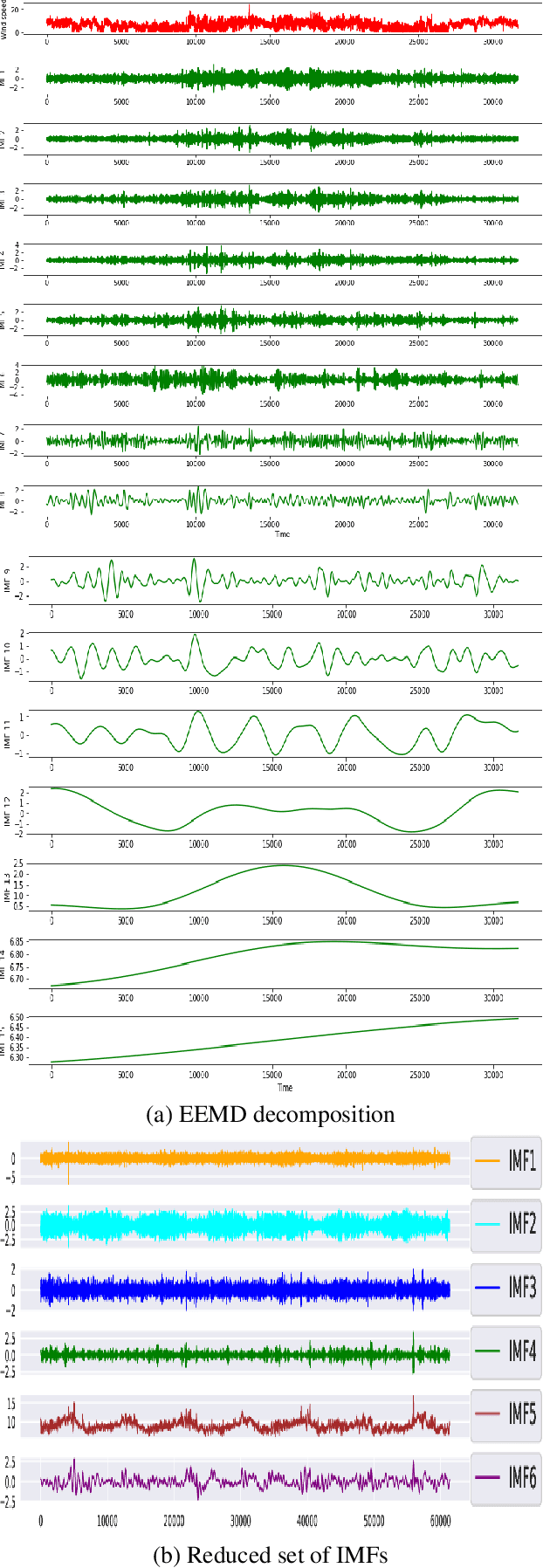

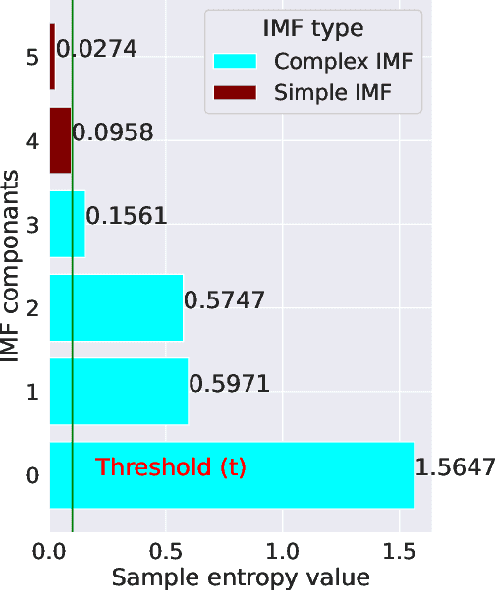
Wind flow can be highly unpredictable and can suffer substantial fluctuations in speed and direction due to the shape and height of hills, mountains, and valleys, making accurate wind speed (WS) forecasting essential in complex terrain. This paper presents a novel and adaptive model for short-term forecasting of WS. The paper's key contributions are as follows: (a) The Partial Auto Correlation Function (PACF) is utilised to minimise the dimension of the set of Intrinsic Mode Functions (IMF), hence reducing training time; (b) The sample entropy (SampEn) was used to calculate the complexity of the reduced set of IMFs. The proposed technique is adaptive since a specific Deep Learning (DL) model-feature combination was chosen based on complexity; (c) A novel bidirectional feature-LSTM framework for complicated IMFs has been suggested, resulting in improved forecasting accuracy; (d) The proposed model shows superior forecasting performance compared to the persistence, hybrid, Ensemble empirical mode decomposition (EEMD), and Variational Mode Decomposition (VMD)-based deep learning models. It has achieved the lowest variance in terms of forecasting accuracy between simple and complex terrain conditions 0.70%. Dimension reduction of IMF's and complexity-based model-feature selection helps reduce the training time by 68.77% and improve forecasting quality by 58.58% on average.
Enhancing Electrocardiogram Signal Analysis Using NLP-Inspired Techniques: A Novel Approach with Embedding and Self-Attention
Jul 15, 2024A language is made up of an infinite/finite number of sentences, which in turn is composed of a number of words. The Electrocardiogram (ECG) is the most popular noninvasive medical tool for studying heart function and diagnosing various irregular cardiac rhythms. Intuitive inspection of the ECG reveals a marked similarity between ECG signals and the spoken language. As a result, the ECG signal may be thought of as a series of heartbeats (similar to sentences in a spoken language), with each heartbeat consisting of a collection of waves (similar to words in a sentence) with varying morphologies. Just as natural language processing (NLP) is used to help computers comprehend and interpret human natural language, it is conceivable to create NLP-inspired algorithms to help computers comprehend the electrocardiogram data more efficiently. In this study, we propose a novel ECG analysis technique, based on embedding and self attention, to capture the spatial as well as the temporal dependencies of the ECG data. To generate the embedding, an encoder-decoder network was proposed to capture the temporal dependencies of the ECG signal and perform data compression. The compressed and encoded data was fed to the embedding layer as its weights. Finally, the proposed CNN-LSTM-Self Attention classifier works on the embedding layer and classifies the signal as normal or anomalous. The approach was tested using the PTB-xl dataset, which is severely imbalanced. Our emphasis was to appropriately recognise the disease classes present in minority numbers, in order to limit the detection of False Negative cases. An accuracy of 91% was achieved with a good F1-score for all the disease classes. Additionally, the the size of the model was reduced by 34% due to compression, making it suitable for deployment in real time applications
TexIm FAST: Text-to-Image Representation for Semantic Similarity Evaluation using Transformers
Jun 06, 2024One of the principal objectives of Natural Language Processing (NLP) is to generate meaningful representations from text. Improving the informativeness of the representations has led to a tremendous rise in the dimensionality and the memory footprint. It leads to a cascading effect amplifying the complexity of the downstream model by increasing its parameters. The available techniques cannot be applied to cross-modal applications such as text-to-image. To ameliorate these issues, a novel Text-to-Image methodology for generating fixed-length representations through a self-supervised Variational Auto-Encoder (VAE) for semantic evaluation applying transformers (TexIm FAST) has been proposed in this paper. The pictorial representations allow oblivious inference while retaining the linguistic intricacies, and are potent in cross-modal applications. TexIm FAST deals with variable-length sequences and generates fixed-length representations with over 75% reduced memory footprint. It enhances the efficiency of the models for downstream tasks by reducing its parameters. The efficacy of TexIm FAST has been extensively analyzed for the task of Semantic Textual Similarity (STS) upon the MSRPC, CNN/ Daily Mail, and XSum data-sets. The results demonstrate 6% improvement in accuracy compared to the baseline and showcase its exceptional ability to compare disparate length sequences such as a text with its summary.
Lumbar Spine Tumor Segmentation and Localization in T2 MRI Images Using AI
May 07, 2024


In medical imaging, segmentation and localization of spinal tumors in three-dimensional (3D) space pose significant computational challenges, primarily stemming from limited data availability. In response, this study introduces a novel data augmentation technique, aimed at automating spine tumor segmentation and localization through AI approaches. Leveraging a fusion of fuzzy c-means clustering and Random Forest algorithms, the proposed method achieves successful spine tumor segmentation based on predefined masks initially delineated by domain experts in medical imaging. Subsequently, a Convolutional Neural Network (CNN) architecture is employed for tumor classification. Moreover, 3D vertebral segmentation and labeling techniques are used to help pinpoint the exact location of the tumors in the lumbar spine. Results indicate a remarkable performance, with 99% accuracy for tumor segmentation, 98% accuracy for tumor classification, and 99% accuracy for tumor localization achieved with the proposed approach. These metrics surpass the efficacy of existing state-of-the-art techniques, as evidenced by superior Dice Score, Class Accuracy, and Intersection over Union (IOU) on class accuracy metrics. This innovative methodology holds promise for enhancing the diagnostic capabilities in detecting and characterizing spinal tumors, thereby facilitating more effective clinical decision-making.