 Add to Chrome
 Add to Firefox
 Add to Edge
What makes a word hard to learn? Modeling L1 influence on English vocabulary difficulty
May 12, 2026
What makes a word difficult to learn, and how does the difficulty depend on the learner's native language? We computationally model vocabulary difficulty for English learners whose first language is Spanish, German, or Chinese with gradient-boosted models trained on features related to a word's familiarity (e.g., frequency), meaning, surface form, and cross-linguistic transfer. Using Shapley values, we determine the importance of each feature group. Word familiarity is the dominant feature group shared by all three languages. However, predictions for Spanish- and German-speaking learners rely additionally on orthographic transfer. This transfer mechanism is unavailable to Chinese learners, whose difficulty is shaped by a combination of familiarity and surface features alone. Our models provide interpretable, L1-tailored difficulty estimates that can be used to design vocabulary curricula.

Vocabulary shapes cross-lingual variation of word-order learnability in language models
Mar 19, 2026Why do some languages like Czech permit free word order, while others like English do not? We address this question by pretraining transformer language models on a spectrum of synthetic word-order variants of natural languages. We observe that greater word-order irregularity consistently raises model surprisal, indicating reduced learnability. Sentence reversal, however, affects learnability only weakly. A coarse distinction of free- (e.g., Czech and Finnish) and fixed-word-order languages (e.g., English and French) does not explain cross-lingual variation. Instead, the structure of the word and subword vocabulary strongly predicts the model surprisal. Overall, vocabulary structure emerges as a key driver of computational word-order learnability across languages.
Once Upon a Time: Interactive Learning for Storytelling with Small Language Models
Sep 19, 2025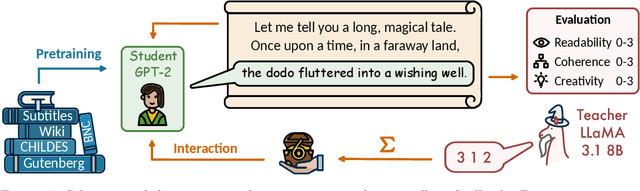
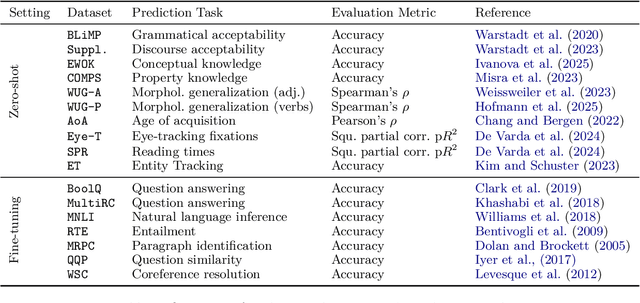
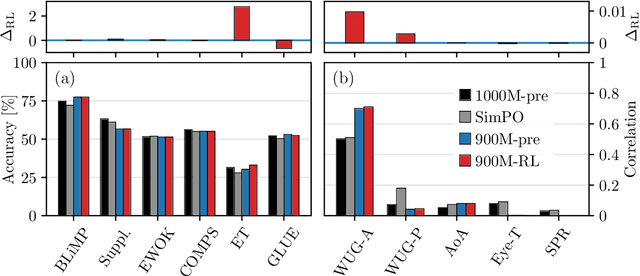
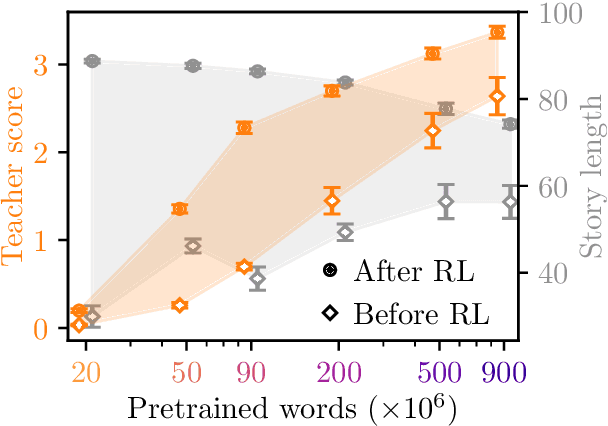
Children efficiently acquire language not just by listening, but by interacting with others in their social environment. Conversely, large language models are typically trained with next-word prediction on massive amounts of text. Motivated by this contrast, we investigate whether language models can be trained with less data by learning not only from next-word prediction but also from high-level, cognitively inspired feedback. We train a student model to generate stories, which a teacher model rates on readability, narrative coherence, and creativity. By varying the amount of pretraining before the feedback loop, we assess the impact of this interactive learning on formal and functional linguistic competence. We find that the high-level feedback is highly data efficient: With just 1 M words of input in interactive learning, storytelling skills can improve as much as with 410 M words of next-word prediction.