 Add to Chrome
 Add to Firefox
 Add to Edge
Domain-Adaptation through Synthetic Data: Fine-Tuning Large Language Models for German Law
Jan 20, 2026
Large language models (LLMs) often struggle in specialized domains such as legal reasoning due to limited expert knowledge, resulting in factually incorrect outputs or hallucinations. This paper presents an effective method for adapting advanced LLMs to German legal question answering through a novel synthetic data generation approach. In contrast to costly human-annotated resources or unreliable synthetic alternatives, our approach systematically produces high-quality, diverse, and legally accurate question-answer pairs directly from authoritative German statutes. Using rigorous automated filtering methods and parameter-efficient fine-tuning techniques, we demonstrate that LLMs adapted with our synthetic dataset significantly outperform their baseline counterparts on German legal question answering tasks. Our results highlight the feasibility of using carefully designed synthetic data as a robust alternative to manual annotation in high-stakes, knowledge-intensive domains.

Once Upon a Time: Interactive Learning for Storytelling with Small Language Models
Sep 19, 2025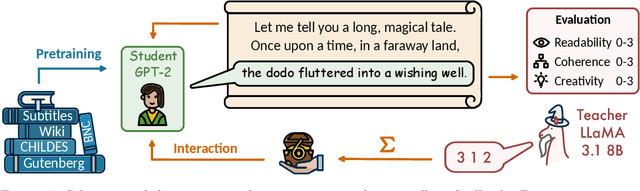
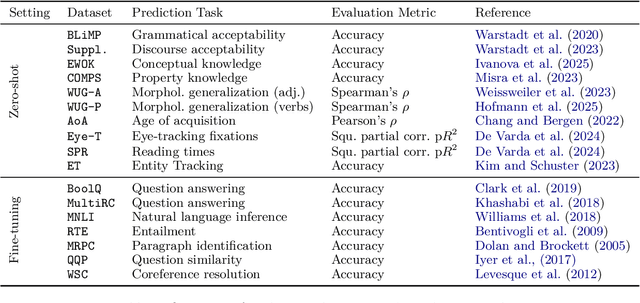
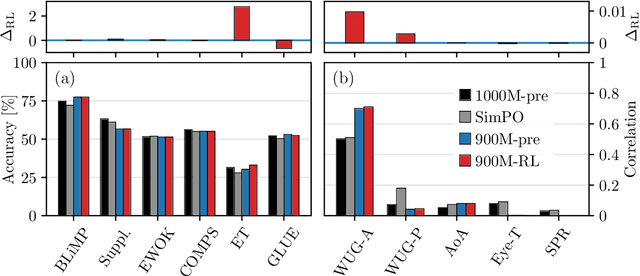
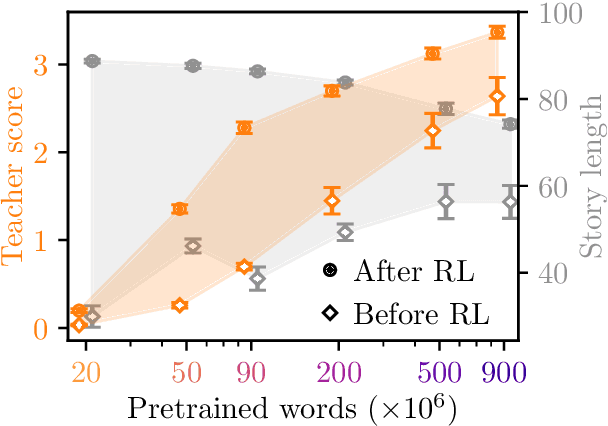
Children efficiently acquire language not just by listening, but by interacting with others in their social environment. Conversely, large language models are typically trained with next-word prediction on massive amounts of text. Motivated by this contrast, we investigate whether language models can be trained with less data by learning not only from next-word prediction but also from high-level, cognitively inspired feedback. We train a student model to generate stories, which a teacher model rates on readability, narrative coherence, and creativity. By varying the amount of pretraining before the feedback loop, we assess the impact of this interactive learning on formal and functional linguistic competence. We find that the high-level feedback is highly data efficient: With just 1 M words of input in interactive learning, storytelling skills can improve as much as with 410 M words of next-word prediction.