 Add to Chrome
 Add to Firefox
 Add to Edge
MomaGraph: State-Aware Unified Scene Graphs with Vision-Language Model for Embodied Task Planning
Dec 18, 2025
Mobile manipulators in households must both navigate and manipulate. This requires a compact, semantically rich scene representation that captures where objects are, how they function, and which parts are actionable. Scene graphs are a natural choice, yet prior work often separates spatial and functional relations, treats scenes as static snapshots without object states or temporal updates, and overlooks information most relevant for accomplishing the current task. To address these limitations, we introduce MomaGraph, a unified scene representation for embodied agents that integrates spatial-functional relationships and part-level interactive elements. However, advancing such a representation requires both suitable data and rigorous evaluation, which have been largely missing. We thus contribute MomaGraph-Scenes, the first large-scale dataset of richly annotated, task-driven scene graphs in household environments, along with MomaGraph-Bench, a systematic evaluation suite spanning six reasoning capabilities from high-level planning to fine-grained scene understanding. Built upon this foundation, we further develop MomaGraph-R1, a 7B vision-language model trained with reinforcement learning on MomaGraph-Scenes. MomaGraph-R1 predicts task-oriented scene graphs and serves as a zero-shot task planner under a Graph-then-Plan framework. Extensive experiments demonstrate that our model achieves state-of-the-art results among open-source models, reaching 71.6% accuracy on the benchmark (+11.4% over the best baseline), while generalizing across public benchmarks and transferring effectively to real-robot experiments.

Reasoning and Tools for Human-Level Forecasting
Aug 21, 2024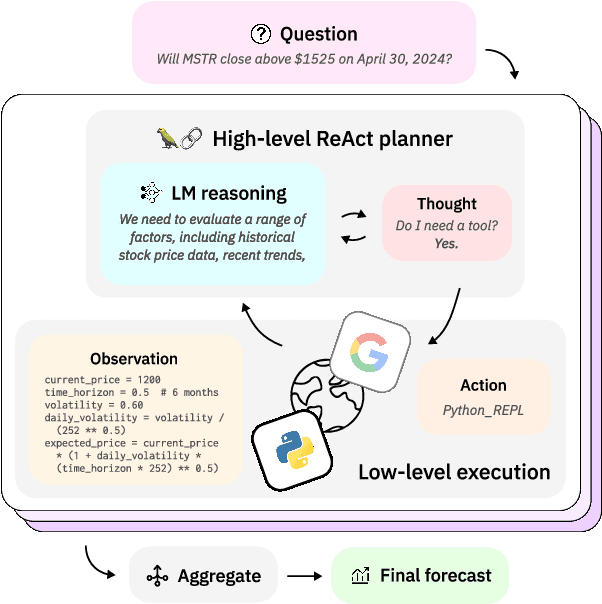
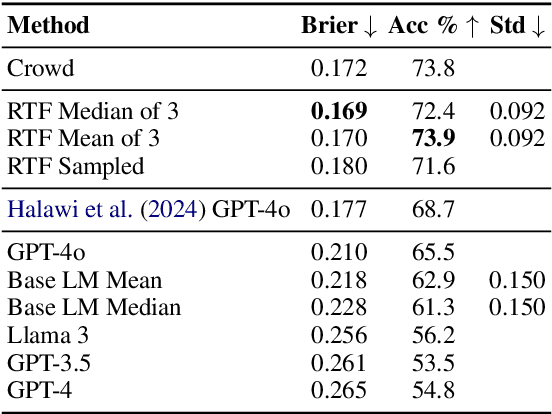
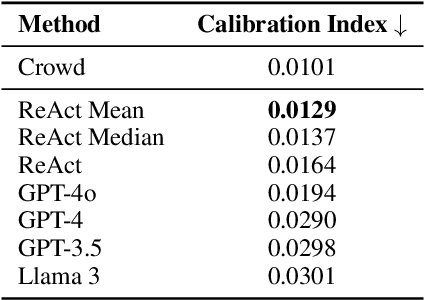
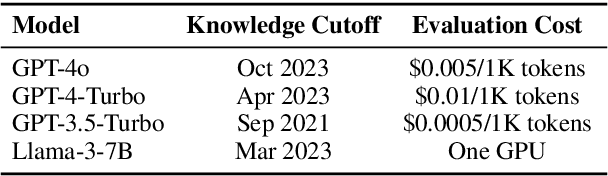
Language models (LMs) trained on web-scale datasets are largely successful due to their ability to memorize large amounts of training data, even if only present in a few examples. These capabilities are often desirable in evaluation on tasks such as question answering but raise questions about whether these models can exhibit genuine reasoning or succeed only at mimicking patterns from the training data. This distinction is particularly salient in forecasting tasks, where the answer is not present in the training data, and the model must reason to make logical deductions. We present Reasoning and Tools for Forecasting (RTF), a framework of reasoning-and-acting (ReAct) agents that can dynamically retrieve updated information and run numerical simulation with equipped tools. We evaluate our model with questions from competitive forecasting platforms and demonstrate that our method is competitive with and can outperform human predictions. This suggests that LMs, with the right tools, can indeed think and adapt like humans, offering valuable insights for real-world decision-making.
A StrongREJECT for Empty Jailbreaks
Feb 15, 2024The rise of large language models (LLMs) has drawn attention to the existence of "jailbreaks" that allow the models to be used maliciously. However, there is no standard benchmark for measuring the severity of a jailbreak, leaving authors of jailbreak papers to create their own. We show that these benchmarks often include vague or unanswerable questions and use grading criteria that are biased towards overestimating the misuse potential of low-quality model responses. Some jailbreak techniques make the problem worse by decreasing the quality of model responses even on benign questions: we show that several jailbreaking techniques substantially reduce the zero-shot performance of GPT-4 on MMLU. Jailbreaks can also make it harder to elicit harmful responses from an "uncensored" open-source model. We present a new benchmark, StrongREJECT, which better discriminates between effective and ineffective jailbreaks by using a higher-quality question set and a more accurate response grading algorithm. We show that our new grading scheme better accords with human judgment of response quality and overall jailbreak effectiveness, especially on the sort of low-quality responses that contribute the most to over-estimation of jailbreak performance on existing benchmarks. We release our code and data at https://github.com/alexandrasouly/strongreject.