 Add to Chrome
 Add to Firefox
 Add to Edge
PhaseFlow4D: Physically Constrained 4D Beam Reconstruction via Feedback-Guided Latent Diffusion
Apr 07, 2026
We address the problem of recovering a time-varying 4D distribution from a sparse sequence of 2D projections - analogous to novel-view synthesis from sparse cameras, but applied to the 4D transverse phase space density $ρ(x,p_x,y,p_y)$ of charged particle beams. Direct single shot measurement of this high-dimensional distribution is physically impossible in real particle accelerator systems; only limited 1D or 2D projections are accessible. We propose PhaseFlow4D, a feedback-guided latent diffusion model that reconstructs and tracks the full 4D phase space from incomplete 2D observations alone, with built-in hard physics constraints. Our core technical contribution is a 4D VAE whose decoder generates the full 4D phase space tensor, from which 2D projections are analytically computed and compared against 2D beam measurements. This projection-consistency constraint guarantees physical correctness by construction - not as a soft penalty, but as an architectural prior. An adaptive feedback loop then continuously tunes the conditioning vector of the latent diffusion model to track time-varying distributions online without retraining. We validate on multi-particle simulations of heavy-ion beams at the Facility for Rare Isotope Beams (FRIB), where full physics simulations require $\sim$6 hours on a 100-core HPC system. PhaseFlow4D achieves accurate 4D reconstructions 11000$\times$ faster while faithfully tracking distribution shifts under time-varying source conditions - demonstrating that principled generative reconstruction under incomplete observations transfers robustly beyond visual domains.

Prior-mean-assisted Bayesian optimization application on FRIB Front-End tunning
Nov 11, 2022Bayesian optimization~(BO) is often used for accelerator tuning due to its high sample efficiency. However, the computational scalability of training over large data-set can be problematic and the adoption of historical data in a computationally efficient way is not trivial. Here, we exploit a neural network model trained over historical data as a prior mean of BO for FRIB Front-End tuning.
Artificial Intelligence and Machine Learning in Nuclear Physics
Dec 04, 2021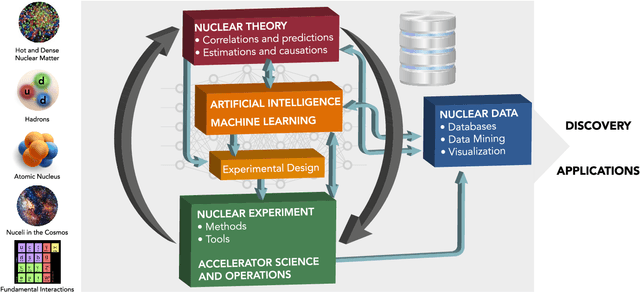
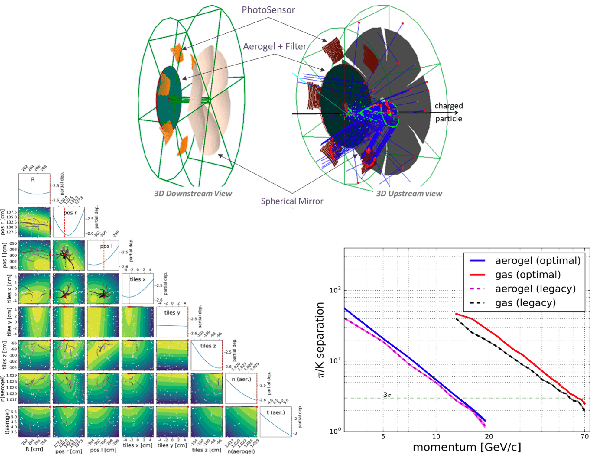
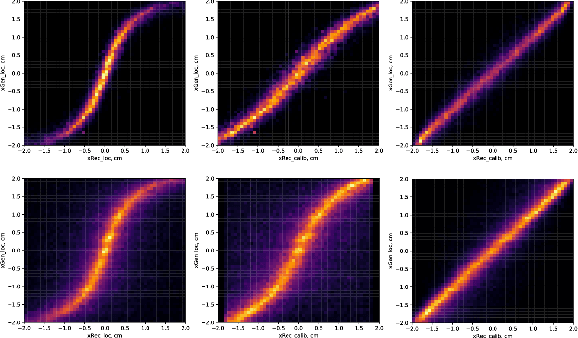
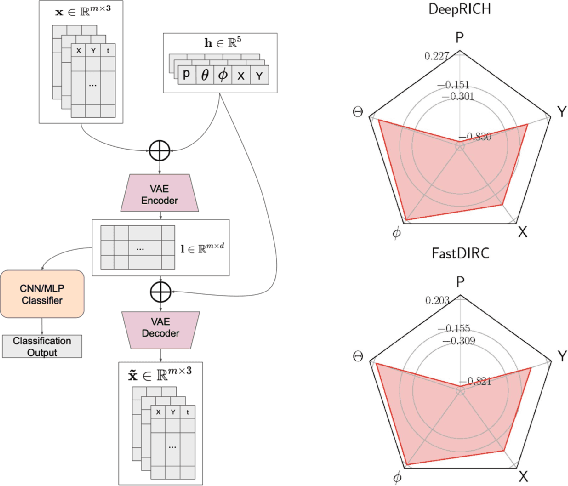
Advances in artificial intelligence/machine learning methods provide tools that have broad applicability in scientific research. These techniques are being applied across the diversity of nuclear physics research topics, leading to advances that will facilitate scientific discoveries and societal applications. This Review gives a snapshot of nuclear physics research which has been transformed by artificial intelligence and machine learning techniques.