 Add to Chrome
 Add to Firefox
 Add to Edge
GFlowState: Visualizing the Training of Generative Flow Networks Beyond the Reward
Apr 23, 2026
We present GFlowState, a visual analytics system designed to illuminate the training process of Generative Flow Networks (GFlowNets or GFNs). GFlowNets are a probabilistic framework for generating samples proportionally to a reward function. While GFlowNets have proved to be powerful tools in applications such as molecule and material discovery, their training dynamics remain difficult to interpret. Standard machine learning tools allow metric tracking but do not reveal how models explore the sample space, construct sample trajectories, or shift sampling probabilities during training. Our solution, GFlowState, allows users to analyze sampling trajectories, compare the sample space relative to reference datasets, and analyze the training dynamics. To this end, we introduce multiple views, including a chart of candidate rankings, a state projection, a node-link diagram of the trajectory network, and a transition heatmap. These visualizations enable GFlowNet developers and users to investigate sampling behavior and policy evolution, and to identify underexplored regions and sources of training failure. Case studies demonstrate how the system supports debugging and assessing the quality of GFlowNets across application domains. By making the structural dynamics of GFlowNets observable, our work enhances their interpretability and can accelerate GFlowNet development in practice.

The implicated scientist: on the role of AI researchers in the development of weapons systems
Apr 20, 2026Artificial intelligence (AI) technologies are increasingly used in modern weapons systems. Notably, these systems have recently been involved in mass killings and destruction at scale. Furthermore, there is currently a strong interest and competition among powerful players to accelerate the proliferation of weapons with automated or AI-based components, a phenomenon known as AI arms race. This competition poses a risk of causing even more deaths and devastation in the future, as well as increased power and wealth inequality. In this work, we aim to shed light on the role of AI researchers as implicated subjects in the harms caused by weapons enabled by AI technologies. We investigate and discuss the specifics of this implication and explore ways to transfigure this position of implication into one of differentiated, long-distance solidarity with the victims of technologically fortified injustices.
Synthesizable Molecular Generation via Soft-constrained GFlowNets with Rich Chemical Priors
Feb 04, 2026The application of generative models for experimental drug discovery campaigns is severely limited by the difficulty of designing molecules de novo that can be synthesized in practice. Previous works have leveraged Generative Flow Networks (GFlowNets) to impose hard synthesizability constraints through the design of state and action spaces based on predefined reaction templates and building blocks. Despite the promising prospects of this approach, it currently lacks flexibility and scalability. As an alternative, we propose S3-GFN, which generates synthesizable SMILES molecules via simple soft regularization of a sequence-based GFlowNet. Our approach leverages rich molecular priors learned from large-scale SMILES corpora to steer molecular generation towards high-reward, synthesizable chemical spaces. The model induces constraints through off-policy replay training with a contrastive learning signal based on separate buffers of synthesizable and unsynthesizable samples. Our experiments show that S3-GFN learns to generate synthesizable molecules ($\geq 95\%$) with higher rewards in diverse tasks.
Catalyst GFlowNet for electrocatalyst design: A hydrogen evolution reaction case study
Oct 02, 2025Efficient and inexpensive energy storage is essential for accelerating the adoption of renewable energy and ensuring a stable supply, despite fluctuations in sources such as wind and solar. Electrocatalysts play a key role in hydrogen energy storage (HES), allowing the energy to be stored as hydrogen. However, the development of affordable and high-performance catalysts for this process remains a significant challenge. We introduce Catalyst GFlowNet, a generative model that leverages machine learning-based predictors of formation and adsorption energy to design crystal surfaces that act as efficient catalysts. We demonstrate the performance of the model through a proof-of-concept application to the hydrogen evolution reaction, a key reaction in HES, for which we successfully identified platinum as the most efficient known catalyst. In future work, we aim to extend this approach to the oxygen evolution reaction, where current optimal catalysts are expensive metal oxides, and open the search space to discover new materials. This generative modeling framework offers a promising pathway for accelerating the search for novel and efficient catalysts.
Torsional-GFN: a conditional conformation generator for small molecules
Jul 15, 2025Generating stable molecular conformations is crucial in several drug discovery applications, such as estimating the binding affinity of a molecule to a target. Recently, generative machine learning methods have emerged as a promising, more efficient method than molecular dynamics for sampling of conformations from the Boltzmann distribution. In this paper, we introduce Torsional-GFN, a conditional GFlowNet specifically designed to sample conformations of molecules proportionally to their Boltzmann distribution, using only a reward function as training signal. Conditioned on a molecular graph and its local structure (bond lengths and angles), Torsional-GFN samples rotations of its torsion angles. Our results demonstrate that Torsional-GFN is able to sample conformations approximately proportional to the Boltzmann distribution for multiple molecules with a single model, and allows for zero-shot generalization to unseen bond lengths and angles coming from the MD simulations for such molecules. Our work presents a promising avenue for scaling the proposed approach to larger molecular systems, achieving zero-shot generalization to unseen molecules, and including the generation of the local structure into the GFlowNet model.
Learning Decision Trees as Amortized Structure Inference
Mar 10, 2025Building predictive models for tabular data presents fundamental challenges, notably in scaling consistently, i.e., more resources translating to better performance, and generalizing systematically beyond the training data distribution. Designing decision tree models remains especially challenging given the intractably large search space, and most existing methods rely on greedy heuristics, while deep learning inductive biases expect a temporal or spatial structure not naturally present in tabular data. We propose a hybrid amortized structure inference approach to learn predictive decision tree ensembles given data, formulating decision tree construction as a sequential planning problem. We train a deep reinforcement learning (GFlowNet) policy to solve this problem, yielding a generative model that samples decision trees from the Bayesian posterior. We show that our approach, DT-GFN, outperforms state-of-the-art decision tree and deep learning methods on standard classification benchmarks derived from real-world data, robustness to distribution shifts, and anomaly detection, all while yielding interpretable models with shorter description lengths. Samples from the trained DT-GFN model can be ensembled to construct a random forest, and we further show that the performance of scales consistently in ensemble size, yielding ensembles of predictors that continue to generalize systematically.
On the importance of catalyst-adsorbate 3D interactions for relaxed energy predictions
Oct 10, 2023The use of machine learning for material property prediction and discovery has traditionally centered on graph neural networks that incorporate the geometric configuration of all atoms. However, in practice not all this information may be readily available, e.g.~when evaluating the potentially unknown binding of adsorbates to catalyst. In this paper, we investigate whether it is possible to predict a system's relaxed energy in the OC20 dataset while ignoring the relative position of the adsorbate with respect to the electro-catalyst. We consider SchNet, DimeNet++ and FAENet as base architectures and measure the impact of four modifications on model performance: removing edges in the input graph, pooling independent representations, not sharing the backbone weights and using an attention mechanism to propagate non-geometric relative information. We find that while removing binding site information impairs accuracy as expected, modified models are able to predict relaxed energies with remarkably decent MAE. Our work suggests future research directions in accelerated materials discovery where information on reactant configurations can be reduced or altogether omitted.
Crystal-GFN: sampling crystals with desirable properties and constraints
Oct 07, 2023Accelerating material discovery holds the potential to greatly help mitigate the climate crisis. Discovering new solid-state crystals such as electrocatalysts, ionic conductors or photovoltaics can have a crucial impact, for instance, in improving the efficiency of renewable energy production and storage. In this paper, we introduce Crystal-GFlowNet, a generative model of crystal structures that sequentially samples a crystal's composition, space group and lattice parameters. This domain-inspired approach enables the flexible incorporation of physical and geometrical constraints, as well as the use of any available predictive model of a desired property as an objective function. We evaluate the capabilities of Crystal-GFlowNet by using as objective the formation energy of a crystal structure, as predicted by a new proxy model trained on MatBench. The results demonstrate that Crystal-GFlowNet is able to sample diverse crystals with low formation energy.
Multi-Fidelity Active Learning with GFlowNets
Jun 20, 2023In the last decades, the capacity to generate large amounts of data in science and engineering applications has been growing steadily. Meanwhile, the progress in machine learning has turned it into a suitable tool to process and utilise the available data. Nonetheless, many relevant scientific and engineering problems present challenges where current machine learning methods cannot yet efficiently leverage the available data and resources. For example, in scientific discovery, we are often faced with the problem of exploring very large, high-dimensional spaces, where querying a high fidelity, black-box objective function is very expensive. Progress in machine learning methods that can efficiently tackle such problems would help accelerate currently crucial areas such as drug and materials discovery. In this paper, we propose the use of GFlowNets for multi-fidelity active learning, where multiple approximations of the black-box function are available at lower fidelity and cost. GFlowNets are recently proposed methods for amortised probabilistic inference that have proven efficient for exploring large, high-dimensional spaces and can hence be practical in the multi-fidelity setting too. Here, we describe our algorithm for multi-fidelity active learning with GFlowNets and evaluate its performance in both well-studied synthetic tasks and practically relevant applications of molecular discovery. Our results show that multi-fidelity active learning with GFlowNets can efficiently leverage the availability of multiple oracles with different costs and fidelities to accelerate scientific discovery and engineering design.
Fourier Neural Operators for Arbitrary Resolution Climate Data Downscaling
May 23, 2023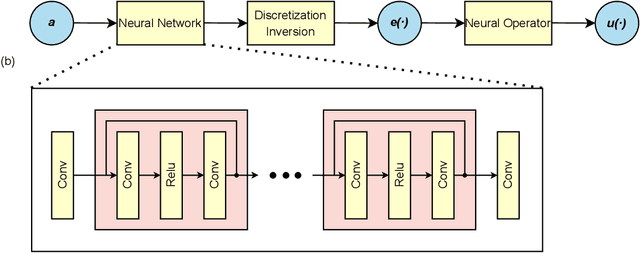
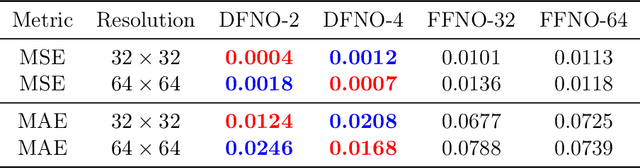
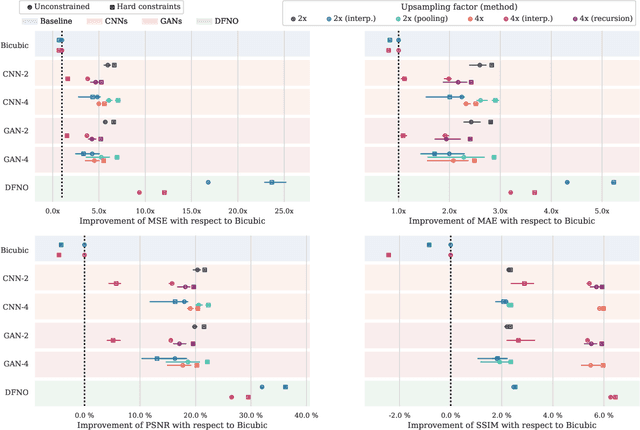
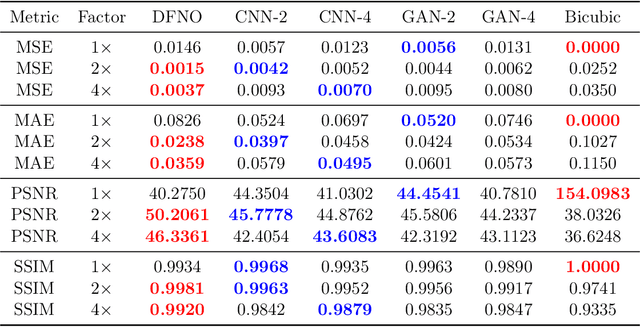
Climate simulations are essential in guiding our understanding of climate change and responding to its effects. However, it is computationally expensive to resolve complex climate processes at high spatial resolution. As one way to speed up climate simulations, neural networks have been used to downscale climate variables from fast-running low-resolution simulations, but high-resolution training data are often unobtainable or scarce, greatly limiting accuracy. In this work, we propose a downscaling method based on the Fourier neural operator. It trains with data of a small upsampling factor and then can zero-shot downscale its input to arbitrary unseen high resolution. Evaluated both on ERA5 climate model data and on the Navier-Stokes equation solution data, our downscaling model significantly outperforms state-of-the-art convolutional and generative adversarial downscaling models, both in standard single-resolution downscaling and in zero-shot generalization to higher upsampling factors. Furthermore, we show that our method also outperforms state-of-the-art data-driven partial differential equation solvers on Navier-Stokes equations. Overall, our work bridges the gap between simulation of a physical process and interpolation of low-resolution output, showing that it is possible to combine both approaches and significantly improve upon each other.