 Add to Chrome
 Add to Firefox
 Add to Edge
Atompack: A Storage and Distribution Layer for Read-Heavy Atomistic ML Training Datasets
Jun 29, 2026
Atomistic machine learning datasets are increasingly used for training: large immutable snapshots are read repeatedly, shuffled across epochs, staged across clusters' storage systems, and republished as reusable scientific artifacts. This workload differs from interactive scientific curation, where mutable records and ad hoc inspection are often more important than random indexed throughput. We present Atompack, an append-oriented storage format and distribution layer designed around a simple workload: training pipelines usually consume complete molecular records, while the order of records is randomized by the learning algorithm. Atompack appends records efficiently during dataset construction, then commits an immutable index and serves records through a memory-mapped read path optimized for training. We compare Atompack with HDF5, LMDB, and ASE baselines representing array stores, key-value records, serialized records, and object-oriented databases. The benchmarks measure sequential reads, shuffled reads, shared-filesystem behavior, write throughput, and artifact size. On a representative 64-atom workload, Atompack is 96x faster than ASE LMDB on shuffled training-style reads while producing artifacts about 79\% smaller. The results indicate that serving complete molecule records, rather than field chunks or reconstructed objects, improves shuffled training throughput while keeping artifacts compact enough for public distribution.

TriForces: Augmenting Atomistic GNNs for Transferable Representations
May 20, 2026Machine learning interatomic potentials (MLIPs) achieve excellent accuracy when trained on large Density Functional Theory (DFT) data. To be useful in practice, they must often be adapted to target chemistries using small and expensive task-specific datasets. However, MLIPs transfer inconsistently across domains, with representations that often loose accessible composition and structure information. To address this, we present TriForces, a model-agnostic three-stream framework that separates composition and structure information, combined with self-supervised learning to preserve transferable representations. TriForces improves performance on MatBench and QM9 over baselines without needing DFT labels and enables efficient similar structure retrieval through its learned latent space. On OMat24, in limited-data training regime, TriForces reduces energy MAE by 57% at 20K samples only and improves force MAE across sample sizes. We release pretrained TriForces variants across multiple MLIP architectures with code at https://github.com/Ramlaoui/triforces.
Catalyst GFlowNet for electrocatalyst design: A hydrogen evolution reaction case study
Oct 02, 2025Efficient and inexpensive energy storage is essential for accelerating the adoption of renewable energy and ensuring a stable supply, despite fluctuations in sources such as wind and solar. Electrocatalysts play a key role in hydrogen energy storage (HES), allowing the energy to be stored as hydrogen. However, the development of affordable and high-performance catalysts for this process remains a significant challenge. We introduce Catalyst GFlowNet, a generative model that leverages machine learning-based predictors of formation and adsorption energy to design crystal surfaces that act as efficient catalysts. We demonstrate the performance of the model through a proof-of-concept application to the hydrogen evolution reaction, a key reaction in HES, for which we successfully identified platinum as the most efficient known catalyst. In future work, we aim to extend this approach to the oxygen evolution reaction, where current optimal catalysts are expensive metal oxides, and open the search space to discover new materials. This generative modeling framework offers a promising pathway for accelerating the search for novel and efficient catalysts.
LeMat-Traj: A Scalable and Unified Dataset of Materials Trajectories for Atomistic Modeling
Aug 28, 2025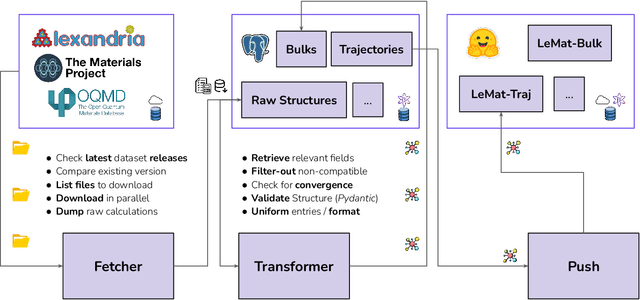
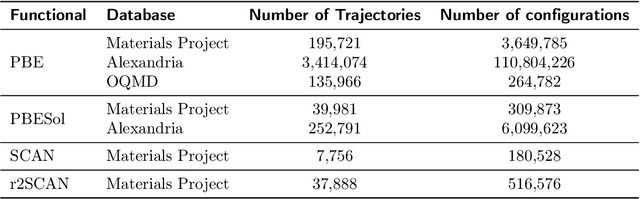
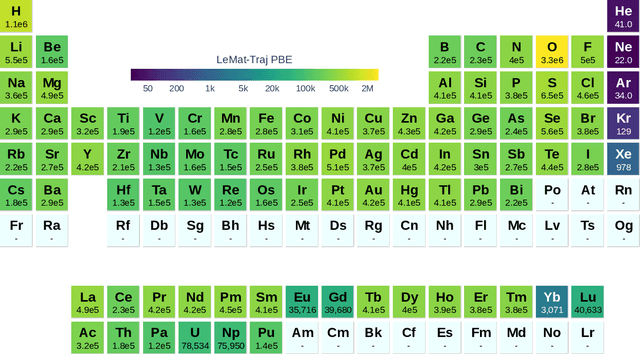

The development of accurate machine learning interatomic potentials (MLIPs) is limited by the fragmented availability and inconsistent formatting of quantum mechanical trajectory datasets derived from Density Functional Theory (DFT). These datasets are expensive to generate yet difficult to combine due to variations in format, metadata, and accessibility. To address this, we introduce LeMat-Traj, a curated dataset comprising over 120 million atomic configurations aggregated from large-scale repositories, including the Materials Project, Alexandria, and OQMD. LeMat-Traj standardizes data representation, harmonizes results and filters for high-quality configurations across widely used DFT functionals (PBE, PBESol, SCAN, r2SCAN). It significantly lowers the barrier for training transferrable and accurate MLIPs. LeMat-Traj spans both relaxed low-energy states and high-energy, high-force structures, complementing molecular dynamics and active learning datasets. By fine-tuning models pre-trained on high-force data with LeMat-Traj, we achieve a significant reduction in force prediction errors on relaxation tasks. We also present LeMaterial-Fetcher, a modular and extensible open-source library developed for this work, designed to provide a reproducible framework for the community to easily incorporate new data sources and ensure the continued evolution of large-scale materials datasets. LeMat-Traj and LeMaterial-Fetcher are publicly available at https://huggingface.co/datasets/LeMaterial/LeMat-Traj and https://github.com/LeMaterial/lematerial-fetcher.
Improving Molecular Modeling with Geometric GNNs: an Empirical Study
Jul 11, 2024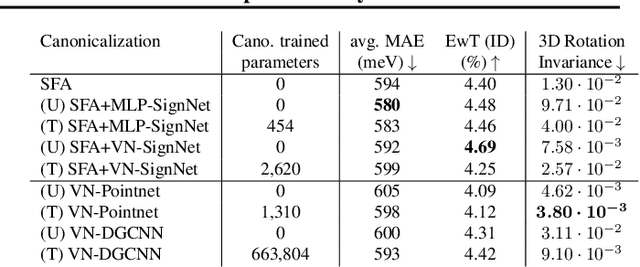
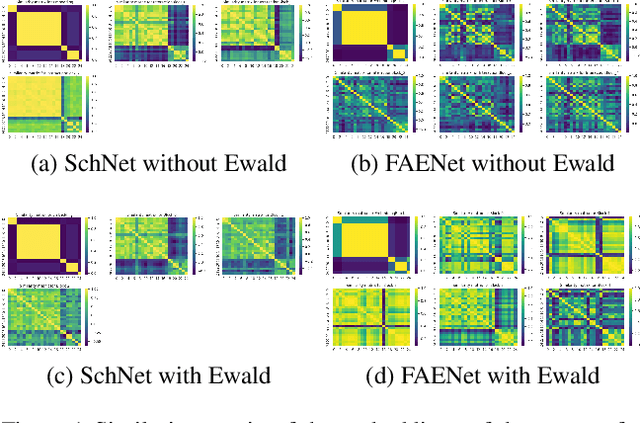
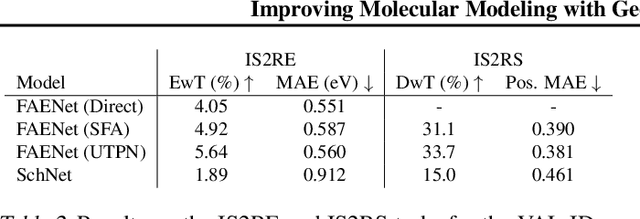
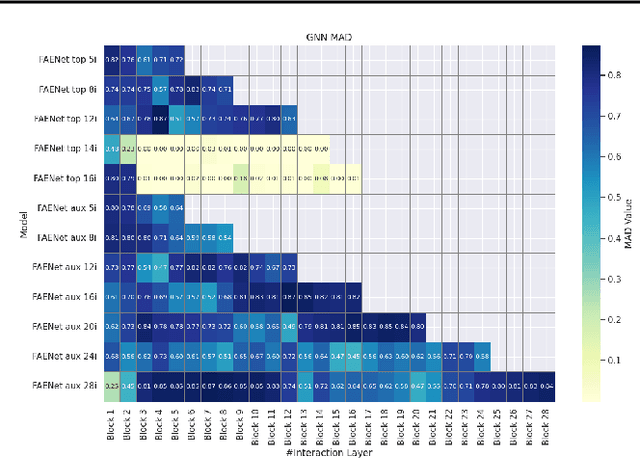
Rapid advancements in machine learning (ML) are transforming materials science by significantly speeding up material property calculations. However, the proliferation of ML approaches has made it challenging for scientists to keep up with the most promising techniques. This paper presents an empirical study on Geometric Graph Neural Networks for 3D atomic systems, focusing on the impact of different (1) canonicalization methods, (2) graph creation strategies, and (3) auxiliary tasks, on performance, scalability and symmetry enforcement. Our findings and insights aim to guide researchers in selecting optimal modeling components for molecular modeling tasks.