 Add to Chrome
 Add to Firefox
 Add to Edge
TREK: Distill to Explore, Reinforce to Refine
Jul 06, 2026
Group Relative Policy Optimization (GRPO) is effective when the current policy already samples useful reasoning trajectories, but it stalls on hard prompts whose correct solution modes lie outside the student's on-policy support. We propose TREK (Teacher-Routed Exploration via Forward KL), a simple staged procedure that uses distillation not for imitation but for exploration support expansion. A key advantage of TREK is its generality: because it only consumes verified output trajectories, it can use an external black-box teacher, a white-box teacher, or the same model given additional inference-time context, and it can efficiently identify which hard-prompt samples are most worth consolidating even when teacher internals are unavailable. TREK first identifies prompts where the unaided student has very low pass rate, queries a proposal source to produce verified candidate solutions, keeps the top-$r$ proposals ranked by current student likelihood, applies a short forward-KL phase to pull those verified modes into the student's support, and then returns to standard on-policy GRPO refinement. On mathematical reasoning, TREK with DeepSeek-V4 proposals improves Qwen3 models across all tested scales on AIME 2024 and AIME 2025; for Qwen3-8B, it improves AIME 2025 from 36.9 to 40.3 and AIME 2024 from 47.9 to 51.1 (avg@16), while the self-context variant reaches 38.5 and 49.6 without an external teacher. On agentic tasks, TREK raises ALFWorld success rate from 75.8 to 82.8 and ScienceWorld success rate from 12.5 to 26.7; notably, on the hardest task types, TREK achieves high success rates early in training while unaided GRPO requires substantially more optimization steps to reach comparable levels.

TRIAGE: Role-Typed Credit Assignment for Agentic Reinforcement Learning
Jun 30, 2026Agentic reinforcement learning requires assigning credit to environment-facing actions such as searches, clicks, edits, navigation commands, and object interactions. Standard GRPO uses the final verifier outcome as a uniform advantage over all action tokens. This outcome signal is useful but structurally incomplete: it punishes useful exploration in failed rollouts and reinforces redundant or regressive actions in successful rollouts. We propose TRIAGE, a role-typed credit assignment framework that adds a semantic role axis to outcome credit. A structured judge classifies each segment as decisive progress, useful exploration, no-progress infrastructure, or regression, and a fixed role-conditioned rule maps these labels to bounded segment-level process rewards. This keeps verifier outcomes as the source of optimization direction while correcting the two main blind spots of outcome-only credit. We further show that role-conditioned credit is the optimal segment-level correction expressible from role labels alone -- a projection of the per-segment advantage residual onto the role variable -- so that the fixed role constants reduce advantage estimation error whenever the judge is reliable, and we connect this to lower-variance policy gradients. Across ALFWorld, Search-QA, and WebShop, TRIAGE improves success rates over GRPO for two policy models and outperforms both a scalar judge-derived process reward and an outcome-supervised shared-backbone value baseline. Ablations show that the gain comes from role typing rather than merely adding dense rewards: reliable detection of regression inside successful trajectories is the dominant contributor, while exploration credit provides a consistent secondary gain; on completed ALFWorld and WebShop rollouts, TRIAGE also reduces environment-facing turns by an additional $10.4\%$ and $14.8\%$ relative to GRPO.
Beyond GRPO and On-Policy Distillation: An Empirical Sparse-to-Dense Reward Principle for Language-Model Post-Training
May 14, 2026When labeled verifiable training data is scarce, each checked example should be used where it has the most value. A common approach is to train the deployment student model directly with sparse RL methods such as GRPO. We argue that this is often inefficient. Sparse sequence-level reward is most useful for strong models that can explore and discover better behavior, while dense token-level teacher supervision is better suited for compressing that behavior into a smaller student. This suggests a simple allocation rule: use scarce labeled data upstream to improve the strongest available teacher, then transfer the improved behavior downstream through dense supervision. In this view, GRPO-style sparse RL and OPD-style distillation are not competing methods, but two reward-density regimes used at different stages. We evaluate this rule on verifiable math tasks with Qwen3 and Llama models. For a fixed Qwen3-1.7B deployment student, distilling from an RL-improved 8B teacher outperforms applying GRPO directly to the student with the same labeled data. In contrast, distilling from the same teacher before RL gives weaker results. The transfer bridge is also important: a forward-KL warmup on teacher rollouts followed by OPD on student rollouts performs best on MATH before any later student-side sparse RL, and gives the strongest pre-Stage 3 AIME results for the canonical 8B and 14B teachers. Finally, the bridge makes later student-side RL more effective. GRPO is weak when applied to a cold student, but after the bridge it raises MATH accuracy from 75.4% to 78.5%, outperforming a matched replay control by 2.8 points. Overall, the lesson is to avoid spending scarce labeled data on the least prepared policy: use sparse reward for teacher-side discovery, dense transfer for student compression, and student-side sparse reward only after the student has been bridged.
TIP: Token Importance in On-Policy Distillation
Apr 15, 2026On-policy knowledge distillation (OPD) trains a student on its own rollouts under token-level supervision from a teacher. Not all token positions matter equally, but existing views of token importance are incomplete. We ask a direct question: which tokens carry the most useful learning signal in OPD? Our answer is that informative tokens come from two regions: positions with high student entropy, and positions with low student entropy plus high teacher--student divergence, where the student is overconfident and wrong. Empirically, student entropy is a strong first-order proxy: retaining $50\%$ of tokens with entropy-based sampling matches or exceeds all-token training while reducing peak memory by up to $47\%$. But entropy alone misses a second important region. When we isolate low-entropy, high-divergence tokens, training on fewer than $10\%$ of all tokens nearly matches full-token baselines, showing that overconfident tokens carry dense corrective signal despite being nearly invisible to entropy-only rules. We organize these findings with TIP (Token Importance in on-Policy distillation), a two-axis taxonomy over student entropy and teacher--student divergence, and give a theoretical explanation for why entropy is useful yet structurally incomplete. This view motivates type-aware token selection rules that combine uncertainty and disagreement. We validate this picture across three teacher--student pairs spanning Qwen3, Llama, and Qwen2.5 on MATH-500 and AIME 2024/2025, and on the DeepPlanning benchmark for long-horizon agentic planning, where Q3-only training on $<$$20\%$ of tokens surpasses full-token OPD. Our experiments are implemented by extending the OPD repository https://github.com/HJSang/OPSD_OnPolicyDistillation, which supports memory-efficient distillation of larger models under limited GPU budgets.
Robust Batch-Level Query Routing for Large Language Models under Cost and Capacity Constraints
Mar 25, 2026We study the problem of routing queries to large language models (LLMs) under cost, GPU resources, and concurrency constraints. Prior per-query routing methods often fail to control batch-level cost, especially under non-uniform or adversarial batching. To address this, we propose a batch-level, resource-aware routing framework that jointly optimizes model assignment for each batch while respecting cost and model capacity limits. We further introduce a robust variant that accounts for uncertainty in predicted LLM performance, along with an offline instance allocation procedure that balances quality and throughput across multiple models. Experiments on two multi-task LLM benchmarks show that robustness improves accuracy by 1-14% over non-robust counterparts (depending on the performance estimator), batch-level routing outperforms per-query methods by up to 24% under adversarial batching, and optimized instance allocation yields additional gains of up to 3% compared to a non-optimized allocation, all while strictly controlling cost and GPU resource constraints.
PACED: Distillation and Self-Distillation at the Frontier of Student Competence
Mar 16, 2026Standard LLM distillation wastes compute on two fronts: problems the student has already mastered (near-zero gradients) and problems far beyond its reach (incoherent gradients that erode existing capabilities). We show that this waste is not merely intuitive but structurally inevitable: the gradient signal-to-noise ratio in distillation provably vanishes at both pass-rate extremes. This theoretical observation leads to Paced, a framework that concentrates distillation on the zone of proximal development -- the frontier of a student model's competence -- via a principled pass-rate weight $w(p) = p^α(1 - p)^β$ derived from the boundary-vanishing structure of distillation gradients. Key results: (1) Theory: We prove that the Beta kernel $w(p) = p^α(1-p)^β$ is a leading-order weight family arising from the SNR structure of distillation, and that it is minimax-robust -- under bounded multiplicative misspecification, worst-case efficiency loss is only $O(δ^2)$. (2)Distillation: On distillation from a larger teacher to a smaller student model with forward KL, Paced achieves significant gain over the base model, while keeping benchmark forgetting at a low level. (3)Self-distillation: On instruction-tuned models with reverse KL, gains are exceeding baselines as well. (4)Two-stage synergy: A forward-KL-then-reverse-KL schedule yields the strongest results in our setting, reaching substantial improvements on standard reasoning benchmarks -- supporting a mode-coverage-then-consolidation interpretation of the distillation process. All configurations require only student rollouts to estimate pass rates, need no architectural changes, and are compatible with any KL direction.
PACED: Distillation at the Frontier of Student Competence
Mar 11, 2026Standard LLM distillation wastes compute on two fronts: problems the student has already mastered (near-zero gradients) and problems far beyond its reach (incoherent gradients that erode existing capabilities). We show that this waste is not merely intuitive but structurally inevitable: the gradient signal-to-noise ratio in distillation provably vanishes at both pass-rate extremes. This theoretical observation leads to Paced, a framework that concentrates distillation on the zone of proximal development -- the frontier of a student model's competence -- via a principled pass-rate weight $w(p) = p^α(1 - p)^β$ derived from the boundary-vanishing structure of distillation gradients. Key results: (1) Theory: We prove that the Beta kernel $w(p) = p^α(1-p)^β$ is a leading-order weight family arising from the SNR structure of distillation, and that it is minimax-robust -- under bounded multiplicative misspecification, worst-case efficiency loss is only $O(δ^2)$. (2)Distillation: On distillation from a larger teacher to a smaller student model with forward KL, Paced achieves significant gain over the base model, while keeping benchmark forgetting at a low level. (3)Self-distillation: On instruction-tuned models with reverse KL, gains are exceeding baselines as well. (4)Two-stage synergy: A forward-KL-then-reverse-KL schedule yields the strongest results in our setting, reaching substantial improvements on standard reasoning benchmarks -- supporting a mode-coverage-then-consolidation interpretation of the distillation process. All configurations require only student rollouts to estimate pass rates, need no architectural changes, and are compatible with any KL direction.
On-Policy Self-Distillation for Reasoning Compression
Mar 05, 2026Reasoning models think out loud, but much of what they say is noise. We introduce OPSDC (On-Policy Self-Distillation for Reasoning Compression), a method that teaches models to reason more concisely by distilling their own concise behavior back into themselves. The entire approach reduces to one idea: condition the same model on a "be concise" instruction to obtain teacher logits, and minimize per-token reverse KL on the student's own rollouts. No ground-truth answers, no token budgets, no difficulty estimators. Just self-distillation. Yet this simplicity belies surprising sophistication: OPSDC automatically compresses easy problems aggressively while preserving the deliberation needed for hard ones. On Qwen3-8B and Qwen3-14B, we achieve 57-59% token reduction on MATH-500 while improving accuracy by 9-16 points absolute. On AIME 2024, the 14B model gains 10 points with 41% compression. The secret? Much of what reasoning models produce is not just redundant-it is actively harmful, compounding errors with every unnecessary token.
Overconfident Errors Need Stronger Correction: Asymmetric Confidence Penalties for Reinforcement Learning
Feb 24, 2026Reinforcement Learning with Verifiable Rewards (RLVR) has become the leading paradigm for enhancing reasoning in Large Language Models (LLMs). However, standard RLVR algorithms suffer from a well-documented pathology: while they improve Pass@1 accuracy through sharpened sampling, they simultaneously narrow the model's reasoning boundary and reduce generation diversity. We identify a root cause that existing methods overlook: the uniform penalization of errors. Current approaches -- whether data-filtering methods that select prompts by difficulty, or advantage normalization schemes -- treat all incorrect rollouts within a group identically. We show that this uniformity allows overconfident errors (incorrect reasoning paths that the RL process has spuriously reinforced) to persist and monopolize probability mass, ultimately suppressing valid exploratory trajectories. To address this, we propose the Asymmetric Confidence-aware Error Penalty (ACE). ACE introduces a per-rollout confidence shift metric, c_i = log(pi_theta(y_i|x) / pi_ref(y_i|x)), to dynamically modulate negative advantages. Theoretically, we demonstrate that ACE's gradient can be decomposed into the gradient of a selective regularizer restricted to overconfident errors, plus a well-characterized residual that partially moderates the regularizer's strength. We conduct extensive experiments fine-tuning Qwen2.5-Math-7B, Qwen3-8B-Base, and Llama-3.1-8B-Instruct on the DAPO-Math-17K dataset using GRPO and DAPO within the VERL framework. Evaluated on MATH-500 and AIME 2025, ACE composes seamlessly with existing methods and consistently improves the full Pass@k spectrum across all three model families and benchmarks.
An Extendible, Graph-Neural-Network-Based Approach for Accurate Force Field Development of Large Flexible Organic Molecules
Jun 02, 2021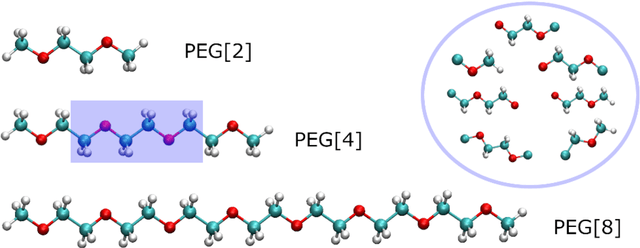
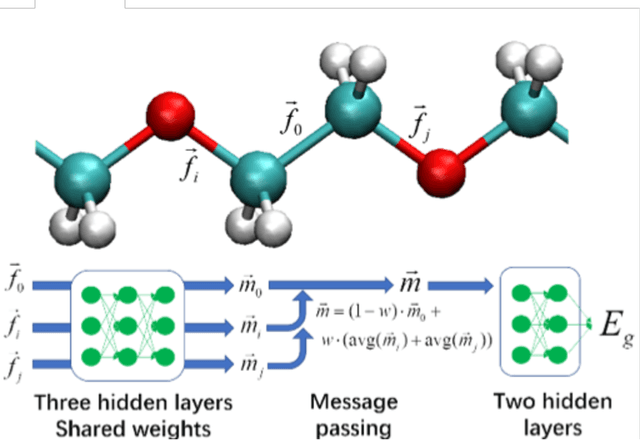
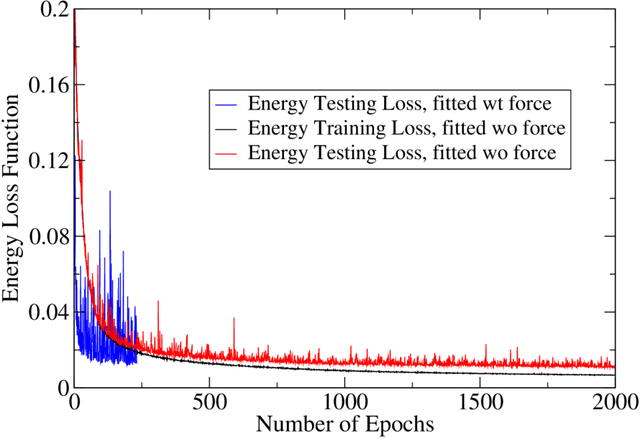
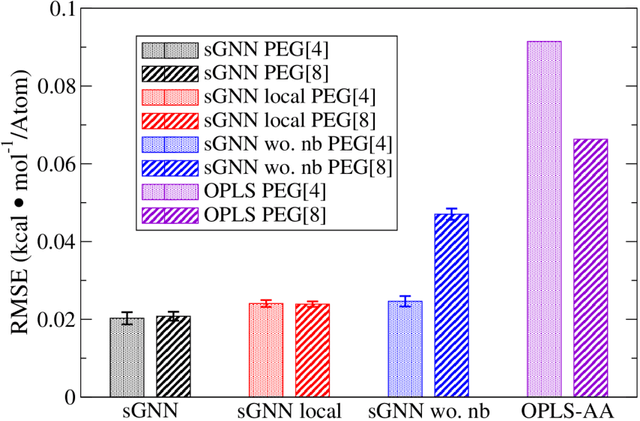
An accurate force field is the key to the success of all molecular mechanics simulations on organic polymers and biomolecules. Accuracy beyond density functional theory is often needed to describe the intermolecular interactions, while most correlated wavefunction (CW) methods are prohibitively expensive for large molecules. Therefore, it posts a great challenge to develop an extendible ab initio force field for large flexible organic molecules at CW level of accuracy. In this work, we face this challenge by combining the physics-driven nonbonding potential with a data-driven subgraph neural network bonding model (named sGNN). Tests on polyethylene glycol polymer chains show that our strategy is highly accurate and robust for molecules of different sizes. Therefore, we can develop the force field from small molecular fragments (with sizes easily accessible to CW methods) and safely transfer it to large polymers, thus opening a new path to the next-generation organic force fields.