 Add to Chrome
 Add to Firefox
 Add to Edge
Controlled Reformulation Testing for Logical Consistency in Large Language Models
Jul 16, 2026
Large language models (LLMs) frequently contradict themselves when the surface form of a logically equivalent question changes. We present a benchmark of 350 question families (1,750 total questions) for Controlled Reformulation Testing (CRTBench) to evaluate logical invariance. In this benchmark, we investigate LLMs' ability to maintain consistent answers across controlled reformulations, which include contrapositive rewriting, double negation, negation flipping, and passive voice. We evaluate several frontier LLMs and observe an accuracy-consistency gap where GPT-5.4-mini achieves $98.9\%$ base accuracy but only $60.3\%$ family-level consistency, while reasoning-optimized o4-mini achieves $96.9\%$ consistency. From our experiments, we observe that failures cluster around logically nontrivial transformations such as contrapositive rewriting ($72.4\%$ for GPT-5.4-mini) and double negation ($84.6\%$), while surface-level rephrasing remains robust ($94-100\%$). Increasing reasoning effort improves GPT-5.4-mini to $85.4\%$ consistency, but leaves GPT-5.4 unchanged overall because gains on nested negation are offset by failures on quantifier families. These results show that accuracy alone is not enough for evaluating logical reasoning in LLMs.

UI-MOPD: Multi-Platform On-Policy Distillation for Continual GUI Agent Learning
Jul 05, 2026Recent advances in multimodal foundation models and agent systems have driven GUI agents from single-platform task execution toward cross-platform interaction. However, building multi-platform GUI agents remains challenging. On one hand, high-quality and executable cross-platform interaction trajectories are still scarce, and existing data often suffer from limited platform coverage. On the other hand, different platforms exhibit distinct interaction conventions, making joint or continual training prone to behavioral pattern mixing, platform-specific capability degradation, and catastrophic forgetting. To address these challenges, we construct Uni-GUI, a high-quality cross-platform GUI interaction dataset, and propose UI-MOPD, the first method that incorporates multi-teacher on-policy distillation into continual learning for GUI agents. UI-MOPD dynamically selects a platform-specific teacher according to the current environment and transfers platform-specific behavioral priors to a shared policy through platform-conditioned distillation, enabling adaptation to new platforms while preserving capabilities on existing ones. Experiments on OSWorld and MobileWorld show that UI-MOPD achieves task success rates of 38.2% and 12.0%, respectively, demonstrating its effectiveness in balancing cross-platform capability retention and new-platform adaptation. Project page: https://elispectre.github.io/UI-MOPD/.
Transferring Features Across Language Models With Model Stitching
Jun 07, 2025In this work, we demonstrate that affine mappings between residual streams of language models is a cheap way to effectively transfer represented features between models. We apply this technique to transfer the weights of Sparse Autoencoders (SAEs) between models of different sizes to compare their representations. We find that small and large models learn highly similar representation spaces, which motivates training expensive components like SAEs on a smaller model and transferring to a larger model at a FLOPs savings. For example, using a small-to-large transferred SAE as initialization can lead to 50% cheaper training runs when training SAEs on larger models. Next, we show that transferred probes and steering vectors can effectively recover ground truth performance. Finally, we dive deeper into feature-level transferability, finding that semantic and structural features transfer noticeably differently while specific classes of functional features have their roles faithfully mapped. Overall, our findings illustrate similarities and differences in the linear representation spaces of small and large models and demonstrate a method for improving the training efficiency of SAEs.
AssemblyComplete: 3D Combinatorial Construction with Deep Reinforcement Learning
Oct 20, 2024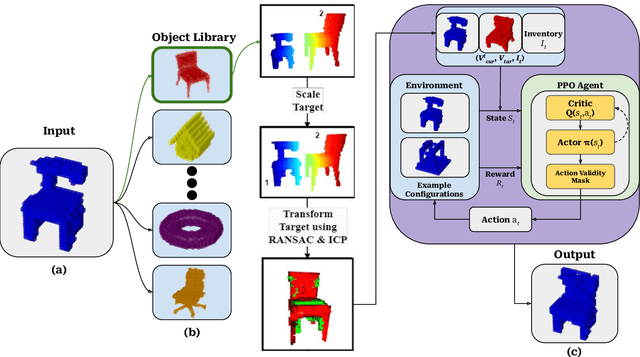
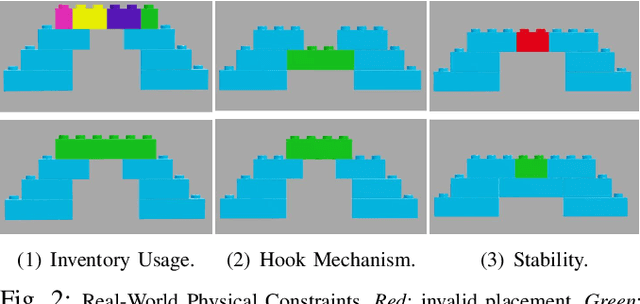
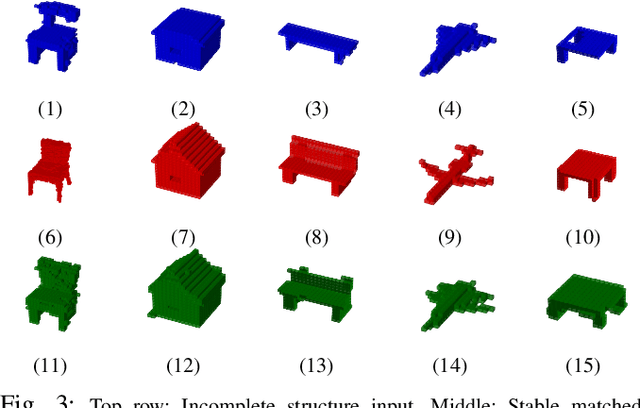
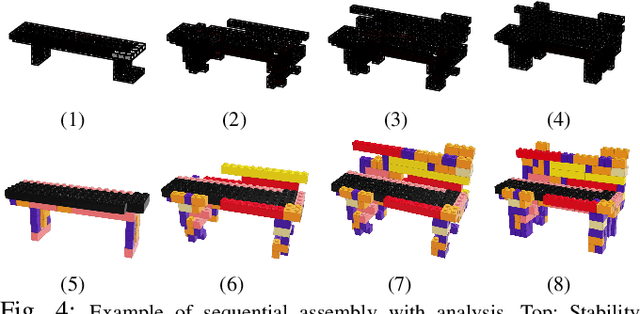
A critical goal in robotics and autonomy is to teach robots to adapt to real-world collaborative tasks, particularly in automatic assembly. The ability of a robot to understand the original intent of an incomplete assembly and complete missing features without human instruction is valuable but challenging. This paper introduces 3D combinatorial assembly completion, which is demonstrated using combinatorial unit primitives (i.e., Lego bricks). Combinatorial assembly is challenging due to the possible assembly combinations and complex physical constraints (e.g., no brick collisions, structure stability, inventory constraints, etc.). To address these challenges, we propose a two-part deep reinforcement learning (DRL) framework that tackles teaching the robot to understand the objective of an incomplete assembly and learning a construction policy to complete the assembly. The robot queries a stable object library to facilitate assembly inference and guide learning. In addition to the robot policy, an action mask is developed to rule out invalid actions that violate physical constraints for object-oriented construction. We demonstrate the proposed framework's feasibility and robustness in a variety of assembly scenarios in which the robot satisfies real-life assembly with respect to both solution and runtime quality. Furthermore, results demonstrate that the proposed framework effectively infers and assembles incomplete structures for unseen and unique object types.
Physics-Aware Combinatorial Assembly Planning using Deep Reinforcement Learning
Aug 19, 2024


Combinatorial assembly uses standardized unit primitives to build objects that satisfy user specifications. Lego is a widely used platform for combinatorial assembly, in which people use unit primitives (ie Lego bricks) to build highly customizable 3D objects. This paper studies sequence planning for physical combinatorial assembly using Lego. Given the shape of the desired object, we want to find a sequence of actions for placing Lego bricks to build the target object. In particular, we aim to ensure the planned assembly sequence is physically executable. However, assembly sequence planning (ASP) for combinatorial assembly is particularly challenging due to its combinatorial nature, ie the vast number of possible combinations and complex constraints. To address the challenges, we employ deep reinforcement learning to learn a construction policy for placing unit primitives sequentially to build the desired object. Specifically, we design an online physics-aware action mask that efficiently filters out invalid actions and guides policy learning. In the end, we demonstrate that the proposed method successfully plans physically valid assembly sequences for constructing different Lego structures. The generated construction plan can be executed in real.
Simulation-aided Learning from Demonstration for Robotic LEGO Construction
Sep 24, 2023Recent advancements in manufacturing have a growing demand for fast, automatic prototyping (i.e. assembly and disassembly) capabilities to meet users' needs. This paper studies automatic rapid LEGO prototyping, which is devoted to constructing target LEGO objects that satisfy individual customization needs and allow users to freely construct their novel designs. A construction plan is needed in order to automatically construct the user-specified LEGO design. However, a freely designed LEGO object might not have an existing construction plan, and generating such a LEGO construction plan requires a non-trivial effort since it requires accounting for numerous constraints (e.g. object shape, colors, stability, etc.). In addition, programming the prototyping skill for the robot requires the users to have expert programming skills, which makes the task beyond the reach of the general public. To address the challenges, this paper presents a simulation-aided learning from demonstration (SaLfD) framework for easily deploying LEGO prototyping capability to robots. In particular, the user demonstrates constructing the customized novel LEGO object. The robot extracts the task information by observing the human operation and generates the construction plan. A simulation is developed to verify the correctness of the learned construction plan and the resulting LEGO prototype. The proposed system is deployed to a FANUC LR-mate 200id/7L robot. Experiments demonstrate that the proposed SaLfD framework can effectively correct and learn the prototyping (i.e. assembly and disassembly) tasks from human demonstrations. And the learned prototyping tasks are realized by the FANUC robot.
Attention-based Neural Load Forecasting: A Dynamic Feature Selection Approach
Aug 25, 2021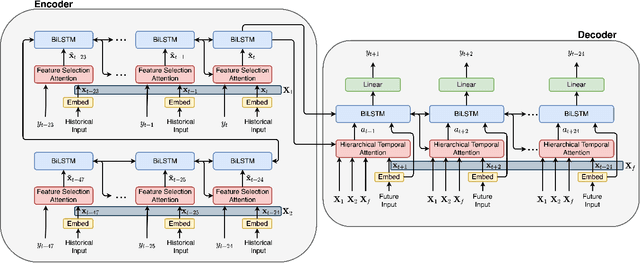
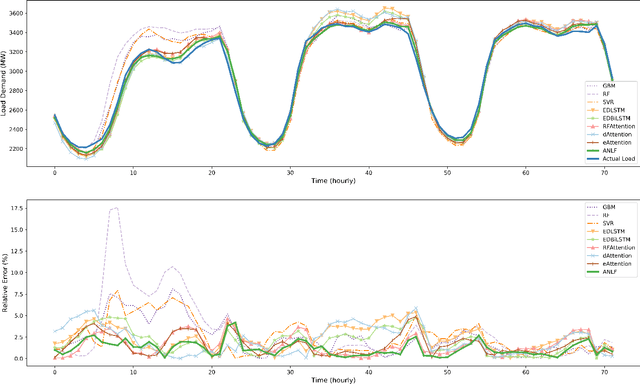
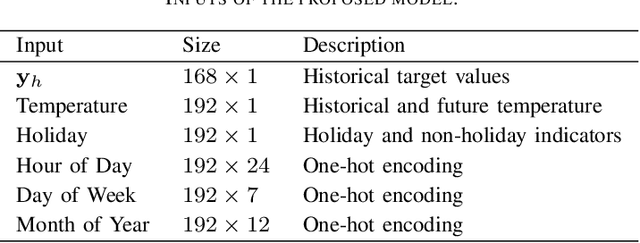
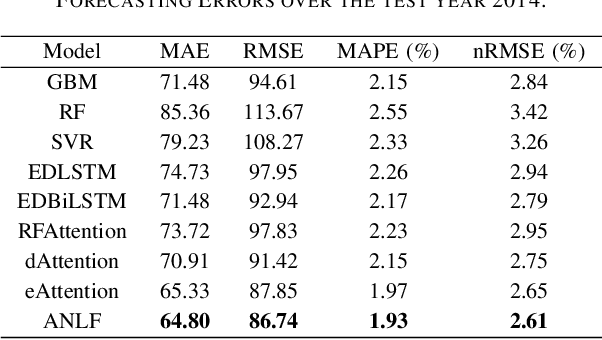
Encoder-decoder-based recurrent neural network (RNN) has made significant progress in sequence-to-sequence learning tasks such as machine translation and conversational models. Recent works have shown the advantage of this type of network in dealing with various time series forecasting tasks. The present paper focuses on the problem of multi-horizon short-term load forecasting, which plays a key role in the power system's planning and operation. Leveraging the encoder-decoder RNN, we develop an attention model to select the relevant features and similar temporal information adaptively. First, input features are assigned with different weights by a feature selection attention layer, while the updated historical features are encoded by a bi-directional long short-term memory (BiLSTM) layer. Then, a decoder with hierarchical temporal attention enables a similar day selection, which re-evaluates the importance of historical information at each time step. Numerical results tested on the dataset of the global energy forecasting competition 2014 show that our proposed model significantly outperforms some existing forecasting schemes.