 Add to Chrome
 Add to Firefox
 Add to Edge
QEvict: Recoverable Quantized KV Eviction for Attention-Drift-Robust Long-Context Decoding
Aug 05, 2026
Autoregressive large language model inference is increasingly constrained by the memory footprint of the Key-Value (KV) cache. A dominant line of work reduces this footprint by evicting tokens that appear unimportant under attention-derived scores. However, such policies make an implicit irreversible decision: once a token is evicted, it cannot become useful again. We show that this assumption is brittle during decoding. Token and window importance drift as generated queries evolve, causing standard eviction policies to permanently discard states that later receive substantial attention under the full-cache model. To characterize this behaviour, we introduce Future Missed Mass and Global LIR, two diagnostics that measure future attention assigned to discarded states and the reactivation of historically inactive regions. We propose QEvict, a three-tier KV-cache management scheme that replaces binary retain-or-delete eviction with recoverable eviction. QEvict maintains high-confidence windows in full precision, stores intermediate windows in a quantized recoverable tier, and deletes only the lowest-confidence windows. During decoding, cumulative attention scores update window importance and when a quantized window becomes important again, it is dequantized and promoted to the full-precision. Under a fixed memory budget, this design preserves broader historical context while retaining exact full precision for the most important regions. Across long-context understanding, retrieval, and reasoning benchmarks, QEvict consistently improves over representative eviction and quantization baselines, reducing missed attention and improving information retention

ReCap: Lightweight Referential Grounding for Coherent Story Visualization
Apr 20, 2026Story Visualization aims to generate a sequence of images that faithfully depicts a textual narrative that preserve character identity, spatial configuration, and stylistic coherence as the narratives unfold. Maintaining such cross-frame consistency has traditionally relied on explicit memory banks, architectural expansion, or auxiliary language models, resulting in substantial parameter growth and inference overhead. We introduce ReCap, a lightweight consistency framework that improves character stability and visual fidelity without modifying the base diffusion backbone. ReCap's CORE (COnditional frame REferencing) module treats anaphors, in our case pronouns, as visual anchors, activating only when characters are referred to by a pronoun and conditioning on the preceding frame to propagate visual identity. This selective design avoids unconditional cross-frame conditioning and introduces only 149K additional parameters, a fraction of the cost of memory-bank and LLM-augmented approaches. To further stabilize identity, we incorporate SemDrift (Guided Semantic Drift Correction) applied only during training. When text is vague or referential, the denoiser lacks a visual anchor for identity-defining attributes, causing character appearance to drift across frames, SemDrift corrects this by aligning denoiser representations with pretrained DINOv3 visual embeddings, enforcing semantic identity stability at zero inference cost. ReCap outperforms previous state-of-the-art, StoryGPT-V, on the two main benchmarks for story visualization by 2.63% Character-Accuracy on FlintstonesSV and by 5.65% on PororoSV, establishing a new state-of-the-art character consistency on both benchmarks. Furthermore, we extend story visualization to human-centric narratives derived from real films, demonstrating the capability of ReCap beyond stylized cartoon domains.
HaloProbe: Bayesian Detection and Mitigation of Object Hallucinations in Vision-Language Models
Apr 07, 2026Large vision-language models can produce object hallucinations in image descriptions, highlighting the need for effective detection and mitigation strategies. Prior work commonly relies on the model's attention weights on visual tokens as a detection signal. We reveal that coarse-grained attention-based analysis is unreliable due to hidden confounders, specifically token position and object repetition in a description. This leads to Simpson's paradox: the attention trends reverse or disappear when statistics are aggregated. Based on this observation, we introduce HaloProbe, a Bayesian framework that factorizes external description statistics and internal decoding signals to estimate token-level hallucination probabilities. HaloProbe uses balanced training to isolate internal evidence and combines it with learned prior over external features to recover the true posterior. While intervention-based mitigation methods often degrade utility or fluency by modifying models' internals, we use HaloProbe as an external scoring signal for non-invasive mitigation. Our experiments show that HaloProbe-guided decoding reduces hallucinations more effectively than state-of-the-art intervention-based methods while preserving utility.
A Comprehensive Benchmark of Histopathology Foundation Models for Kidney Histopathology
Mar 16, 2026Histopathology foundation models (HFMs), pretrained on large-scale cancer datasets, have advanced computational pathology. However, their applicability to non-cancerous chronic kidney disease remains underexplored, despite coexistence of renal pathology with malignancies such as renal cell and urothelial carcinoma. We systematically evaluate 11 publicly available HFMs across 11 kidney-specific downstream tasks spanning multiple stains (PAS, H&E, PASM, and IHC), spatial scales (tile and slide-level), task types (classification, regression, and copy detection), and clinical objectives, including detection, diagnosis, and prognosis. Tile-level performance is assessed using repeated stratified group cross-validation, while slide-level tasks are evaluated using repeated nested stratified cross-validation. Statistical significance is examined using Friedman test followed by pairwise Wilcoxon signed-rank testing with Holm-Bonferroni correction and compact letter display visualization. To promote reproducibility, we release an open-source Python package, kidney-hfm-eval, available at https://pypi.org/project/kidney-hfm-eval/ , that reproduces the evaluation pipelines. Results show moderate to strong performance on tasks driven by coarse meso-scale renal morphology, including diagnostic classification and detection of prominent structural alterations. In contrast, performance consistently declines for tasks requiring fine-grained microstructural discrimination, complex biological phenotypes, or slide-level prognostic inference, largely independent of stain type. Overall, current HFMs appear to encode predominantly static meso-scale representations and may have limited capacity to capture subtle renal pathology or prognosis-related signals. Our results highlight the need for kidney-specific, multi-stain, and multimodal foundation models to support clinically reliable decision-making in nephrology.
Extending $μ$P: Spectral Conditions for Feature Learning Across Optimizers
Feb 24, 2026Several variations of adaptive first-order and second-order optimization methods have been proposed to accelerate and scale the training of large language models. The performance of these optimization routines is highly sensitive to the choice of hyperparameters (HPs), which are computationally expensive to tune for large-scale models. Maximal update parameterization $(μ$P$)$ is a set of scaling rules which aims to make the optimal HPs independent of the model size, thereby allowing the HPs tuned on a smaller (computationally cheaper) model to be transferred to train a larger, target model. Despite promising results for SGD and Adam, deriving $μ$P for other optimizers is challenging because the underlying tensor programming approach is difficult to grasp. Building on recent work that introduced spectral conditions as an alternative to tensor programs, we propose a novel framework to derive $μ$P for a broader class of optimizers, including AdamW, ADOPT, LAMB, Sophia, Shampoo and Muon. We implement our $μ$P derivations on multiple benchmark models and demonstrate zero-shot learning rate transfer across increasing model width for the above optimizers. Further, we provide empirical insights into depth-scaling parameterization for these optimizers.
Information-Driven Fault Detection and Identification for Multi-Agent Spacecraft Systems: Collaborative On-Orbit Inspection Mission
Nov 11, 2025This work presents a global-to-local, task-aware fault detection and identification (FDI) framework for multi-spacecraft systems conducting collaborative inspection missions in low Earth orbit. The inspection task is represented by a global information-driven cost functional that integrates the sensor model, spacecraft poses, and mission-level information-gain objectives. This formulation links guidance, control, and FDI by using the same cost function to drive both global task allocation and local sensing or motion decisions. Fault detection is achieved through comparisons between expected and observed task metrics, while higher-order cost-gradient measures enable the identification of faults among sensors, actuators, and state estimators. An adaptive thresholding mechanism captures the time-varying inspection geometry and dynamic mission conditions. Simulation results for representative multi-spacecraft inspection scenarios demonstrate the reliability of fault localization and classification under uncertainty, providing a unified, information-driven foundation for resilient autonomous inspection architectures.
A multi-modal dataset for insect biodiversity with imagery and DNA at the trap and individual level
Jul 09, 2025Insects comprise millions of species, many experiencing severe population declines under environmental and habitat changes. High-throughput approaches are crucial for accelerating our understanding of insect diversity, with DNA barcoding and high-resolution imaging showing strong potential for automatic taxonomic classification. However, most image-based approaches rely on individual specimen data, unlike the unsorted bulk samples collected in large-scale ecological surveys. We present the Mixed Arthropod Sample Segmentation and Identification (MassID45) dataset for training automatic classifiers of bulk insect samples. It uniquely combines molecular and imaging data at both the unsorted sample level and the full set of individual specimens. Human annotators, supported by an AI-assisted tool, performed two tasks on bulk images: creating segmentation masks around each individual arthropod and assigning taxonomic labels to over 17 000 specimens. Combining the taxonomic resolution of DNA barcodes with precise abundance estimates of bulk images holds great potential for rapid, large-scale characterization of insect communities. This dataset pushes the boundaries of tiny object detection and instance segmentation, fostering innovation in both ecological and machine learning research.
Global Task-aware Fault Detection, Identification For On-Orbit Multi-Spacecraft Collaborative Inspection
May 06, 2025In this paper, we present a global-to-local task-aware fault detection and identification algorithm to detect failures in a multi-spacecraft system performing a collaborative inspection (referred to as global) task. The inspection task is encoded as a cost functional $\costH$ that informs global (task allocation and assignment) and local (agent-level) decision-making. The metric $\costH$ is a function of the inspection sensor model, and the agent full-pose. We use the cost functional $\costH$ to design a metric that compares the expected and actual performance to detect the faulty agent using a threshold. We use higher-order cost gradients $\costH$ to derive a new metric to identify the type of fault, including task-specific sensor fault, an agent-level actuator, and sensor faults. Furthermore, we propose an approach to design adaptive thresholds for each fault mentioned above to incorporate the time dependence of the inspection task. We demonstrate the efficacy of the proposed method empirically, by simulating and detecting faults (such as inspection sensor faults, actuators, and sensor faults) in a low-Earth orbit collaborative spacecraft inspection task using the metrics and the threshold designed using the global task cost $\costH$.
Visatronic: A Multimodal Decoder-Only Model for Speech Synthesis
Nov 26, 2024
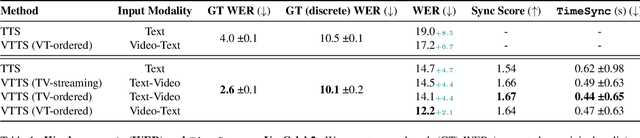

In this paper, we propose a new task -- generating speech from videos of people and their transcripts (VTTS) -- to motivate new techniques for multimodal speech generation. This task generalizes the task of generating speech from cropped lip videos, and is also more complicated than the task of generating generic audio clips (e.g., dog barking) from videos and text. Multilingual versions of the task could lead to new techniques for cross-lingual dubbing. We also present a decoder-only multimodal model for this task, which we call Visatronic. This model embeds vision, text and speech directly into the common subspace of a transformer model and uses an autoregressive loss to learn a generative model of discretized mel-spectrograms conditioned on speaker videos and transcripts of their speech. By embedding all modalities into a common subspace, Visatronic can achieve improved results over models that use only text or video as input. Further, it presents a much simpler approach for multimodal speech generation compared to prevailing approaches which rely on lip-detectors and complicated architectures to fuse modalities while producing better results. Since the model is flexible enough to accommodate different ways of ordering inputs as a sequence, we carefully explore different strategies to better understand the best way to propagate information to the generative steps. To facilitate further research on VTTS, we will release (i) our code, (ii) clean transcriptions for the large-scale VoxCeleb2 dataset, and (iii) a standardized evaluation protocol for VTTS incorporating both objective and subjective metrics.
Open-Vocabulary Temporal Action Localization using Multimodal Guidance
Jun 21, 2024Open-Vocabulary Temporal Action Localization (OVTAL) enables a model to recognize any desired action category in videos without the need to explicitly curate training data for all categories. However, this flexibility poses significant challenges, as the model must recognize not only the action categories seen during training but also novel categories specified at inference. Unlike standard temporal action localization, where training and test categories are predetermined, OVTAL requires understanding contextual cues that reveal the semantics of novel categories. To address these challenges, we introduce OVFormer, a novel open-vocabulary framework extending ActionFormer with three key contributions. First, we employ task-specific prompts as input to a large language model to obtain rich class-specific descriptions for action categories. Second, we introduce a cross-attention mechanism to learn the alignment between class representations and frame-level video features, facilitating the multimodal guided features. Third, we propose a two-stage training strategy which includes training with a larger vocabulary dataset and finetuning to downstream data to generalize to novel categories. OVFormer extends existing TAL methods to open-vocabulary settings. Comprehensive evaluations on the THUMOS14 and ActivityNet-1.3 benchmarks demonstrate the effectiveness of our method. Code and pretrained models will be publicly released.