 Add to Chrome
 Add to Firefox
 Add to Edge
HANCLIP: A Family of Hyperbolic Angular Negation Vision Language Models
Jun 22, 2026
Vision-Language Models (VLMs) are typically pre-trained on large-scale image-text datasets to capture semantic correspondences between visual content and natural language. However, they remain surprisingly brittle to negation: models often rely on shallow word co-occurrence and are easily distracted by misleading or irrelevant textual cues, even when their overall retrieval or classification performance is strong. Moreover, directly finetuning on negation data can interfere with previously acquired knowledge, causing noticeable degradation on standard vision-language benchmarks. To tackle these issues, this work introduces HANCLIP (Hyperbolic + Angular + Negation), a family of VLMs that explicitly restructures the embedding space to encode "what an image is not" alongside "what it is." HANCLIP is trained on a compact set of 20,000 image-text quadruplets and combines a hyperbolic formulation, which models hierarchical semantic relations and asymmetries, with an angular triplet objective that drives systematic separation between negated descriptions and their corresponding positives. This geometry-aware design strengthens negation sensitivity while preserving the global structure of pretrained representations, rather than overwriting them. Extensive experiments across multiple vision-language tasks show that HANCLIP delivers consistent gains on the negation-focused NegBench benchmark, while maintaining competitive or improved performance on standard classification and image-text retrieval benchmarks. The framework is model-agnostic and can be plugged into CLIP, LongCLIP, SmartCLIP, and HiMo-CLIP without large-scale retraining, demonstrating that a carefully designed geometric objective can substantially extend the reasoning capabilities of existing VLMs using only modest additional data.

Trust-Aware Predictive Emissions Monitoring for Gas Turbine Fleets with Limited Labelled Data
Jun 04, 2026Machine learning-based predictive emissions monitoring systems offer a practical alternative to direct emissions measurement, but their deployment across gas turbine fleets is challenging when emissions labels are available for only a small subset of assets. In this work, a trust-aware probabilistic framework is proposed for fleet-level gas turbine NOx prediction under limited labelled supervision. The framework combines a multi-head recurrent prediction model with learned confidence estimation, ensemble-based uncertainty quantification, auxiliary feature prediction, feature-space distance analysis, and operating-range diagnostics. These signals are calibrated on labelled data to produce interpretable per-sample trust scores, providing indicators of prediction reliability on unlabelled turbines, supporting the identification of predictions that should be treated with greater caution during fleet-level deployment. Confidence-based filtering reduces MAE from 0.202 at full coverage to 0.070 for the highest-confidence 10\% of predictions, demonstrating that confidence estimates are meaningfully related to prediction error. Unlabelled and out-of-distribution samples exhibit increased uncertainty and reduced confidence, indicating that the framework responds appropriately to distributional shift. The results show that the proposed trust framework provides actionable reliability information for emissions prediction on unlabelled turbines, supporting more transparent and trustworthy deployment of PEMS across industrial fleets.
Agent-Based Post-Hoc Correction of Agricultural Yield Forecasts
May 12, 2026Accurate crop yield forecasting in commercial soft fruit production is constrained by the data available in typical commercial farm records, which lack the sensor networks, satellite imagery, and high-resolution meteorological inputs that most state-of-the-art approaches assume. We propose a structured LLM agent framework that performs post-hoc correction of existing model predictions, encoding agricultural domain knowledge across tools for phase detection, bias learning, and range validation. Evaluated on a proprietary strawberry yield dataset and a public USDA corn harvest dataset, agent refinement of XGBoost reduced MAE by 20% and MASE by 56% on strawberry, with consistent improvements across Moirai2 (MAE 24%, MASE 22%) and Random Forest (MAE 28%, MASE 66%) baselines. Using Llama 3.1 8B as the agent produced the strongest corrections across all configurations; LLaVA 13B showed inconsistent gains, highlighting sensitivity to the choice of refinement model.
HiAP: A Multi-Granular Stochastic Auto-Pruning Framework for Vision Transformers
Mar 12, 2026Vision Transformers require significant computational resources and memory bandwidth, severely limiting their deployment on edge devices. While recent structured pruning methods successfully reduce theoretical FLOPs, they typically operate at a single structural granularity and rely on complex, multi-stage pipelines with post-hoc thresholding to satisfy sparsity budgets. In this paper, we propose Hierarchical Auto-Pruning (HiAP), a continuous relaxation framework that discovers optimal sub-networks in a single end-to-end training phase without requiring manual importance heuristics or predefined per-layer sparsity targets. HiAP introduces stochastic Gumbel-Sigmoid gates at multiple granularities: macro-gates to prune entire attention heads and FFN blocks, and micro-gates to selectively prune intra-head dimensions and FFN neurons. By optimizing both levels simultaneously, HiAP addresses both the memory-bound overhead of loading large matrices and the compute-bound mathematical operations. HiAP naturally converges to stable sub-networks using a loss function that incorporates both structural feasibility penalties and analytical FLOPs. Extensive experiments on ImageNet demonstrate that HiAP organically discovers highly efficient architectures, and achieves a competitive accuracy-efficiency Pareto frontier for models like DeiT-Small, matching the performance of sophisticated multi-stage methods while significantly simplifying the deployment pipeline.
EquiCaps: Predictor-Free Pose-Aware Pre-Trained Capsule Networks
Jun 11, 2025
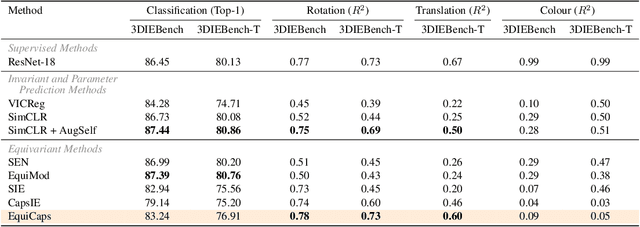
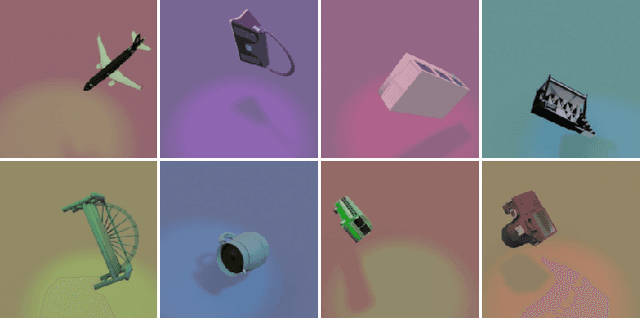
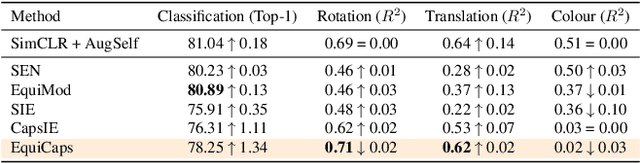
Learning self-supervised representations that are invariant and equivariant to transformations is crucial for advancing beyond traditional visual classification tasks. However, many methods rely on predictor architectures to encode equivariance, despite evidence that architectural choices, such as capsule networks, inherently excel at learning interpretable pose-aware representations. To explore this, we introduce EquiCaps (Equivariant Capsule Network), a capsule-based approach to pose-aware self-supervision that eliminates the need for a specialised predictor for enforcing equivariance. Instead, we leverage the intrinsic pose-awareness capabilities of capsules to improve performance in pose estimation tasks. To further challenge our assumptions, we increase task complexity via multi-geometric transformations to enable a more thorough evaluation of invariance and equivariance by introducing 3DIEBench-T, an extension of a 3D object-rendering benchmark dataset. Empirical results demonstrate that EquiCaps outperforms prior state-of-the-art equivariant methods on rotation prediction, achieving a supervised-level $R^2$ of 0.78 on the 3DIEBench rotation prediction benchmark and improving upon SIE and CapsIE by 0.05 and 0.04 $R^2$, respectively. Moreover, in contrast to non-capsule-based equivariant approaches, EquiCaps maintains robust equivariant performance under combined geometric transformations, underscoring its generalisation capabilities and the promise of predictor-free capsule architectures.
Monkey Transfer Learning Can Improve Human Pose Estimation
Dec 20, 2024In this study, we investigated whether transfer learning from macaque monkeys could improve human pose estimation. Current state-of-the-art pose estimation techniques, often employing deep neural networks, can match human annotation in non-clinical datasets. However, they underperform in novel situations, limiting their generalisability to clinical populations with pathological movement patterns. Clinical datasets are not widely available for AI training due to ethical challenges and a lack of data collection. We observe that data from other species may be able to bridge this gap by exposing the network to a broader range of motion cues. We found that utilising data from other species and undertaking transfer learning improved human pose estimation in terms of precision and recall compared to the benchmark, which was trained on humans only. Compared to the benchmark, fewer human training examples were needed for the transfer learning approach (1,000 vs 19,185). These results suggest that macaque pose estimation can improve human pose estimation in clinical situations. Future work should further explore the utility of pose estimation trained with monkey data in clinical populations.
Pushing the Limits of Sparsity: A Bag of Tricks for Extreme Pruning
Nov 21, 2024
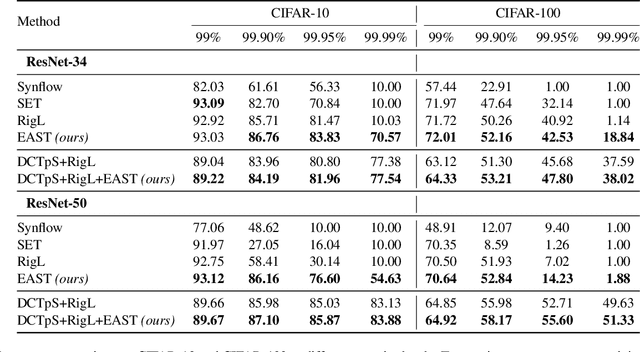

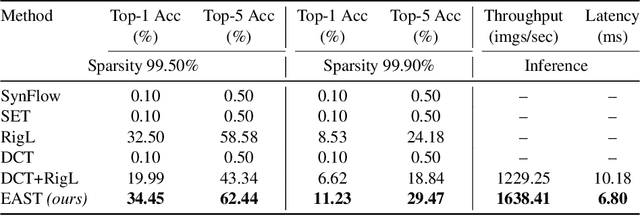
Pruning of deep neural networks has been an effective technique for reducing model size while preserving most of the performance of dense networks, crucial for deploying models on memory and power-constrained devices. While recent sparse learning methods have shown promising performance up to moderate sparsity levels such as 95% and 98%, accuracy quickly deteriorates when pushing sparsities to extreme levels. Obtaining sparse networks at such extreme sparsity levels presents unique challenges, such as fragile gradient flow and heightened risk of layer collapse. In this work, we explore network performance beyond the commonly studied sparsities, and propose a collection of techniques that enable the continuous learning of networks without accuracy collapse even at extreme sparsities, including 99.90%, 99.95% and 99.99% on ResNet architectures. Our approach combines 1) Dynamic ReLU phasing, where DyReLU initially allows for richer parameter exploration before being gradually replaced by standard ReLU, 2) weight sharing which reuses parameters within a residual layer while maintaining the same number of learnable parameters, and 3) cyclic sparsity, where both sparsity levels and sparsity patterns evolve dynamically throughout training to better encourage parameter exploration. We evaluate our method, which we term Extreme Adaptive Sparse Training (EAST) at extreme sparsities using ResNet-34 and ResNet-50 on CIFAR-10, CIFAR-100, and ImageNet, achieving significant performance improvements over state-of-the-art methods we compared with.
Capsule Network Projectors are Equivariant and Invariant Learners
May 23, 2024Learning invariant representations has been the longstanding approach to self-supervised learning. However, recently progress has been made in preserving equivariant properties in representations, yet do so with highly prescribed architectures. In this work, we propose an invariant-equivariant self-supervised architecture that employs Capsule Networks (CapsNets) which have been shown to capture equivariance with respect to novel viewpoints. We demonstrate that the use of CapsNets in equivariant self-supervised architectures achieves improved downstream performance on equivariant tasks with higher efficiency and fewer network parameters. To accommodate the architectural changes of CapsNets, we introduce a new objective function based on entropy minimisation. This approach, which we name CapsIE (Capsule Invariant Equivariant Network), achieves state-of-the-art performance across all invariant and equivariant downstream tasks on the 3DIEBench dataset, while outperforming supervised baselines. Our results demonstrate the ability of CapsNets to learn complex and generalised representations for large-scale, multi-task datasets compared to previous CapsNet benchmarks. Code is available at https://github.com/AberdeenML/CapsIE.
S-JEA: Stacked Joint Embedding Architectures for Self-Supervised Visual Representation Learning
May 19, 2023The recent emergence of Self-Supervised Learning (SSL) as a fundamental paradigm for learning image representations has, and continues to, demonstrate high empirical success in a variety of tasks. However, most SSL approaches fail to learn embeddings that capture hierarchical semantic concepts that are separable and interpretable. In this work, we aim to learn highly separable semantic hierarchical representations by stacking Joint Embedding Architectures (JEA) where higher-level JEAs are input with representations of lower-level JEA. This results in a representation space that exhibits distinct sub-categories of semantic concepts (e.g., model and colour of vehicles) in higher-level JEAs. We empirically show that representations from stacked JEA perform on a similar level as traditional JEA with comparative parameter counts and visualise the representation spaces to validate the semantic hierarchies.
HMSN: Hyperbolic Self-Supervised Learning by Clustering with Ideal Prototypes
May 18, 2023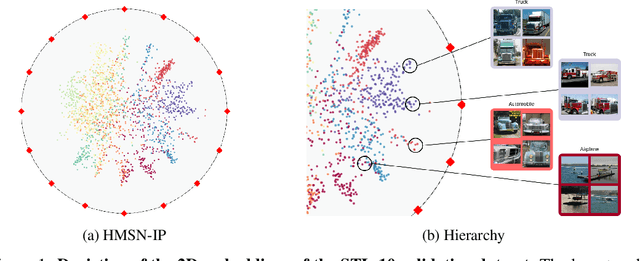
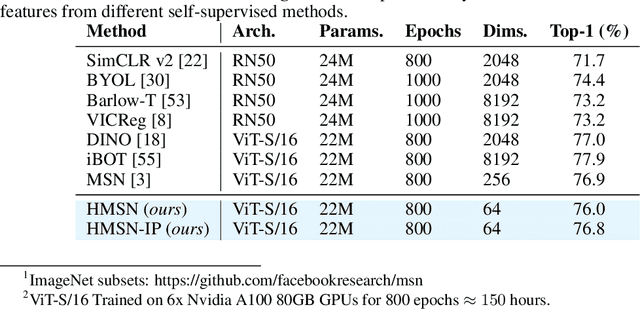
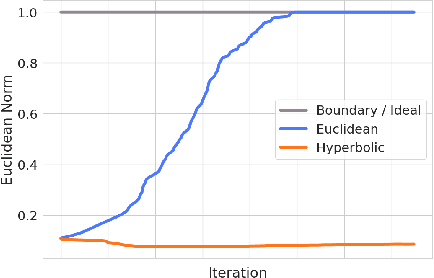
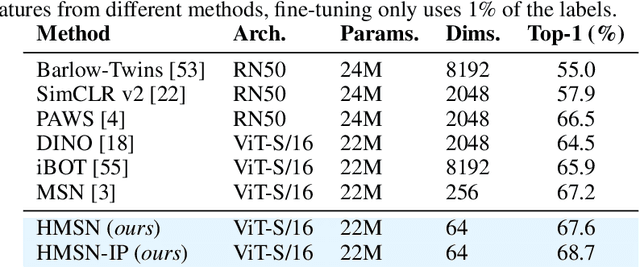
Hyperbolic manifolds for visual representation learning allow for effective learning of semantic class hierarchies by naturally embedding tree-like structures with low distortion within a low-dimensional representation space. The highly separable semantic class hierarchies produced by hyperbolic learning have shown to be powerful in low-shot tasks, however, their application in self-supervised learning is yet to be explored fully. In this work, we explore the use of hyperbolic representation space for self-supervised representation learning for prototype-based clustering approaches. First, we extend the Masked Siamese Networks to operate on the Poincar\'e ball model of hyperbolic space, secondly, we place prototypes on the ideal boundary of the Poincar\'e ball. Unlike previous methods we project to the hyperbolic space at the output of the encoder network and utilise a hyperbolic projection head to ensure that the representations used for downstream tasks remain hyperbolic. Empirically we demonstrate the ability of these methods to perform comparatively to Euclidean methods in lower dimensions for linear evaluation tasks, whilst showing improvements in extreme few-shot learning tasks.