 Add to Chrome
 Add to Firefox
 Add to Edge
CrevasseSeg: A Label-Efficient UAV Crevasse Segmentation Framework
Aug 18, 2026
Crevasse mapping from uncrewed aerial vehicle (UAV) imagery matters for glaciological research and for field safety in glaciated terrain. Yet, pixel-level annotation of glacier surfaces is costly and requires domain experts. We introduce CrevasseSeg, a framework for binary segmentation over the terminus of Borebreen, Svalbard, comprising 1,938 unlabelled UAV orthomosaic tiles for self-supervised/unsupervised fine-tuning, 24 labelled tiles for validation and 176 labelled tiles for testing. Using CrevasseSeg, we benchmark five self-supervised objectives -- BYOL, a Jensen-Shannon Divergence (JSD) objective, Barlow-Twins, VICReg, and a combined BYOL-JSD objective -- across three architectures: O-Net, O-Net++, and a DINOv3-initialised O-Net. Each configuration is evaluated under two frozen-feature readouts that differ only in the form of their decision boundary: a linear probe and a non-linear XGBoost classifier fit only on the 24 labelled validation images. Our central finding is a consistent inversion between the two readouts: DINOv3 features are the weakest under linear probing but the strongest under a non-linear readout. A UMAP analysis of the learned feature space shows that DINOv3 fragments pixels into many small clusters in which the classes are locally interleaved, whereas the convolutional architectures (O-Net and O-Net++) embed them onto a single class-sorted manifold. Satellite-pretrained DINOv3 improves over natural-image initialisation across objectives, and our label-efficient DINOv3-ViT-L-Sat-O-Net-BYOL-JSD pipeline reaches 75.33 mDSC / 61.28 mIoU, outperforming standard machine learning baselines fit on the same 24 labelled images with the RGB pixel values used as features. We release CrevasseSeg to support label-efficient segmentation research in remote sensing.

Causal State-Space Model for Causal Inference: Estimating Longitudinal Individual Treatment Effects
Aug 12, 2026Estimating counterfactual outcomes over time from longitudinal observational data is central to clinical decision support. Existing methods rely on domain confusion -- adversarial training that renders representations invariant to treatment assignment -- yet this invariance creates a mutual information conflict: it suppresses treatment-correlated covariate signals necessary for accurate outcome prediction. We formalise this tension via a Jensen-Shannon divergence bound on counterfactual prediction error and develop two complementary models. CSSD (Causal State-Space model with Direct decoder) adapts selective State Space Models with a parallel multi-step decoder that eliminates accumulated rollout error by producing all prediction horizons simultaneously in a single forward pass. CSSPD (Causal State-Space model with Predictive regularisation and Direct decoder) augments CSSD with Contrastive Predictive Coding and Local Information Maximisation to reinforce temporal predictability in the balancing representation and recover local covariate information destroyed by domain confusion. On MIMIC-III, CSSPD achieves lower counterfactual RMSE than the Causal Transformer at every horizon tau >= 2 at O(T) encoder cost, with gains from 0.02 (2-step) to 0.07 (6-step). On Cancer Simulation across confounding strengths gamma in {0,1,2,3,4}, CSSPD outperforms CT at gamma <= 3 (margins 25.9%--37.0%), and CSSD achieves the lowest overall average RMSE (12.7% reduction over CT), confirming the MI conflict analysis. To our knowledge, this is the first work to formalise the balancing-prediction MI conflict and propose a structured resolution through complementary predictive and information-theoretic training objectives.
Group-Equivariant Poincaré Convolutional Networks
Jul 01, 2026While recent advancements like the Poincaré ResNet have demonstrated the potential of learning visual representations directly in hyperbolic space, their optimisation remains hampered by the computationally intensive nature of Riemannian gradients and the strict boundaries of the manifold. Furthermore, standard hyperbolic networks treat spatial transformations of the same object as distinct hierarchical concepts, leading to redundant parameter usage and vanishing signals. We propose Equivariant Poincaré ResNets, combining hyperbolic geometry with discrete symmetry groups ($C_4$ and $D_4$). We identify critical roadblocks in applying Euclidean equivariance to hyperbolic space and propose geometrically safe tensor reshaping, left-regular permutations for hyperbolic group convolutions, and joint-orientation Poincaré Midpoint Batch normalisation. Empirically, embedding equivariance drastically reduces the optimisation space, accelerating convergence while accelerating convergence while respecting the boundary constraints of the Poincaré ball and preserving spatial-group equivariance.
Trust-Aware Predictive Emissions Monitoring for Gas Turbine Fleets with Limited Labelled Data
Jun 04, 2026Machine learning-based predictive emissions monitoring systems offer a practical alternative to direct emissions measurement, but their deployment across gas turbine fleets is challenging when emissions labels are available for only a small subset of assets. In this work, a trust-aware probabilistic framework is proposed for fleet-level gas turbine NOx prediction under limited labelled supervision. The framework combines a multi-head recurrent prediction model with learned confidence estimation, ensemble-based uncertainty quantification, auxiliary feature prediction, feature-space distance analysis, and operating-range diagnostics. These signals are calibrated on labelled data to produce interpretable per-sample trust scores, providing indicators of prediction reliability on unlabelled turbines, supporting the identification of predictions that should be treated with greater caution during fleet-level deployment. Confidence-based filtering reduces MAE from 0.202 at full coverage to 0.070 for the highest-confidence 10\% of predictions, demonstrating that confidence estimates are meaningfully related to prediction error. Unlabelled and out-of-distribution samples exhibit increased uncertainty and reduced confidence, indicating that the framework responds appropriately to distributional shift. The results show that the proposed trust framework provides actionable reliability information for emissions prediction on unlabelled turbines, supporting more transparent and trustworthy deployment of PEMS across industrial fleets.
Agent-Based Post-Hoc Correction of Agricultural Yield Forecasts
May 12, 2026Accurate crop yield forecasting in commercial soft fruit production is constrained by the data available in typical commercial farm records, which lack the sensor networks, satellite imagery, and high-resolution meteorological inputs that most state-of-the-art approaches assume. We propose a structured LLM agent framework that performs post-hoc correction of existing model predictions, encoding agricultural domain knowledge across tools for phase detection, bias learning, and range validation. Evaluated on a proprietary strawberry yield dataset and a public USDA corn harvest dataset, agent refinement of XGBoost reduced MAE by 20% and MASE by 56% on strawberry, with consistent improvements across Moirai2 (MAE 24%, MASE 22%) and Random Forest (MAE 28%, MASE 66%) baselines. Using Llama 3.1 8B as the agent produced the strongest corrections across all configurations; LLaVA 13B showed inconsistent gains, highlighting sensitivity to the choice of refinement model.
NOFE -- Neural Operator Function Embedding
May 12, 2026Most dimensionality reduction methods treat data as discrete point clouds, ignoring the continuous domain structure inherent to many real-world processes. To bridge this gap, we introduce Neural Operator Function Embedding (NOFE), a domain-aware framework for continuous dimensionality reduction. NOFE learns function-to-function mappings via a Graph Kernel Operator, enabling mesh-free evaluation at arbitrary query locations independent of input discretization. We establish NOFE as approximation of sheaf-to-sheaf mappings, generalizing Sheaf Neural Networks to continuous domains. We evaluate NOFE across different datasets, comparing it against PCA, t-SNE, and UMAP. Our results demonstrate that NOFE significantly outperforms baselines in local structure preservation, achieving a local Stress of 0.111 compared to 0.398 for PCA, 0.773 for t-SNE, and 0.791 for UMAP for the ERA5 climate reanalysis dataset. NOFE also exhibits robust sampling independence, reducing the Patch Stitching Error by up to $20.0\times$ relative to UMAP (59.0 vs. 267.6 under regional normalization) and ensuring consistency across disjoint domain patches. While maintaining competitive global structure preservation (Stress-1: 0.379 vs. PCA's 0.268), NOFE resolves fine-grained structures and produces smooth, consistent embeddings that generalize across varying sample densities, addressing key limitations of discrete reduction methods.
HiAP: A Multi-Granular Stochastic Auto-Pruning Framework for Vision Transformers
Mar 12, 2026Vision Transformers require significant computational resources and memory bandwidth, severely limiting their deployment on edge devices. While recent structured pruning methods successfully reduce theoretical FLOPs, they typically operate at a single structural granularity and rely on complex, multi-stage pipelines with post-hoc thresholding to satisfy sparsity budgets. In this paper, we propose Hierarchical Auto-Pruning (HiAP), a continuous relaxation framework that discovers optimal sub-networks in a single end-to-end training phase without requiring manual importance heuristics or predefined per-layer sparsity targets. HiAP introduces stochastic Gumbel-Sigmoid gates at multiple granularities: macro-gates to prune entire attention heads and FFN blocks, and micro-gates to selectively prune intra-head dimensions and FFN neurons. By optimizing both levels simultaneously, HiAP addresses both the memory-bound overhead of loading large matrices and the compute-bound mathematical operations. HiAP naturally converges to stable sub-networks using a loss function that incorporates both structural feasibility penalties and analytical FLOPs. Extensive experiments on ImageNet demonstrate that HiAP organically discovers highly efficient architectures, and achieves a competitive accuracy-efficiency Pareto frontier for models like DeiT-Small, matching the performance of sophisticated multi-stage methods while significantly simplifying the deployment pipeline.
MMDEW: Multipurpose Multiclass Density Estimation in the Wild
Oct 02, 2025Density map estimation can be used to estimate object counts in dense and occluded scenes where discrete counting-by-detection methods fail. We propose a multicategory counting framework that leverages a Twins pyramid vision-transformer backbone and a specialised multi-class counting head built on a state-of-the-art multiscale decoding approach. A two-task design adds a segmentation-based Category Focus Module, suppressing inter-category cross-talk at training time. Training and evaluation on the VisDrone and iSAID benchmarks demonstrates superior performance versus prior multicategory crowd-counting approaches (33%, 43% and 64% reduction to MAE), and the comparison with YOLOv11 underscores the necessity of crowd counting methods in dense scenes. The method's regional loss opens up multi-class crowd counting to new domains, demonstrated through the application to a biodiversity monitoring dataset, highlighting its capacity to inform conservation efforts and enable scalable ecological insights.
EquiCaps: Predictor-Free Pose-Aware Pre-Trained Capsule Networks
Jun 11, 2025
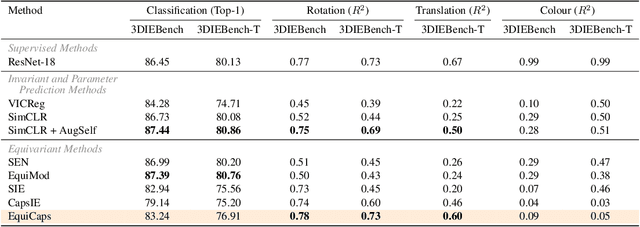
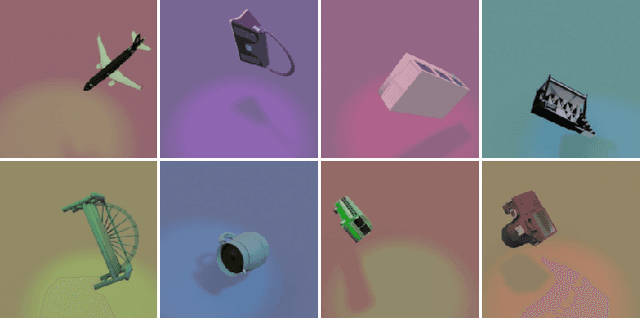
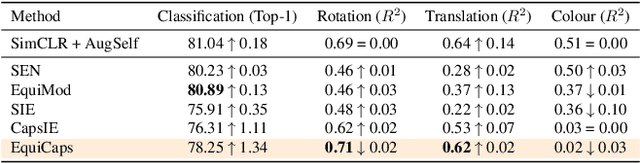
Learning self-supervised representations that are invariant and equivariant to transformations is crucial for advancing beyond traditional visual classification tasks. However, many methods rely on predictor architectures to encode equivariance, despite evidence that architectural choices, such as capsule networks, inherently excel at learning interpretable pose-aware representations. To explore this, we introduce EquiCaps (Equivariant Capsule Network), a capsule-based approach to pose-aware self-supervision that eliminates the need for a specialised predictor for enforcing equivariance. Instead, we leverage the intrinsic pose-awareness capabilities of capsules to improve performance in pose estimation tasks. To further challenge our assumptions, we increase task complexity via multi-geometric transformations to enable a more thorough evaluation of invariance and equivariance by introducing 3DIEBench-T, an extension of a 3D object-rendering benchmark dataset. Empirical results demonstrate that EquiCaps outperforms prior state-of-the-art equivariant methods on rotation prediction, achieving a supervised-level $R^2$ of 0.78 on the 3DIEBench rotation prediction benchmark and improving upon SIE and CapsIE by 0.05 and 0.04 $R^2$, respectively. Moreover, in contrast to non-capsule-based equivariant approaches, EquiCaps maintains robust equivariant performance under combined geometric transformations, underscoring its generalisation capabilities and the promise of predictor-free capsule architectures.
Enhancing Strawberry Yield Forecasting with Backcasted IoT Sensor Data and Machine Learning
Apr 25, 2025Due to rapid population growth globally, digitally-enabled agricultural sectors are crucial for sustainable food production and making informed decisions about resource management for farmers and various stakeholders. The deployment of Internet of Things (IoT) technologies that collect real-time observations of various environmental (e.g., temperature, humidity, etc.) and operational factors (e.g., irrigation) influencing production is often seen as a critical step to enable additional novel downstream tasks, such as AI-based yield forecasting. However, since AI models require large amounts of data, this creates practical challenges in a real-world dynamic farm setting where IoT observations would need to be collected over a number of seasons. In this study, we deployed IoT sensors in strawberry production polytunnels for two growing seasons to collect environmental data, including water usage, external and internal temperature, external and internal humidity, soil moisture, soil temperature, and photosynthetically active radiation. The sensor observations were combined with manually provided yield records spanning a period of four seasons. To bridge the gap of missing IoT observations for two additional seasons, we propose an AI-based backcasting approach to generate synthetic sensor observations using historical weather data from a nearby weather station and the existing polytunnel observations. We built an AI-based yield forecasting model to evaluate our approach using the combination of real and synthetic observations. Our results demonstrated that incorporating synthetic data improved yield forecasting accuracy, with models incorporating synthetic data outperforming those trained only on historical yield, weather records, and real sensor data.