 Add to Chrome
 Add to Firefox
 Add to Edge
Layers Matter: Why Continual Learning Regularization Should Be Layer-Adaptive
Aug 16, 2026
Continual learning regularizers like EWC fight forgetting by penalizing changes from previous-task parameters with per-parameter importance, typically diagonal Fisher values. Per-parameter looks more flexible than per-layer, but each layer's diagonal Fisher is a weak summary of its actual curvature, missing the top-eigenvalue information that controls forgetting. Adversarial bit-flip attacks and Hessian-spectrum studies show that this missing per-layer sensitivity spans orders of magnitude in neural networks. Under a block-diagonal Hessian assumption, the layer-level analogue of EWC's existing diagonal assumption, we prove three things. Forgetting decomposes as a sum of per-layer terms weighted by each layer's top Hessian eigenvalue. Diagonal-Fisher weights cannot recover this eigenvalue. For instance, two layers with identical Fisher averages can have top eigenvalues differing by a factor as large as the layer width. For the same level of forgetting, uniform regularization loses new-task performance by an amount scaling with the layer condition number. Our theoretical analysis leads to a simple recipe: protect early layers strongly, let deeper layers move. We apply this recipe to EWC and SLCA and show clear improvements in average performance and forgetting metrics.

The Gentle Collapse: Distributional Metrics for Continual Learning
Jun 23, 2026Accuracy degradation is the standard metric for Catastrophic Forgetting (CF), however, it records only whether forgetting occurred or not. It saturates at the extremes and collapses discretely at task boundaries, hiding the internal structure of what is being forgotten. We introduce six softmax-derived metrics spanning true-label rank (TLR), predictive confidence, and distributional divergence that characterize forgetting continuously, each normalized to [0, 1] with no modification to training. On CIFAR-100, these metrics carry information where accuracy does not: at 0% accuracy, the Confusion Margin spans an IQR of [0.32, 0.50] across classes that accuracy treats identically. We demonstrate that this richer signal is actionable in mitigating catastrophic forgetting. Per-sample metric scores used as loss weights reduce forgetting by 1.3 percentage points over uniform experience replay (ER) on CIFAR-100. Furthermore, the slope of a metric over a small window provides a stable sampling criterion: at a small-window size (e.g. 3 epochs), accuracy-trend degrades to 34.79% (std. = 2.32) while log-TLR achieves 41.07% (std. = 0.57). This gap is structural since reliable small-window trend estimation requires a continuous signal. On TinyImageNet, log-TLR trend sampling reduces forgetting by 7.7 percentage points over the ER baseline.
TextTeacher: What Can Language Teach About Images?
May 21, 2026The platonic representation hypothesis suggests that sufficiently large models converge to a shared representation geometry, even across modalities. Motivated by this, we ask: Can the semantic knowledge of a language model efficiently improve a vision model? As an answer, we introduce TextTeacher, a simple auxiliary objective that injects text embeddings as additional information into image classification training. TextTeacher uses readily available image captions, a pre-trained and frozen text encoder, and a lightweight projection to produce semantic anchors that efficiently guide representations during training while leaving the inference-time model unchanged. On ImageNet with standard ViT backbones, TextTeacher improves accuracy by up to +2.7 percentage points (p.p.) and yields consistent transfer gains (on average +1.0 p.p.) under the same recipe and compute. It outperforms vision knowledge distillation, yielding more accuracy at a constant compute budget or similar accuracy, but 33% faster. Our analysis indicates that TextTeacher acts as a feature-space preconditioner, shaping deeper layers in the first stages of training, and aiding generalization by supplying complementary semantic cues. TextTeacher adds negligible overhead, requires no costly multimodal training of the target model and preserves the simplicity and latency of pure vision models. Project page with code and captions: https://nauen-it.de/publications/text-teacher
* Published at TMLR
FedAD-Bench: A Unified Benchmark for Federated Unsupervised Anomaly Detection in Tabular Data
Aug 08, 2024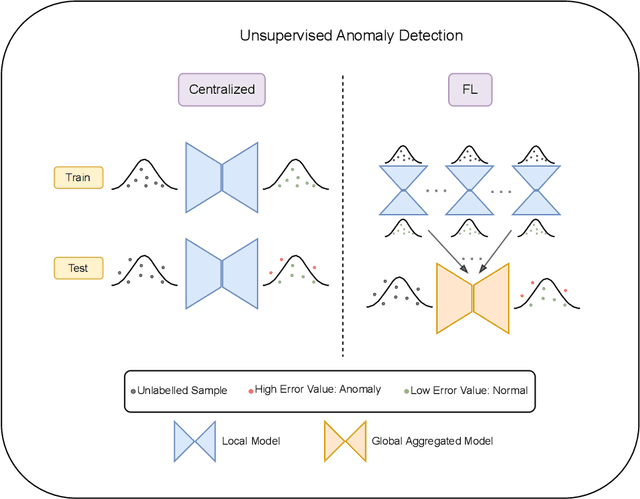
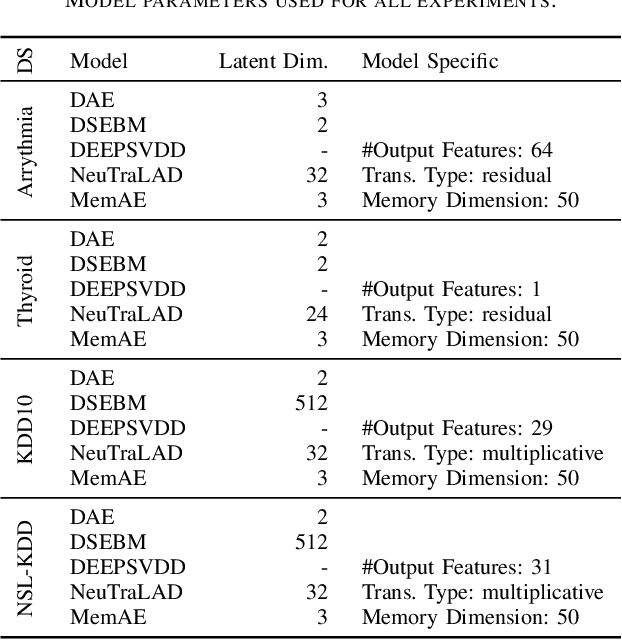
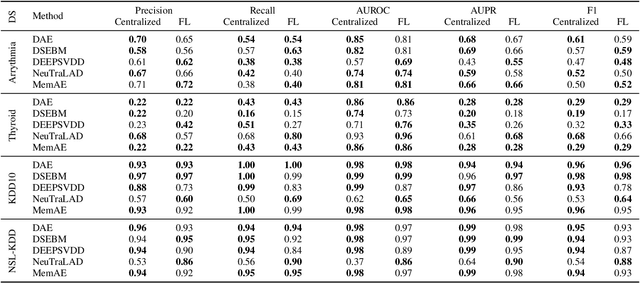
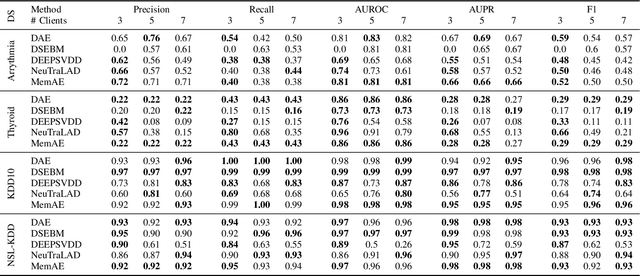
The emergence of federated learning (FL) presents a promising approach to leverage decentralized data while preserving privacy. Furthermore, the combination of FL and anomaly detection is particularly compelling because it allows for detecting rare and critical anomalies (usually also rare in locally gathered data) in sensitive data from multiple sources, such as cybersecurity and healthcare. However, benchmarking the performance of anomaly detection methods in FL environments remains an underexplored area. This paper introduces FedAD-Bench, a unified benchmark for evaluating unsupervised anomaly detection algorithms within the context of FL. We systematically analyze and compare the performance of recent deep learning anomaly detection models under federated settings, which were typically assessed solely in centralized settings. FedAD-Bench encompasses diverse datasets and metrics to provide a holistic evaluation. Through extensive experiments, we identify key challenges such as model aggregation inefficiencies and metric unreliability. We present insights into FL's regularization effects, revealing scenarios in which it outperforms centralized approaches due to its inherent ability to mitigate overfitting. Our work aims to establish a standardized benchmark to guide future research and development in federated anomaly detection, promoting reproducibility and fair comparison across studies.
Federated Learning for Blind Image Super-Resolution
Apr 26, 2024


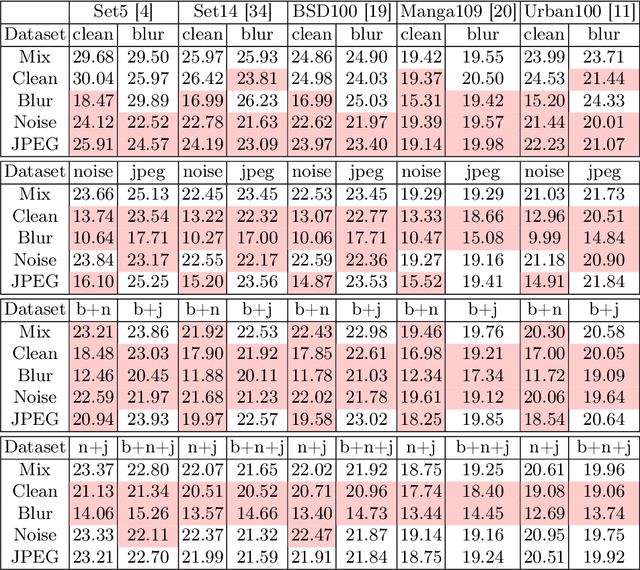
Traditional blind image SR methods need to model real-world degradations precisely. Consequently, current research struggles with this dilemma by assuming idealized degradations, which leads to limited applicability to actual user data. Moreover, the ideal scenario - training models on data from the targeted user base - presents significant privacy concerns. To address both challenges, we propose to fuse image SR with federated learning, allowing real-world degradations to be directly learned from users without invading their privacy. Furthermore, it enables optimization across many devices without data centralization. As this fusion is underexplored, we introduce new benchmarks specifically designed to evaluate new SR methods in this federated setting. By doing so, we employ known degradation modeling techniques from SR research. However, rather than aiming to mirror real degradations, our benchmarks use these degradation models to simulate the variety of degradations found across clients within a distributed user base. This distinction is crucial as it circumvents the need to precisely model real-world degradations, which limits contemporary blind image SR research. Our proposed benchmarks investigate blind image SR under new aspects, namely differently distributed degradation types among users and varying user numbers. We believe new methods tested within these benchmarks will perform more similarly in an application, as the simulated scenario addresses the variety while federated learning enables the training on actual degradations.
Fin-Fed-OD: Federated Outlier Detection on Financial Tabular Data
Apr 23, 2024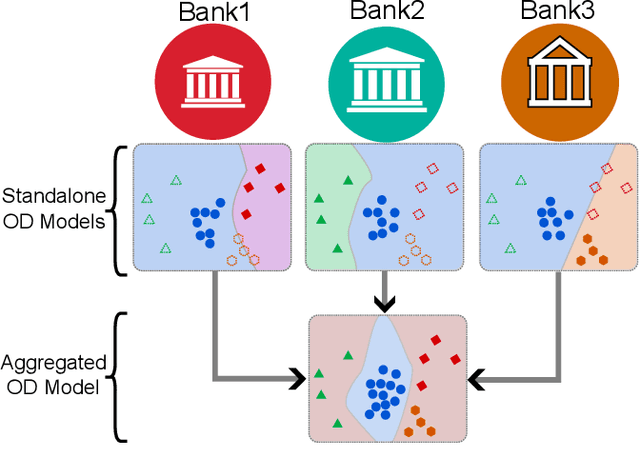


Anomaly detection in real-world scenarios poses challenges due to dynamic and often unknown anomaly distributions, requiring robust methods that operate under an open-world assumption. This challenge is exacerbated in practical settings, where models are employed by private organizations, precluding data sharing due to privacy and competitive concerns. Despite potential benefits, the sharing of anomaly information across organizations is restricted. This paper addresses the question of enhancing outlier detection within individual organizations without compromising data confidentiality. We propose a novel method leveraging representation learning and federated learning techniques to improve the detection of unknown anomalies. Specifically, our approach utilizes latent representations obtained from client-owned autoencoders to refine the decision boundary of inliers. Notably, only model parameters are shared between organizations, preserving data privacy. The efficacy of our proposed method is evaluated on two standard financial tabular datasets and an image dataset for anomaly detection in a distributed setting. The results demonstrate a strong improvement in the classification of unknown outliers during the inference phase for each organization's model.