 Add to Chrome
 Add to Firefox
 Add to Edge
Layers Matter: Why Continual Learning Regularization Should Be Layer-Adaptive
Aug 16, 2026
Continual learning regularizers like EWC fight forgetting by penalizing changes from previous-task parameters with per-parameter importance, typically diagonal Fisher values. Per-parameter looks more flexible than per-layer, but each layer's diagonal Fisher is a weak summary of its actual curvature, missing the top-eigenvalue information that controls forgetting. Adversarial bit-flip attacks and Hessian-spectrum studies show that this missing per-layer sensitivity spans orders of magnitude in neural networks. Under a block-diagonal Hessian assumption, the layer-level analogue of EWC's existing diagonal assumption, we prove three things. Forgetting decomposes as a sum of per-layer terms weighted by each layer's top Hessian eigenvalue. Diagonal-Fisher weights cannot recover this eigenvalue. For instance, two layers with identical Fisher averages can have top eigenvalues differing by a factor as large as the layer width. For the same level of forgetting, uniform regularization loses new-task performance by an amount scaling with the layer condition number. Our theoretical analysis leads to a simple recipe: protect early layers strongly, let deeper layers move. We apply this recipe to EWC and SLCA and show clear improvements in average performance and forgetting metrics.

LUMA: Benchmarking Segmentation via a Lightweight Universal Mask Adapter
Jul 01, 2026Comparing transformer backbones for image segmentation is confounded: each is paired with a different decoder, recipe, and pretraining, so reported differences rarely reflect the backbone itself. We introduce the Lightweight Universal Mask Adapter (LUMA), a lightweight, backbone-agnostic mask-transformer head that treats any backbone as a black-box feature extractor, letting a set of queries read from its features through cheap cross-attention. LUMA matches the accuracy of EoMT, the state-of-the-art efficient ViT-segmenter, at lower cost, while attaching unchanged to isotropic, hierarchical, convolutional, and mixture-of-experts backbones alike. Holding this head fixed, we benchmark 20 backbones, 11 pretraining schemes and a range of resolutions on ADE20K and Cityscapes under one modern recipe. We find that ``efficient'' token mixers fail to deliver efficiency even at the high resolutions that motivate them, with plain ViT holding the throughput Pareto-front at every resolution. Additionally, the pretraining objective, not the architecture, the lever the field has tuned hardest, governs segmentation quality.
OA-CutMix: Correcting the Label Bias of CutMix
Jun 03, 2026CutMix has become the de facto standard mixing augmentation, yet its label assignment rests on a flawed assumption: The area of the pasted patch faithfully reflects its semantic contribution to the mixed image. In practice, however, patches frequently land on background regions, assigning label credit to classes whose objects are not visible. The mean discrepancy of the CutMix label and the semantic object area is $21.5\%$. In $17\%$ of samples an image contributes zero visible object pixels yet receives nonzero label weight. We propose Object-Aware CutMix (OA-CutMix), which corrects this bias by replacing the area-based CutMix weight with one derived from precomputed segmentation masks, assigning labels in proportion to the visible object area each image contributes to the mix. The image mixing procedure is left entirely unchanged. We evaluate OA-CutMix against 10+ static and dynamic mixing methods across 4 architectures and 6 datasets. OA-CutMix consistently achieves the highest accuracy over all tasks, outperforming even dynamic mixing methods, but at a fraction of the training-time cost. Improvements are largest for small objects, where the label bias from CutMix is greatest. Thus, correcting the label is sufficient to match or exceed the performance of methods modifying the image mixing algorithm.
PRISM: Diversifying Dataset Distillation by Decoupling Architectural Priors
Nov 13, 2025Dataset distillation (DD) promises compact yet faithful synthetic data, but existing approaches often inherit the inductive bias of a single teacher model. As dataset size increases, this bias drives generation toward overly smooth, homogeneous samples, reducing intra-class diversity and limiting generalization. We present PRISM (PRIors from diverse Source Models), a framework that disentangles architectural priors during synthesis. PRISM decouples the logit-matching and regularization objectives, supervising them with different teacher architectures: a primary model for logits and a stochastic subset for batch-normalization (BN) alignment. On ImageNet-1K, PRISM consistently and reproducibly outperforms single-teacher methods (e.g., SRe2L) and recent multi-teacher variants (e.g., G-VBSM) at low- and mid-IPC regimes. The generated data also show significantly richer intra-class diversity, as reflected by a notable drop in cosine similarity between features. We further analyze teacher selection strategies (pre- vs. intra-distillation) and introduce a scalable cross-class batch formation scheme for fast parallel synthesis. Code will be released after the review period.
A Coreset Selection of Coreset Selection Literature: Introduction and Recent Advances
May 23, 2025Coreset selection targets the challenge of finding a small, representative subset of a large dataset that preserves essential patterns for effective machine learning. Although several surveys have examined data reduction strategies before, most focus narrowly on either classical geometry-based methods or active learning techniques. In contrast, this survey presents a more comprehensive view by unifying three major lines of coreset research, namely, training-free, training-oriented, and label-free approaches, into a single taxonomy. We present subfields often overlooked by existing work, including submodular formulations, bilevel optimization, and recent progress in pseudo-labeling for unlabeled datasets. Additionally, we examine how pruning strategies influence generalization and neural scaling laws, offering new insights that are absent from prior reviews. Finally, we compare these methods under varying computational, robustness, and performance demands and highlight open challenges, such as robustness, outlier filtering, and adapting coreset selection to foundation models, for future research.
A Study in Dataset Distillation for Image Super-Resolution
Feb 05, 2025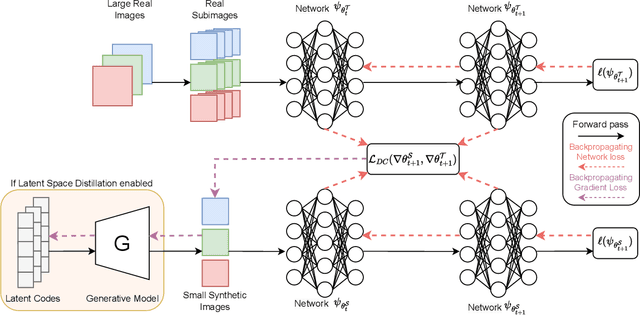


Dataset distillation is the concept of condensing large datasets into smaller but highly representative synthetic samples. While previous research has primarily focused on image classification, its application to image Super-Resolution (SR) remains underexplored. This exploratory work studies multiple dataset distillation techniques applied to SR, including pixel- and latent-space approaches under different aspects. Our experiments demonstrate that a 91.12% dataset size reduction can be achieved while maintaining comparable SR performance to the full dataset. We further analyze initialization strategies and distillation methods to optimize memory efficiency and computational costs. Our findings provide new insights into dataset distillation for SR and set the stage for future advancements.
Multi-Label Scene Classification in Remote Sensing Benefits from Image Super-Resolution
Jan 12, 2025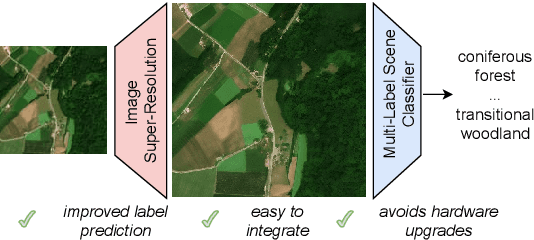

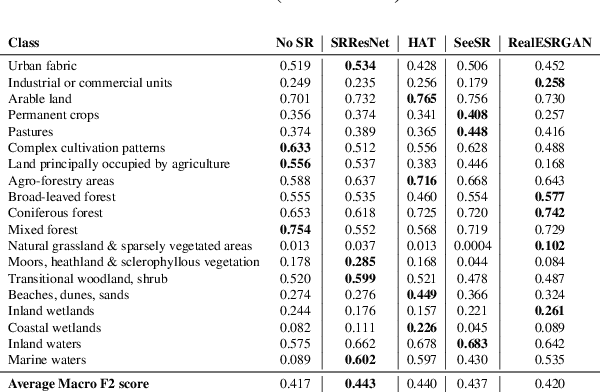
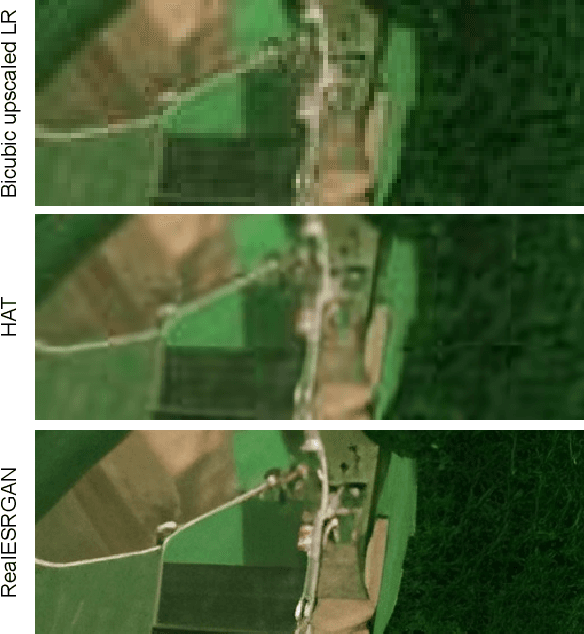
Satellite imagery is a cornerstone for numerous Remote Sensing (RS) applications; however, limited spatial resolution frequently hinders the precision of such systems, especially in multi-label scene classification tasks as it requires a higher level of detail and feature differentiation. In this study, we explore the efficacy of image Super-Resolution (SR) as a pre-processing step to enhance the quality of satellite images and thus improve downstream classification performance. We investigate four SR models - SRResNet, HAT, SeeSR, and RealESRGAN - and evaluate their impact on multi-label scene classification across various CNN architectures, including ResNet-50, ResNet-101, ResNet-152, and Inception-v4. Our results show that applying SR significantly improves downstream classification performance across various metrics, demonstrating its ability to preserve spatial details critical for multi-label tasks. Overall, this work offers valuable insights into the selection of SR techniques for multi-label prediction in remote sensing and presents an easy-to-integrate framework to improve existing RS systems.
Distill the Best, Ignore the Rest: Improving Dataset Distillation with Loss-Value-Based Pruning
Nov 18, 2024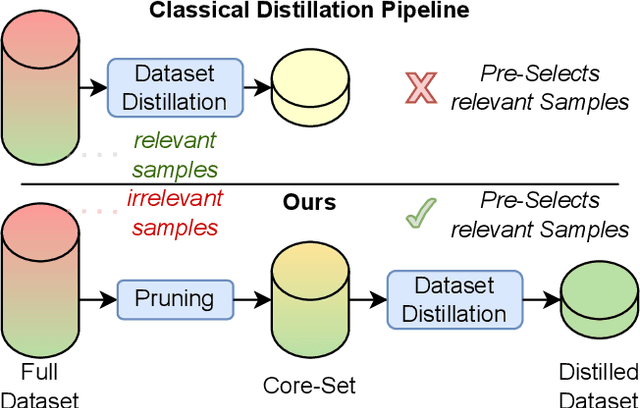
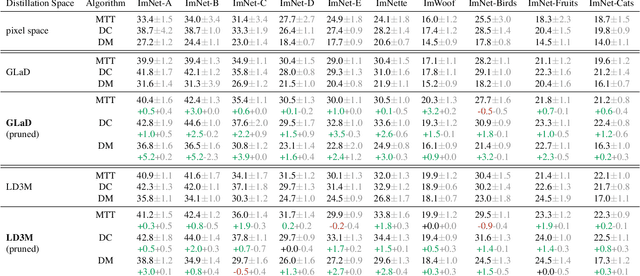
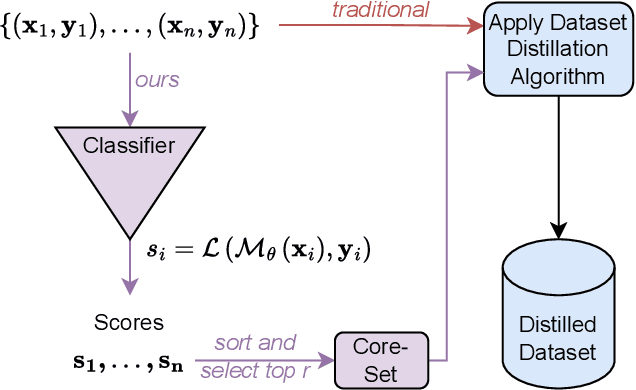
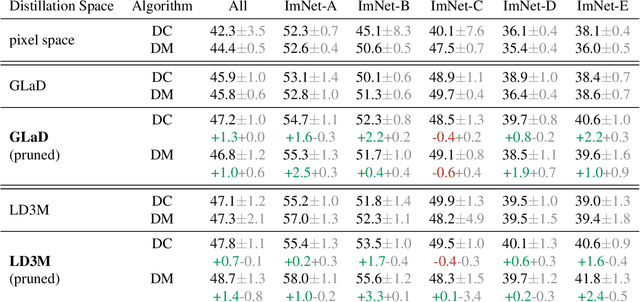
Dataset distillation has gained significant interest in recent years, yet existing approaches typically distill from the entire dataset, potentially including non-beneficial samples. We introduce a novel "Prune First, Distill After" framework that systematically prunes datasets via loss-based sampling prior to distillation. By leveraging pruning before classical distillation techniques and generative priors, we create a representative core-set that leads to enhanced generalization for unseen architectures - a significant challenge of current distillation methods. More specifically, our proposed framework significantly boosts distilled quality, achieving up to a 5.2 percentage points accuracy increase even with substantial dataset pruning, i.e., removing 80% of the original dataset prior to distillation. Overall, our experimental results highlight the advantages of our easy-sample prioritization and cross-architecture robustness, paving the way for more effective and high-quality dataset distillation.
Just Leaf It: Accelerating Diffusion Classifiers with Hierarchical Class Pruning
Nov 18, 2024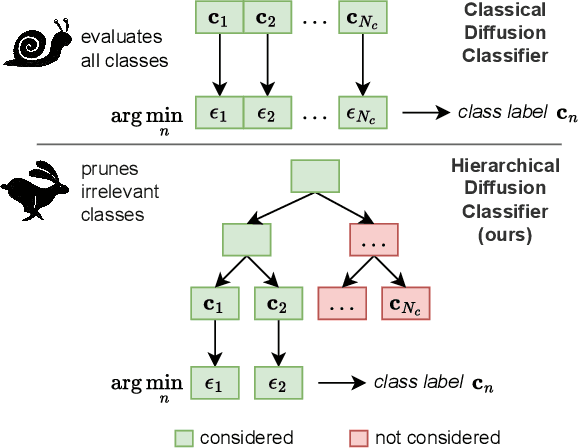

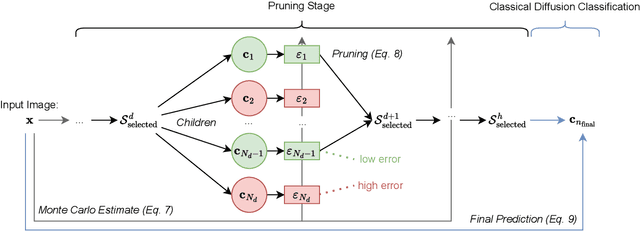

Diffusion models, known for their generative capabilities, have recently shown unexpected potential in image classification tasks by using Bayes' theorem. However, most diffusion classifiers require evaluating all class labels for a single classification, leading to significant computational costs that can hinder their application in large-scale scenarios. To address this, we present a Hierarchical Diffusion Classifier (HDC) that exploits the inherent hierarchical label structure of a dataset. By progressively pruning irrelevant high-level categories and refining predictions only within relevant subcategories, i.e., leaf nodes, HDC reduces the total number of class evaluations. As a result, HDC can accelerate inference by up to 60% while maintaining and, in some cases, improving classification accuracy. Our work enables a new control mechanism of the trade-off between speed and precision, making diffusion-based classification more viable for real-world applications, particularly in large-scale image classification tasks.
Zoomed In, Diffused Out: Towards Local Degradation-Aware Multi-Diffusion for Extreme Image Super-Resolution
Nov 18, 2024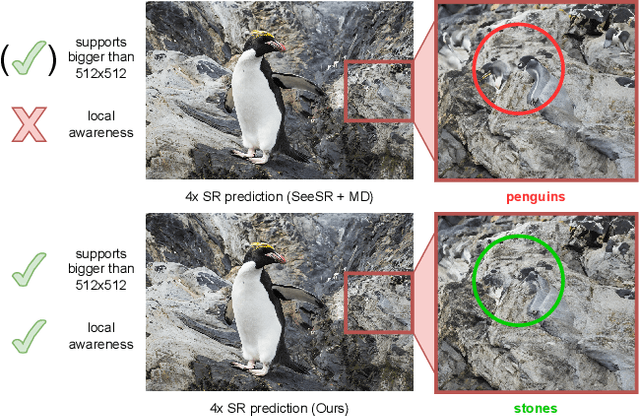
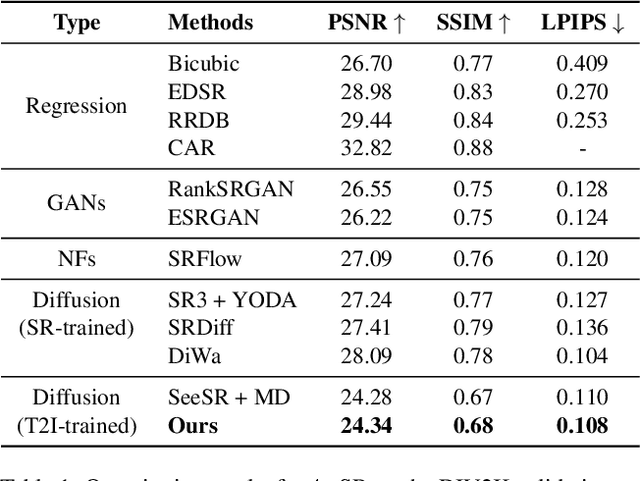
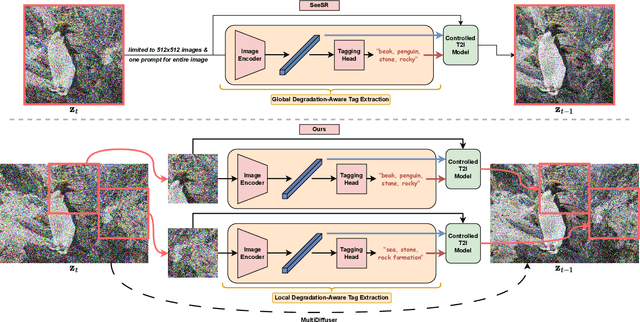
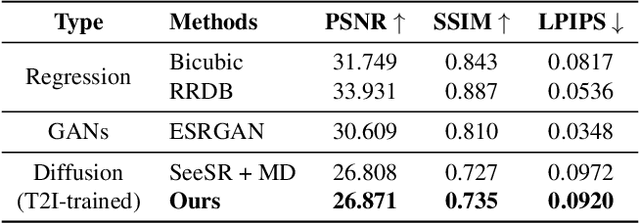
Large-scale, pre-trained Text-to-Image (T2I) diffusion models have gained significant popularity in image generation tasks and have shown unexpected potential in image Super-Resolution (SR). However, most existing T2I diffusion models are trained with a resolution limit of 512x512, making scaling beyond this resolution an unresolved but necessary challenge for image SR. In this work, we introduce a novel approach that, for the first time, enables these models to generate 2K, 4K, and even 8K images without any additional training. Our method leverages MultiDiffusion, which distributes the generation across multiple diffusion paths to ensure global coherence at larger scales, and local degradation-aware prompt extraction, which guides the T2I model to reconstruct fine local structures according to its low-resolution input. These innovations unlock higher resolutions, allowing T2I diffusion models to be applied to image SR tasks without limitation on resolution.