 Add to Chrome
 Add to Firefox
 Add to Edge
Layers Matter: Why Continual Learning Regularization Should Be Layer-Adaptive
Aug 16, 2026
Continual learning regularizers like EWC fight forgetting by penalizing changes from previous-task parameters with per-parameter importance, typically diagonal Fisher values. Per-parameter looks more flexible than per-layer, but each layer's diagonal Fisher is a weak summary of its actual curvature, missing the top-eigenvalue information that controls forgetting. Adversarial bit-flip attacks and Hessian-spectrum studies show that this missing per-layer sensitivity spans orders of magnitude in neural networks. Under a block-diagonal Hessian assumption, the layer-level analogue of EWC's existing diagonal assumption, we prove three things. Forgetting decomposes as a sum of per-layer terms weighted by each layer's top Hessian eigenvalue. Diagonal-Fisher weights cannot recover this eigenvalue. For instance, two layers with identical Fisher averages can have top eigenvalues differing by a factor as large as the layer width. For the same level of forgetting, uniform regularization loses new-task performance by an amount scaling with the layer condition number. Our theoretical analysis leads to a simple recipe: protect early layers strongly, let deeper layers move. We apply this recipe to EWC and SLCA and show clear improvements in average performance and forgetting metrics.

Sequence-SOD: Bio-inspired Sequence-aware Spiking ObjectDetection for Event Cameras
Jul 29, 2026Event cameras follow a retina-inspired sensing principle, reporting local intensity changes asynchronously with hightemporal resolution and a wide dynamic range. Spiking Neural Networks (SNNs) complement these sparse event streams through brain-inspired dynamics, using sparse spikes and leaky membrane potentials to integrate information over time. However, many SNN object detectors process isolated event intervals with a single label and reset the network state after each prediction, thereby underusing temporal information in continuous event streams. We introduce Sequence-SOD, a sequence-aware SNN object detector that processes extended event sequences containing labels at multiple time points. Events are accumulated into short intervals, discretized into temporal steps, and fed sequentially to an SSD-style Spiking DenseNet while preserving membrane potentials across intervals within a sequence, so that detection is driven by an evolving neural state instead of independently reset input windows. On the Gen1 Automotive Detection Dataset, sequence-aware training improves mAP from 23.38 for single-interval training to 25.30 without augmentation and to 26.88 withevent-data augmentation. The model achieves a theoretical prediction frequency of 40 Hz. Training and evaluating SNN object detectors on extended event sequences improves their ability to exploit temporal cues while preserving the energy-efficiency benefits of sparse spiking computation. The results highlight sequence-aware training as a complementary direction to architectural improvements for event-based SNN detection.
Bounding Box Label Propagation for Re-Annotation of Document Layout Analysis Datasets
Jun 16, 2026Datasets in practical document processing scenarios typically grow over time, and their class annotations undergo continuous refinement. This creates significant re-annotation efforts, which are time-consuming and costly. A promising remedy is to re-annotate only a small subset of available documents manually and apply semi-supervised learning techniques that leverage both labelled and unlabelled data. Although there are numerous approaches to tackle this problem for classification, there exists no adaptation for the problem of re-classifying object detection instances, e.g. for document layout analysis. To this end, we propose Bounding Box Label Propagation (BBLP), a pseudo-labelling framework for object detection. An object encoder integrates visual, textual, and positional embeddings from object detection samples to come up with a joint embedding that can be used for Label Propagation on partially annotated datasets in a plug-and-play fashion. Evaluation results indicate that the proposed approach produces high-quality class annotations of bounding boxes. In the D4LA layout analysis dataset, it achieves a mAP of 54.0%, corresponding to 81.6% of fully supervised performance, while using only 10% labelled data. Our work demonstrates the potential of Label Propagation for object detection and lays the groundwork for reducing manual annotation efforts in real-world document processing applications.
MILE: Mixture of Incremental LoRA Experts for Continual Semantic Segmentation across Domains and Modalities
May 05, 2026Continual semantic segmentation requires models to adapt to new domains or modalities without sacrificing performance on previously learned tasks. Expert-based learning, in which task-specific modules specialize in different domains, has proven effective in mitigating forgetting. These methods include dynamic expansion, which suffers from scalability issues, or parameter isolation, which constrains the ability to learn new tasks. We introduce Mixture of Incremental LoRA Experts (MILE), a modular and parameter-efficient framework for continual segmentation across both domains and modalities. MILE leverages Low-Rank Adaptation (LoRA) to instantiate lightweight experts for each new task while keeping the pretrained base network frozen. Each expert is trained exclusively on its task data, thus avoids overwriting previously learned information. A prototype-guided gating mechanism dynamically selects the most appropriate expert at inference. MILE achieves the benefits of expert-based learning while overcoming its scalability limitations. It requires only a marginal parameter increase per task and tens of LoRA adapters are needed before matching the size of a single full model, making it highly efficient in both training and storage. Across domain- and modality-incremental benchmarks, MILE achieves strong performance while ensuring better stability, plasticity, and scalability.
Sensor Generalization for Adaptive Sensing in Event-based Object Detection via Joint Distribution Training
Feb 26, 2026Bio-inspired event cameras have recently attracted significant research due to their asynchronous and low-latency capabilities. These features provide a high dynamic range and significantly reduce motion blur. However, because of the novelty in the nature of their output signals, there is a gap in the variability of available data and a lack of extensive analysis of the parameters characterizing their signals. This paper addresses these issues by providing readers with an in-depth understanding of how intrinsic parameters affect the performance of a model trained on event data, specifically for object detection. We also use our findings to expand the capabilities of the downstream model towards sensor-agnostic robustness.
LiREC-Net: A Target-Free and Learning-Based Network for LiDAR, RGB, and Event Calibration
Feb 25, 2026Advanced autonomous systems rely on multi-sensor fusion for safer and more robust perception. To enable effective fusion, calibrating directly from natural driving scenes (i.e., target-free) with high accuracy is crucial for precise multi-sensor alignment. Existing learning-based calibration methods are typically designed for only a single pair of sensor modalities (i.e., a bi-modal setup). Unlike these methods, we propose LiREC-Net, a target-free, learning-based calibration network that jointly calibrates multiple sensor modality pairs, including LiDAR, RGB, and event data, within a unified framework. To reduce redundant computation and improve efficiency, we introduce a shared LiDAR representation that leverages features from both its 3D nature and projected depth map, ensuring better consistency across modalities. Trained and evaluated on established datasets, such as KITTI and DSEC, our LiREC-Net achieves competitive performance to bi-modal models and sets a new strong baseline for the tri-modal use case.
SF3D-RGB: Scene Flow Estimation from Monocular Camera and Sparse LiDAR
Feb 25, 2026Scene flow estimation is an extremely important task in computer vision to support the perception of dynamic changes in the scene. For robust scene flow, learning-based approaches have recently achieved impressive results using either image-based or LiDAR-based modalities. However, these methods have tended to focus on the use of a single modality. To tackle these problems, we present a deep learning architecture, SF3D-RGB, that enables sparse scene flow estimation using 2D monocular images and 3D point clouds (e.g., acquired by LiDAR) as inputs. Our architecture is an end-to-end model that first encodes information from each modality into features and fuses them together. Then, the fused features enhance a graph matching module for better and more robust mapping matrix computation to generate an initial scene flow. Finally, a residual scene flow module further refines the initial scene flow. Our model is designed to strike a balance between accuracy and efficiency. Furthermore, experiments show that our proposed method outperforms single-modality methods and achieves better scene flow accuracy on real-world datasets while using fewer parameters compared to other state-of-the-art methods with fusion.
SAILS: Segment Anything with Incrementally Learned Semantics for Task-Invariant and Training-Free Continual Learning
Feb 16, 2026Continual learning remains constrained by the need for repeated retraining, high computational costs, and the persistent challenge of forgetting. These factors significantly limit the applicability of continuous learning in real-world settings, as iterative model updates require significant computational resources and inherently exacerbate forgetting. We present SAILS -- Segment Anything with Incrementally Learned Semantics, a training-free framework for Class-Incremental Semantic Segmentation (CISS) that sidesteps these challenges entirely. SAILS leverages foundational models to decouple CISS into two stages: Zero-shot region extraction using Segment Anything Model (SAM), followed by semantic association through prototypes in a fixed feature space. SAILS incorporates selective intra-class clustering, resulting in multiple prototypes per class to better model intra-class variability. Our results demonstrate that, despite requiring no incremental training, SAILS typically surpasses the performance of existing training-based approaches on standard CISS datasets, particularly in long and challenging task sequences where forgetting tends to be most severe. By avoiding parameter updates, SAILS completely eliminates forgetting and maintains consistent, task-invariant performance. Furthermore, SAILS exhibits positive backward transfer, where the introduction of new classes can enhance performance on previous classes.
Domain-Incremental Semantic Segmentation for Autonomous Driving under Adverse Driving Conditions
Jan 09, 2025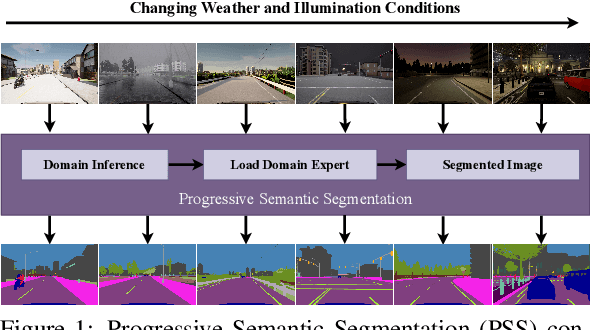

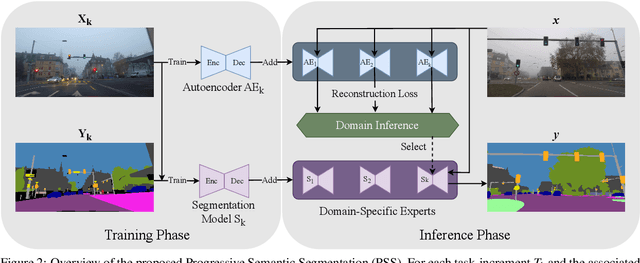

Semantic segmentation for autonomous driving is an even more challenging task when faced with adverse driving conditions. Standard models trained on data recorded under ideal conditions show a deteriorated performance in unfavorable weather or illumination conditions. Fine-tuning on the new task or condition would lead to overwriting the previously learned information resulting in catastrophic forgetting. Adapting to the new conditions through traditional domain adaption methods improves the performance on the target domain at the expense of the source domain. Addressing these issues, we propose an architecture-based domain-incremental learning approach called Progressive Semantic Segmentation (PSS). PSS is a task-agnostic, dynamically growing collection of domain-specific segmentation models. The task of inferring the domain and subsequently selecting the appropriate module for segmentation is carried out using a collection of convolutional autoencoders. We extensively evaluate our proposed approach using several datasets at varying levels of granularity in the categorization of adverse driving conditions. Furthermore, we demonstrate the generalization of the proposed approach to similar and unseen domains.
Modality-Incremental Learning with Disjoint Relevance Mapping Networks for Image-based Semantic Segmentation
Nov 26, 2024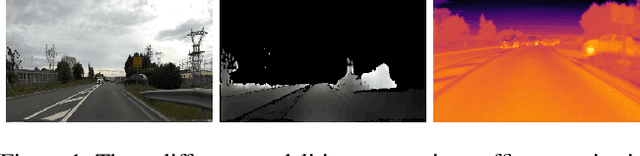

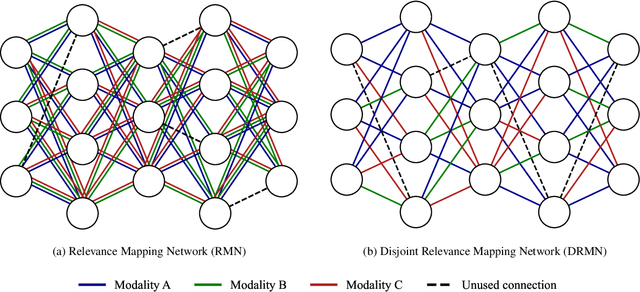

In autonomous driving, environment perception has significantly advanced with the utilization of deep learning techniques for diverse sensors such as cameras, depth sensors, or infrared sensors. The diversity in the sensor stack increases the safety and contributes to robustness against adverse weather and lighting conditions. However, the variance in data acquired from different sensors poses challenges. In the context of continual learning (CL), incremental learning is especially challenging for considerably large domain shifts, e.g. different sensor modalities. This amplifies the problem of catastrophic forgetting. To address this issue, we formulate the concept of modality-incremental learning and examine its necessity, by contrasting it with existing incremental learning paradigms. We propose the use of a modified Relevance Mapping Network (RMN) to incrementally learn new modalities while preserving performance on previously learned modalities, in which relevance maps are disjoint. Experimental results demonstrate that the prevention of shared connections in this approach helps alleviate the problem of forgetting within the constraints of a strict continual learning framework.