 Add to Chrome
 Add to Firefox
 Add to Edge
TextTeacher: What Can Language Teach About Images?
May 21, 2026
The platonic representation hypothesis suggests that sufficiently large models converge to a shared representation geometry, even across modalities. Motivated by this, we ask: Can the semantic knowledge of a language model efficiently improve a vision model? As an answer, we introduce TextTeacher, a simple auxiliary objective that injects text embeddings as additional information into image classification training. TextTeacher uses readily available image captions, a pre-trained and frozen text encoder, and a lightweight projection to produce semantic anchors that efficiently guide representations during training while leaving the inference-time model unchanged. On ImageNet with standard ViT backbones, TextTeacher improves accuracy by up to +2.7 percentage points (p.p.) and yields consistent transfer gains (on average +1.0 p.p.) under the same recipe and compute. It outperforms vision knowledge distillation, yielding more accuracy at a constant compute budget or similar accuracy, but 33% faster. Our analysis indicates that TextTeacher acts as a feature-space preconditioner, shaping deeper layers in the first stages of training, and aiding generalization by supplying complementary semantic cues. TextTeacher adds negligible overhead, requires no costly multimodal training of the target model and preserves the simplicity and latency of pure vision models. Project page with code and captions: https://nauen-it.de/publications/text-teacher
* Published at TMLR

LimeCross: Context-Conditioned Layered Image Editing with Structural Consistency
May 11, 2026Layered image assets are widely used in real-world creative workflows, enabling non-destructive iteration and flexible re-composition. Recent advances in layered image generation and decomposition synthesize or recover layered representations, yet controllable editing of layered images remains challenging. Manual editing requires careful coordination across layers to maintain consistent illumination and contact, while AI-based pipelines collapse layers into a flattened image for editing, then decompose them again, introducing background-to-foreground leakage and unstable transparency. To address these limitations, we propose LimeCross, a training-free context-conditioned layered image editing framework that edits user-selected RGBA layers according to text while keeping the remaining layers unchanged. It leverages contextual cues from other layers using a bi-stream attention mechanism to preserve cross-layer consistency, while explicitly maintaining layer integrity to prevent the contamination of edited layers. To evaluate our approach, we introduce LayerEditBench, a benchmark of 1500 layered scenes with paired source/target prompts, along with evaluation protocols that assess both edit fidelity and alpha channel stability. Extensive experiments demonstrate that LimeCross improves layer purity and composite realism over strong editing baselines, establishing context-conditioned layered editing as a principled framework for controllable generative creation.
LGTM: Training-Free Light-Guided Text-to-Image Diffusion Model via Initial Noise Manipulation
Mar 25, 2026Diffusion models have demonstrated high-quality performance in conditional text-to-image generation, particularly with structural cues such as edges, layouts, and depth. However, lighting conditions have received limited attention and remain difficult to control within the generative process. Existing methods handle lighting through a two-stage pipeline that relights images after generation, which is inefficient. Moreover, they rely on fine-tuning with large datasets and heavy computation, limiting their adaptability to new models and tasks. To address this, we propose a novel Training-Free Light-Guided Text-to-Image Diffusion Model via Initial Noise Manipulation (LGTM), which manipulates the initial latent noise of the diffusion process to guide image generation with text prompts and user-specified light directions. Through a channel-wise analysis of the latent space, we find that selectively manipulating latent channels enables fine-grained lighting control without fine-tuning or modifying the pre-trained model. Extensive experiments show that our method surpasses prompt-based baselines in lighting consistency, while preserving image quality and text alignment. This approach introduces new possibilities for dynamic, user-guided light control. Furthermore, it integrates seamlessly with models like ControlNet, demonstrating adaptability across diverse scenarios.
Spherical Dense Text-to-Image Synthesis
Feb 19, 2025Recent advancements in text-to-image (T2I) have improved synthesis results, but challenges remain in layout control and generating omnidirectional panoramic images. Dense T2I (DT2I) and spherical T2I (ST2I) models address these issues, but so far no unified approach exists. Trivial approaches, like prompting a DT2I model to generate panoramas can not generate proper spherical distortions and seamless transitions at the borders. Our work shows that spherical dense text-to-image (SDT2I) can be achieved by integrating training-free DT2I approaches into finetuned panorama models. Specifically, we propose MultiStitchDiffusion (MSTD) and MultiPanFusion (MPF) by integrating MultiDiffusion into StitchDiffusion and PanFusion, respectively. Since no benchmark for SDT2I exists, we further construct Dense-Synthetic-View (DSynView), a new synthetic dataset containing spherical layouts to evaluate our models. Our results show that MSTD outperforms MPF across image quality as well as prompt- and layout adherence. MultiPanFusion generates more diverse images but struggles to synthesize flawless foreground objects. We propose bootstrap-coupling and turning off equirectangular perspective-projection attention in the foreground as an improvement of MPF.
TKG-DM: Training-free Chroma Key Content Generation Diffusion Model
Nov 23, 2024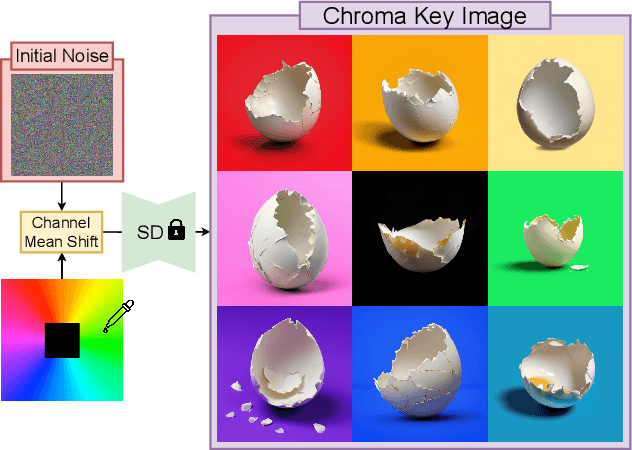
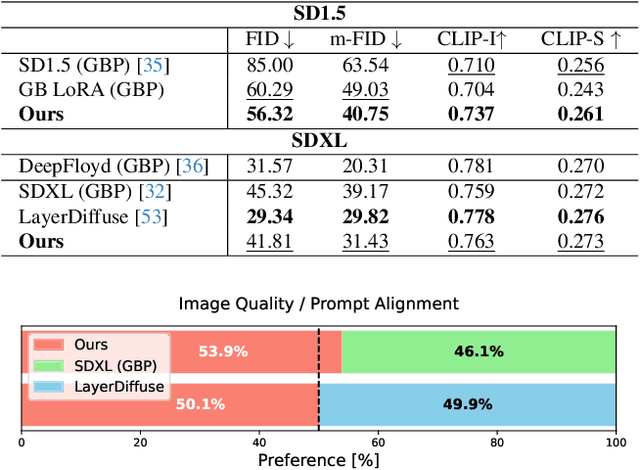
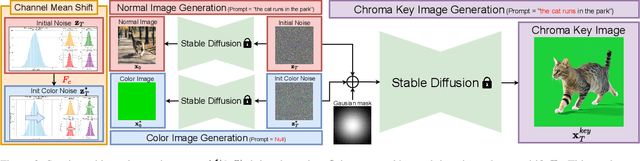
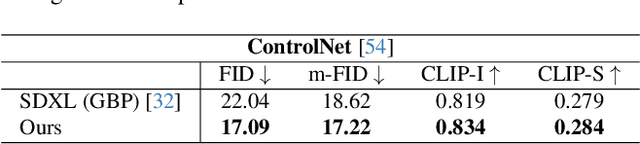
Diffusion models have enabled the generation of high-quality images with a strong focus on realism and textual fidelity. Yet, large-scale text-to-image models, such as Stable Diffusion, struggle to generate images where foreground objects are placed over a chroma key background, limiting their ability to separate foreground and background elements without fine-tuning. To address this limitation, we present a novel Training-Free Chroma Key Content Generation Diffusion Model (TKG-DM), which optimizes the initial random noise to produce images with foreground objects on a specifiable color background. Our proposed method is the first to explore the manipulation of the color aspects in initial noise for controlled background generation, enabling precise separation of foreground and background without fine-tuning. Extensive experiments demonstrate that our training-free method outperforms existing methods in both qualitative and quantitative evaluations, matching or surpassing fine-tuned models. Finally, we successfully extend it to other tasks (e.g., consistency models and text-to-video), highlighting its transformative potential across various generative applications where independent control of foreground and background is crucial.
A Low-Resolution Image is Worth 1x1 Words: Enabling Fine Image Super-Resolution with Transformers and TaylorShift
Nov 15, 2024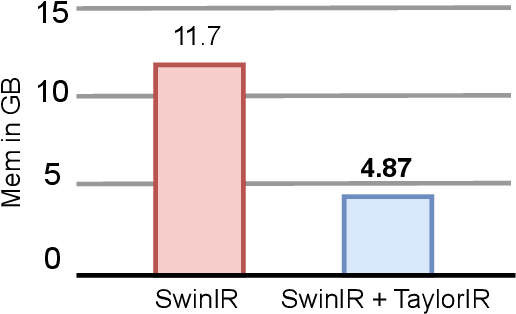

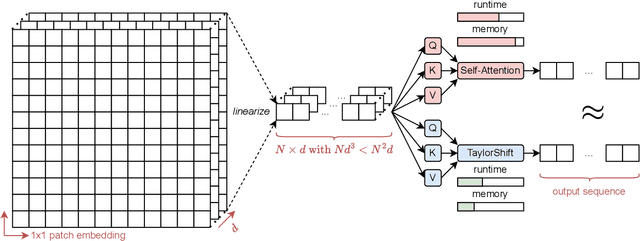
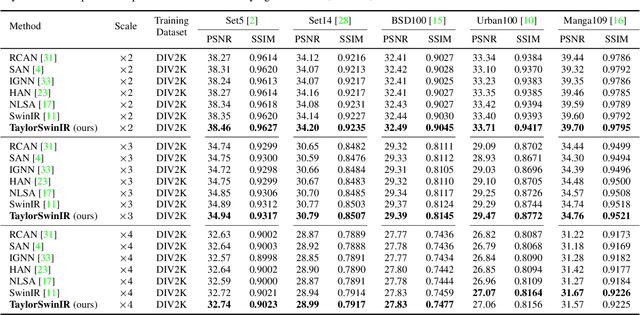
Transformer-based Super-Resolution (SR) models have recently advanced image reconstruction quality, yet challenges remain due to computational complexity and an over-reliance on large patch sizes, which constrain fine-grained detail enhancement. In this work, we propose TaylorIR to address these limitations by utilizing a patch size of 1x1, enabling pixel-level processing in any transformer-based SR model. To address the significant computational demands under the traditional self-attention mechanism, we employ the TaylorShift attention mechanism, a memory-efficient alternative based on Taylor series expansion, achieving full token-to-token interactions with linear complexity. Experimental results demonstrate that our approach achieves new state-of-the-art SR performance while reducing memory consumption by up to 60% compared to traditional self-attention-based transformers.