 Add to Chrome
 Add to Firefox
 Add to Edge
Exact Posterior Score Estimation for Solving Linear Inverse Problems
Jun 15, 2026
Diffusion and flow-based models learn powerful data priors by training a denoiser to reverse Gaussian corruption. To use this prior to solve a linear inverse problem, one needs to sample from the posterior, but the score that the prior provides is the unconditional score, not the posterior score. Existing methods either steer a fixed pretrained denoiser with approximate measurement-matching corrections, or train a conditional restoration model that abandons the denoising structure of the prior. We derive the exact posterior score in closed form for linear Gaussian inverse problems under general Gaussian interpolants, and show that posterior sampling reduces to a denoising problem at an operator-dependent shifted pivot under an anisotropic noise covariance. We turn this identity into Exact Posterior Score (EPS), a denoising training objective that preserves the input/output structure of standard pretraining and can therefore be trained from scratch or fine-tuned from a pretrained denoiser. At inference, EPS uses the same sampler as the underlying backbone, with no likelihood gradients or projections. We evaluate EPS on five linear inverse problems across FFHQ and ImageNet, where it outperforms training-free and training-based baselines on fidelity, perceptual, and distributional metrics, while using roughly an order of magnitude fewer denoiser evaluations than gradient-based posterior samplers.

VideoMLA: Low-Rank Latent KV Cache for Minute-Scale Autoregressive Video Diffusion
May 28, 2026Long-rollout causal video diffusion has converged on a fixed-size sliding-window KV cache, with recent progress innovating within this layout by changing which tokens occupy the window or how their positions are encoded. The per-head KV layout itself, a dominant contributor to streaming memory and latency, has been mostly left unchanged. In this paper, we present the first study of Multi-Head Latent Attention (MLA) in video diffusion. VideoMLA replaces per-head keys and values with a shared low-rank content latent and a shared decoupled 3D-RoPE positional key, reducing per-token KV memory by 92.7% at every cached layer. We further investigate why MLA succeeds in video diffusion even though the spectral assumption often used to motivate it in language models does not hold: pretrained video attention is not low-rank, with 99%-energy effective rank far above any practical latent dimension. VideoMLA retains quality at compression ratios where direct spectral approximation would predict large reconstruction error. We show that the MLA bottleneck, rather than the pretrained spectrum, determines the effective rank: both spectral and random initialization occupy nearly the full rank budget from initialization, and training preserves this budget while adapting within it. On VBench, VideoMLA matches short-horizon streaming video diffusion baselines, achieves the best overall score at long horizons among evaluated methods, and improves throughput by 1.23x on a single B200.
Aligning Latent Geometry for Spherical Flow Matching in Image Generation
May 14, 2026Latent flow matching for image generation usually transports Gaussian noise to variational autoencoder latents along linear paths. Both endpoints, however, concentrate in thin spherical shells, and a Euclidean chord leaves those shells even when preprocessing aligns their radii. By decomposing each latent token into radial and angular components, we show through component-swap probes that decoded perceptual and semantic content is carried predominantly by direction, with radius contributing much less. We therefore project data latents onto a fixed token radius, use the radial projection of Gaussian noise as the spherical prior, finetune the decoder with the encoder frozen, and replace linear interpolation with spherical linear interpolation. The resulting geodesic paths stay on the sphere at every timestep, and their velocity targets are purely angular by construction. Under matched training, the method consistently improves class-conditional ImageNet-256 FID across different image tokenizers, leaves the diffusion architecture unchanged, and requires no auxiliary encoder or representation-alignment objective.
Compositional Video Synthesis by Temporal Object-Centric Learning
Jul 28, 2025We present a novel framework for compositional video synthesis that leverages temporally consistent object-centric representations, extending our previous work, SlotAdapt, from images to video. While existing object-centric approaches either lack generative capabilities entirely or treat video sequences holistically, thus neglecting explicit object-level structure, our approach explicitly captures temporal dynamics by learning pose invariant object-centric slots and conditioning them on pretrained diffusion models. This design enables high-quality, pixel-level video synthesis with superior temporal coherence, and offers intuitive compositional editing capabilities such as object insertion, deletion, or replacement, maintaining consistent object identities across frames. Extensive experiments demonstrate that our method sets new benchmarks in video generation quality and temporal consistency, outperforming previous object-centric generative methods. Although our segmentation performance closely matches state-of-the-art methods, our approach uniquely integrates this capability with robust generative performance, significantly advancing interactive and controllable video generation and opening new possibilities for advanced content creation, semantic editing, and dynamic scene understanding.
Slot-Guided Adaptation of Pre-trained Diffusion Models for Object-Centric Learning and Compositional Generation
Jan 27, 2025We present SlotAdapt, an object-centric learning method that combines slot attention with pretrained diffusion models by introducing adapters for slot-based conditioning. Our method preserves the generative power of pretrained diffusion models, while avoiding their text-centric conditioning bias. We also incorporate an additional guidance loss into our architecture to align cross-attention from adapter layers with slot attention. This enhances the alignment of our model with the objects in the input image without using external supervision. Experimental results show that our method outperforms state-of-the-art techniques in object discovery and image generation tasks across multiple datasets, including those with real images. Furthermore, we demonstrate through experiments that our method performs remarkably well on complex real-world images for compositional generation, in contrast to other slot-based generative methods in the literature. The project page can be found at $\href{https://kaanakan.github.io/SlotAdapt/}{\text{this https url}}$.
ADAPT: Efficient Multi-Agent Trajectory Prediction with Adaptation
Jul 26, 2023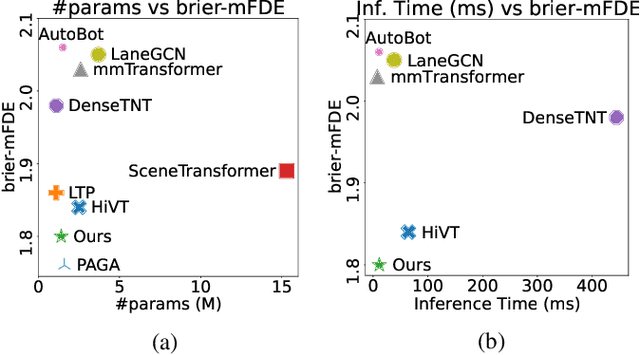
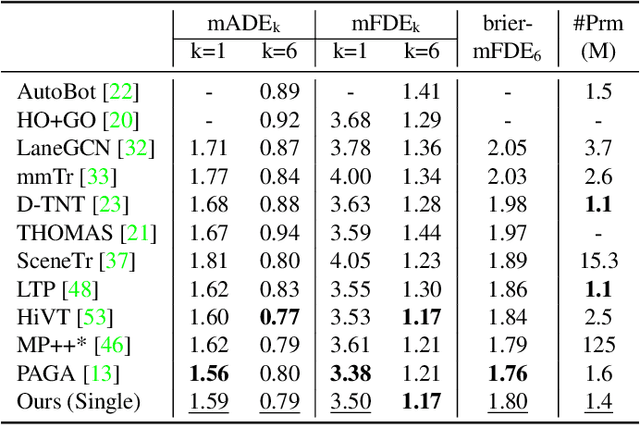
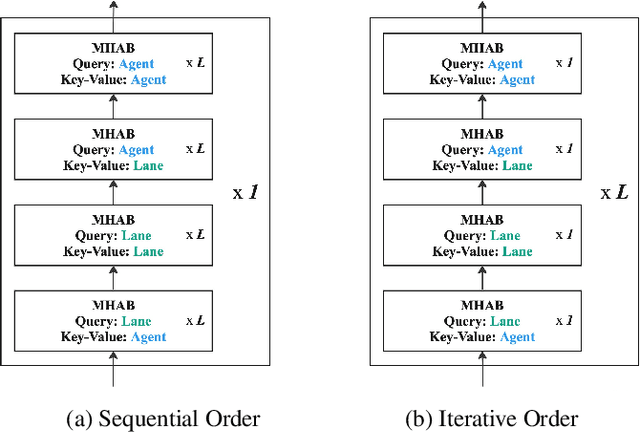
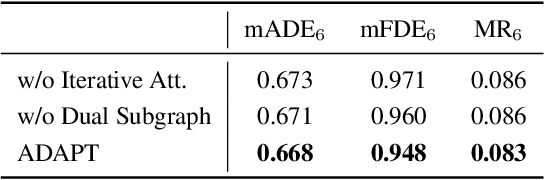
Forecasting future trajectories of agents in complex traffic scenes requires reliable and efficient predictions for all agents in the scene. However, existing methods for trajectory prediction are either inefficient or sacrifice accuracy. To address this challenge, we propose ADAPT, a novel approach for jointly predicting the trajectories of all agents in the scene with dynamic weight learning. Our approach outperforms state-of-the-art methods in both single-agent and multi-agent settings on the Argoverse and Interaction datasets, with a fraction of their computational overhead. We attribute the improvement in our performance: first, to the adaptive head augmenting the model capacity without increasing the model size; second, to our design choices in the endpoint-conditioned prediction, reinforced by gradient stopping. Our analyses show that ADAPT can focus on each agent with adaptive prediction, allowing for accurate predictions efficiently. https://KUIS-AI.github.io/adapt
Stochastic Future Prediction in Real World Driving Scenarios
Sep 27, 2022


Uncertainty plays a key role in future prediction. The future is uncertain. That means there might be many possible futures. A future prediction method should cover the whole possibilities to be robust. In autonomous driving, covering multiple modes in the prediction part is crucially important to make safety-critical decisions. Although computer vision systems have advanced tremendously in recent years, future prediction remains difficult today. Several examples are uncertainty of the future, the requirement of full scene understanding, and the noisy outputs space. In this thesis, we propose solutions to these challenges by modeling the motion explicitly in a stochastic way and learning the temporal dynamics in a latent space.
Trajectory Forecasting on Temporal Graphs
Jul 01, 2022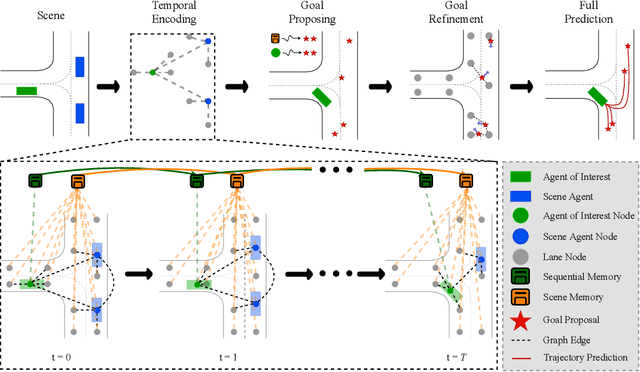
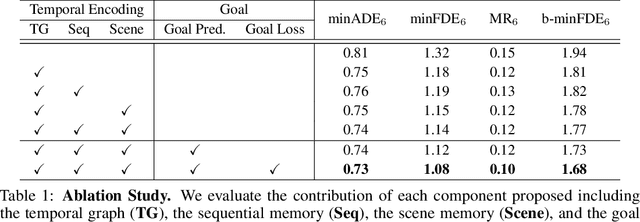
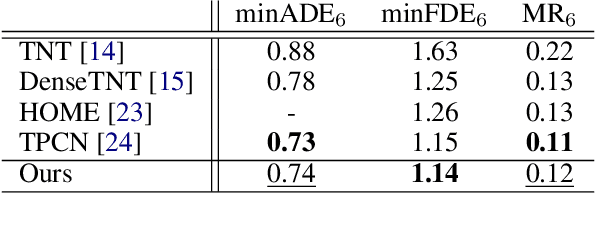
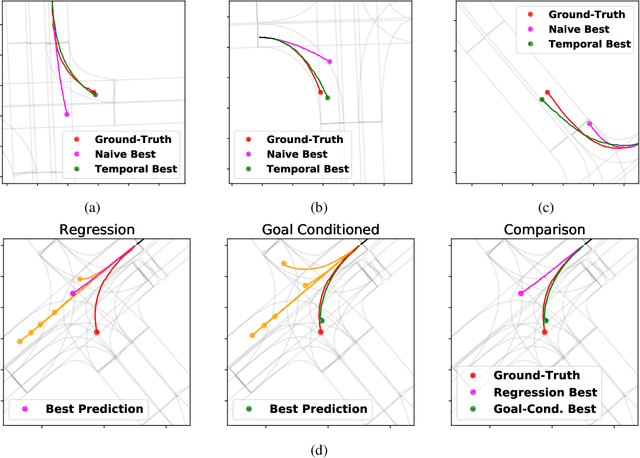
Predicting future locations of agents in the scene is an important problem in self-driving. In recent years, there has been a significant progress in representing the scene and the agents in it. The interactions of agents with the scene and with each other are typically modeled with a Graph Neural Network. However, the graph structure is mostly static and fails to represent the temporal changes in highly dynamic scenes. In this work, we propose a temporal graph representation to better capture the dynamics in traffic scenes. We complement our representation with two types of memory modules; one focusing on the agent of interest and the other on the entire scene. This allows us to learn temporally-aware representations that can achieve good results even with simple regression of multiple futures. When combined with goal-conditioned prediction, we show better results that can reach the state-of-the-art performance on the Argoverse benchmark.
StretchBEV: Stretching Future Instance Prediction Spatially and Temporally
Mar 25, 2022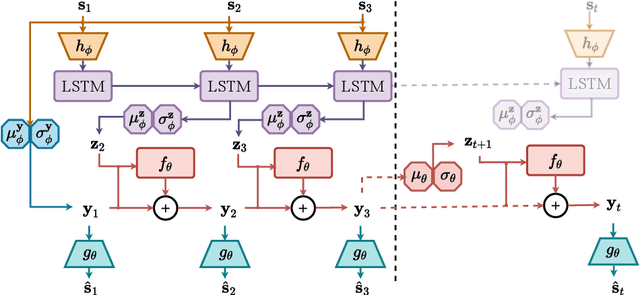
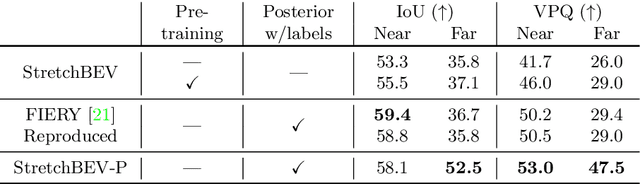
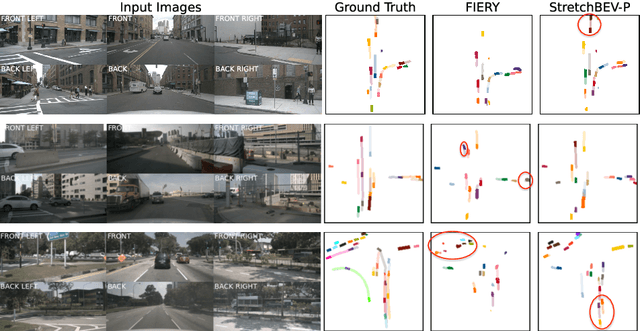

In self-driving, predicting future in terms of location and motion of all the agents around the vehicle is a crucial requirement for planning. Recently, a new joint formulation of perception and prediction has emerged by fusing rich sensory information perceived from multiple cameras into a compact bird's-eye view representation to perform prediction. However, the quality of future predictions degrades over time while extending to longer time horizons due to multiple plausible predictions. In this work, we address this inherent uncertainty in future predictions with a stochastic temporal model. Our model learns temporal dynamics in a latent space through stochastic residual updates at each time step. By sampling from a learned distribution at each time step, we obtain more diverse future predictions that are also more accurate compared to previous work, especially stretching both spatially further regions in the scene and temporally over longer time horizons. Despite separate processing of each time step, our model is still efficient through decoupling of the learning of dynamics and the generation of future predictions.
Stochastic Video Prediction with Structure and Motion
Mar 20, 2022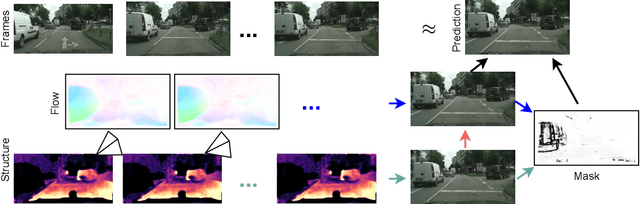
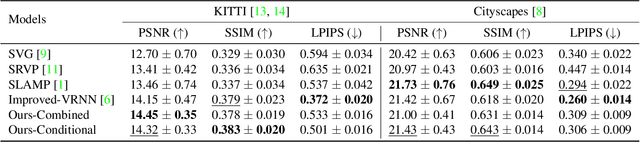
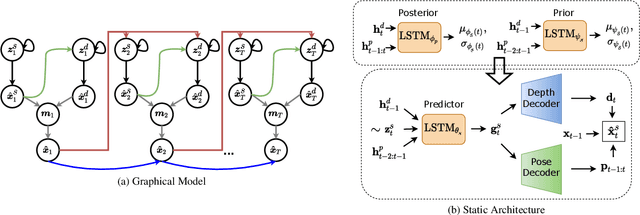
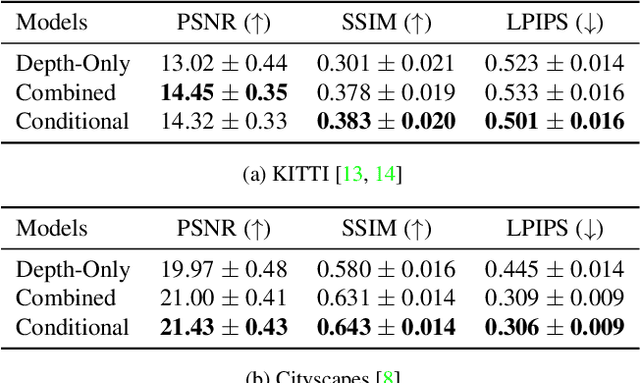
While stochastic video prediction models enable future prediction under uncertainty, they mostly fail to model the complex dynamics of real-world scenes. For example, they cannot provide reliable predictions for scenes with a moving camera and independently moving foreground objects in driving scenarios. The existing methods fail to fully capture the dynamics of the structured world by only focusing on changes in pixels. In this paper, we assume that there is an underlying process creating observations in a video and propose to factorize it into static and dynamic components. We model the static part based on the scene structure and the ego-motion of the vehicle, and the dynamic part based on the remaining motion of the dynamic objects. By learning separate distributions of changes in foreground and background, we can decompose the scene into static and dynamic parts and separately model the change in each. Our experiments demonstrate that disentangling structure and motion helps stochastic video prediction, leading to better future predictions in complex driving scenarios on two real-world driving datasets, KITTI and Cityscapes.