 Add to Chrome
 Add to Firefox
 Add to Edge
Modular Pretraining Enables Access Control
Jul 09, 2026
AI developers face a dual-use dilemma. An AI capability that helps one user cure a disease can help another synthesize one. This dilemma could be resolved with access control, limiting dual-use AI capabilities to trusted deployments with a legitimate need. A gold standard for access control would be to serve separate models with different capabilities to different users. However, training and deploying multiple models is prohibitively expensive. To address this challenge, we propose gradient-routed auxiliary modules (GRAM), a pre-training method that adds modules to a neural network and selectively updates them to induce specialization. Ablating a module at inference time removes its capability from the network, approximating a model trained on filtered data. We evaluate GRAM on synthetic stories and realistic dual-use data spanning virology, cybersecurity, nuclear physics, and specialized code. These experiments show that GRAM disables targeted capabilities while preserving the rest, and resists their recovery under finetuning better than post-hoc unlearning. Most importantly, a Chinchilla-optimal scaling analysis from 50M to 5B parameters shows that the gap between data-filtered and full-data models widens with scale on removed capabilities but stays small on retained ones, and that GRAM closely tracks data filtering. GRAM's training cost is independent of the number of supported capability profiles, yielding a 5x reduction over data filtering in our 5-profile setting.

Distillation Robustifies Unlearning
Jun 06, 2025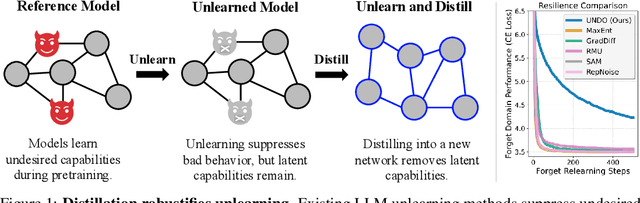
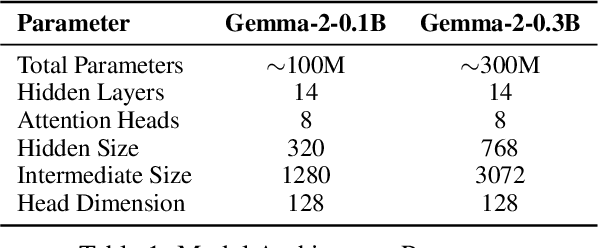
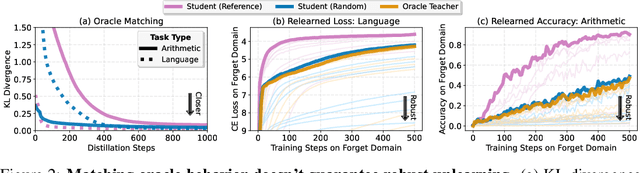
Current LLM unlearning methods are not robust: they can be reverted easily with a few steps of finetuning. This is true even for the idealized unlearning method of training to imitate an oracle model that was never exposed to unwanted information, suggesting that output-based finetuning is insufficient to achieve robust unlearning. In a similar vein, we find that training a randomly initialized student to imitate an unlearned model transfers desired behaviors while leaving undesired capabilities behind. In other words, distillation robustifies unlearning. Building on this insight, we propose Unlearn-Noise-Distill-on-Outputs (UNDO), a scalable method that distills an unlearned model into a partially noised copy of itself. UNDO introduces a tunable tradeoff between compute cost and robustness, establishing a new Pareto frontier on synthetic language and arithmetic tasks. At its strongest setting, UNDO matches the robustness of a model retrained from scratch with perfect data filtering while using only 60-80% of the compute and requiring only 0.01% of the pretraining data to be labeled. We also show that UNDO robustifies unlearning on the more realistic Weapons of Mass Destruction Proxy (WMDP) benchmark. Since distillation is widely used in practice, incorporating an unlearning step beforehand offers a convenient path to robust capability removal.