 Add to Chrome
 Add to Firefox
 Add to Edge
What do you learn from context? Probing for sentence structure in contextualized word representations
May 15, 2019
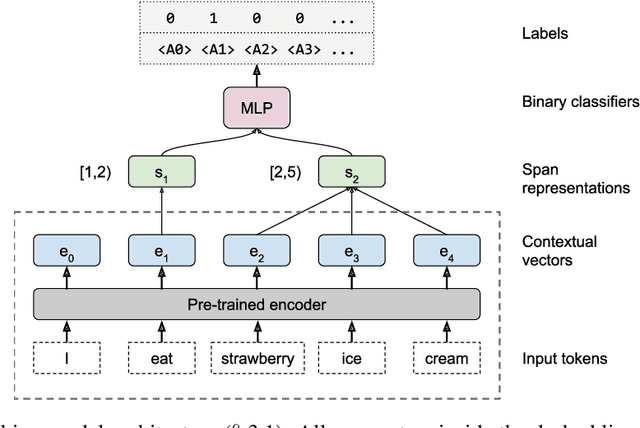
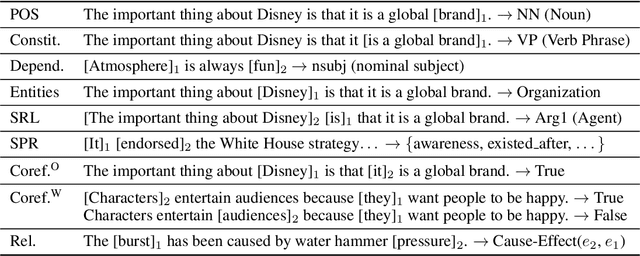
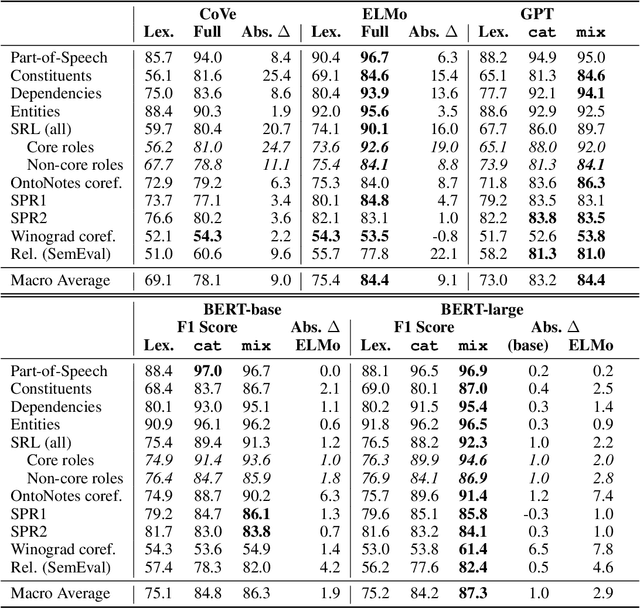
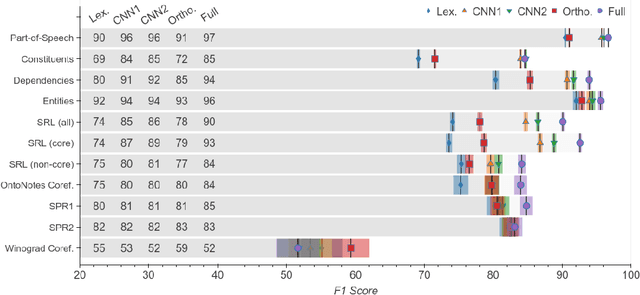
Contextualized representation models such as ELMo (Peters et al., 2018a) and BERT (Devlin et al., 2018) have recently achieved state-of-the-art results on a diverse array of downstream NLP tasks. Building on recent token-level probing work, we introduce a novel edge probing task design and construct a broad suite of sub-sentence tasks derived from the traditional structured NLP pipeline. We probe word-level contextual representations from four recent models and investigate how they encode sentence structure across a range of syntactic, semantic, local, and long-range phenomena. We find that existing models trained on language modeling and translation produce strong representations for syntactic phenomena, but only offer comparably small improvements on semantic tasks over a non-contextual baseline.

Probing What Different NLP Tasks Teach Machines about Function Word Comprehension
Apr 25, 2019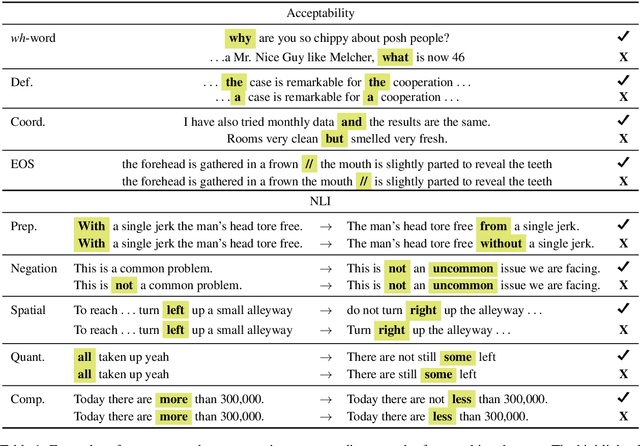
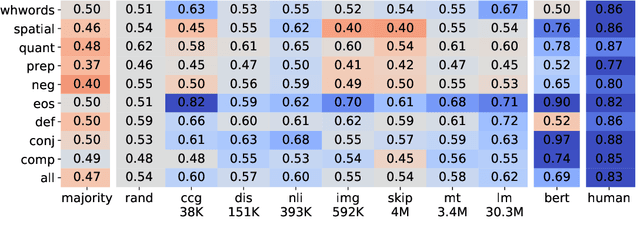
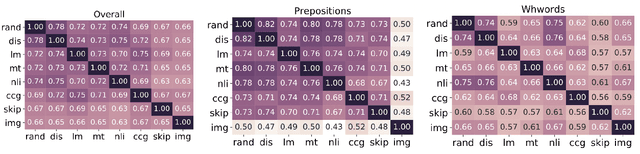
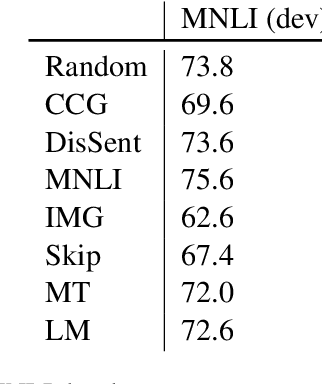
We introduce a set of nine challenge tasks that test for the understanding of function words. These tasks are created by structurally mutating sentences from existing datasets to target the comprehension of specific types of function words (e.g., prepositions, wh-words). Using these probing tasks, we explore the effects of various pretraining objectives for sentence encoders (e.g., language modeling, CCG supertagging and natural language inference (NLI)) on the learned representations. Our results show that pretraining on CCG---our most syntactic objective---performs the best on average across our probing tasks, suggesting that syntactic knowledge helps function word comprehension. Language modeling also shows strong performance, supporting its widespread use for pretraining state-of-the-art NLP models. Overall, no pretraining objective dominates across the board, and our function word probing tasks highlight several intuitive differences between pretraining objectives, e.g., that NLI helps the comprehension of negation.
Collecting Diverse Natural Language Inference Problems for Sentence Representation Evaluation
Aug 29, 2018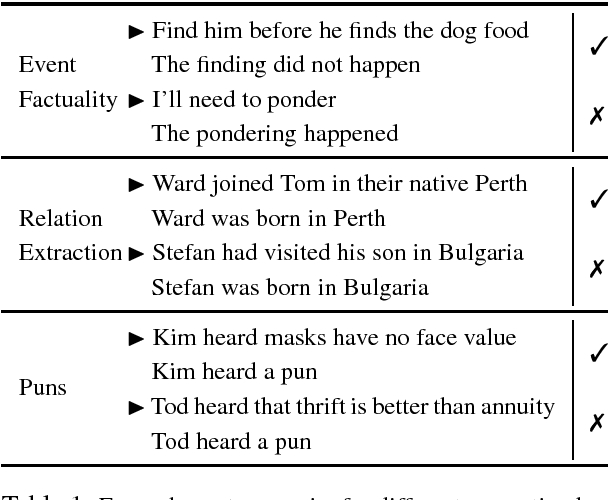
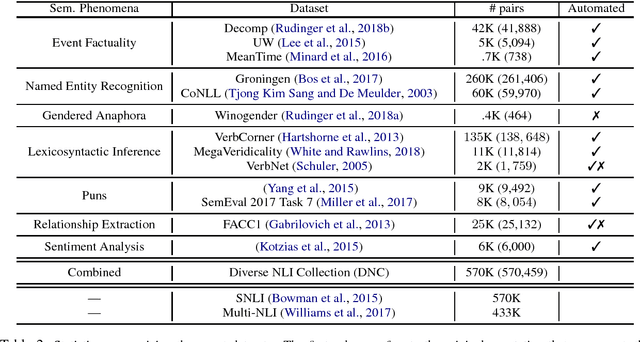
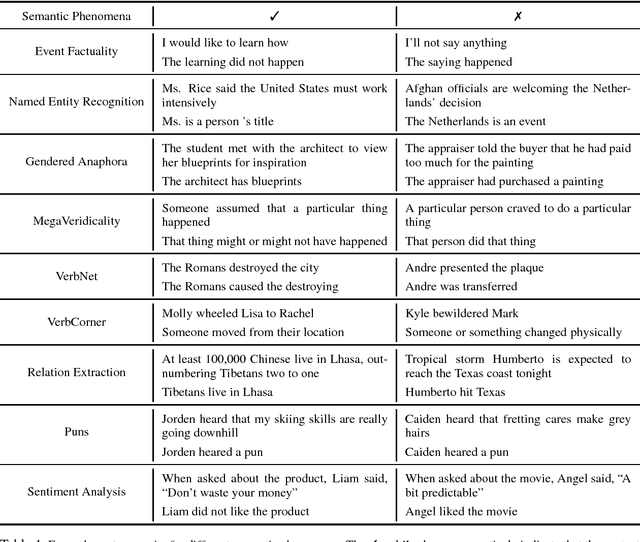
We present a large-scale collection of diverse natural language inference (NLI) datasets that help provide insight into how well a sentence representation captures distinct types of reasoning. The collection results from recasting 13 existing datasets from 7 semantic phenomena into a common NLI structure, resulting in over half a million labeled context-hypothesis pairs in total. We refer to our collection as the DNC: Diverse Natural Language Inference Collection. The DNC is available online at https://www.decomp.net, and will grow over time as additional resources are recast and added from novel sources.
On the Evaluation of Semantic Phenomena in Neural Machine Translation Using Natural Language Inference
May 06, 2018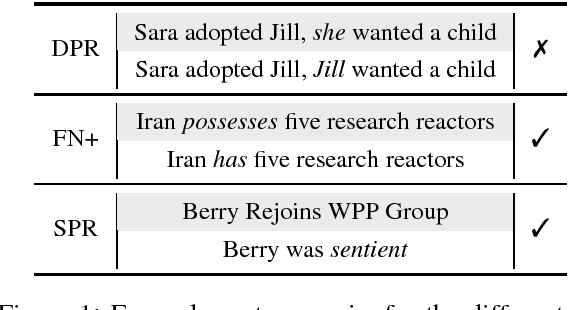

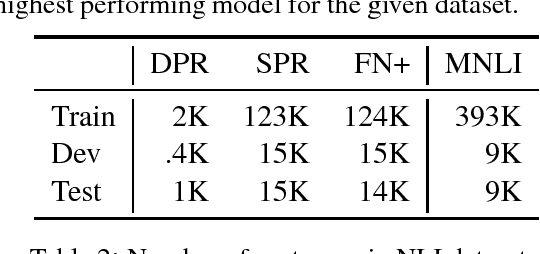
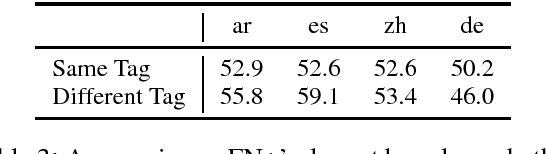
We propose a process for investigating the extent to which sentence representations arising from neural machine translation (NMT) systems encode distinct semantic phenomena. We use these representations as features to train a natural language inference (NLI) classifier based on datasets recast from existing semantic annotations. In applying this process to a representative NMT system, we find its encoder appears most suited to supporting inferences at the syntax-semantics interface, as compared to anaphora resolution requiring world-knowledge. We conclude with a discussion on the merits and potential deficiencies of the existing process, and how it may be improved and extended as a broader framework for evaluating semantic coverage.
Hypothesis Only Baselines in Natural Language Inference
May 02, 2018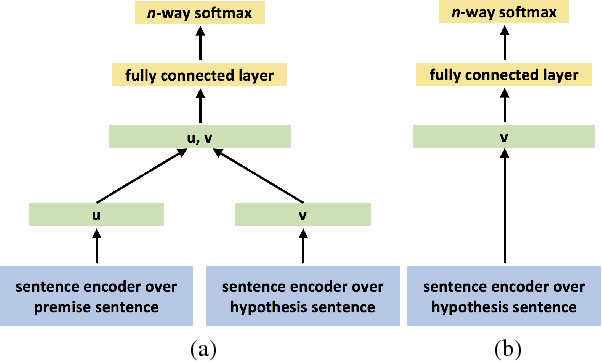
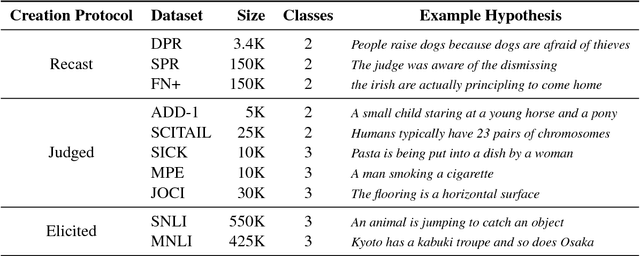
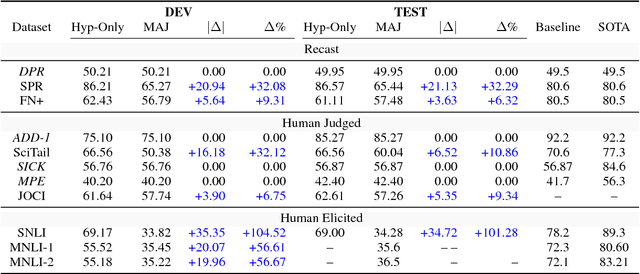
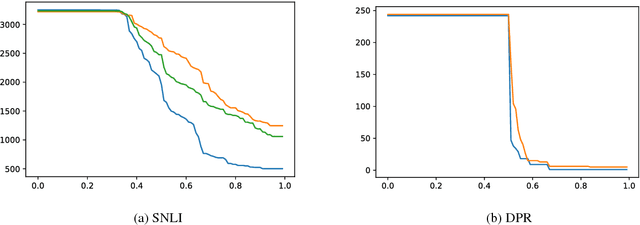
We propose a hypothesis only baseline for diagnosing Natural Language Inference (NLI). Especially when an NLI dataset assumes inference is occurring based purely on the relationship between a context and a hypothesis, it follows that assessing entailment relations while ignoring the provided context is a degenerate solution. Yet, through experiments on ten distinct NLI datasets, we find that this approach, which we refer to as a hypothesis-only model, is able to significantly outperform a majority class baseline across a number of NLI datasets. Our analysis suggests that statistical irregularities may allow a model to perform NLI in some datasets beyond what should be achievable without access to the context.
Frame-Based Continuous Lexical Semantics through Exponential Family Tensor Factorization and Semantic Proto-Roles
Jun 29, 2017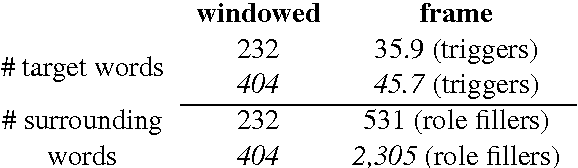
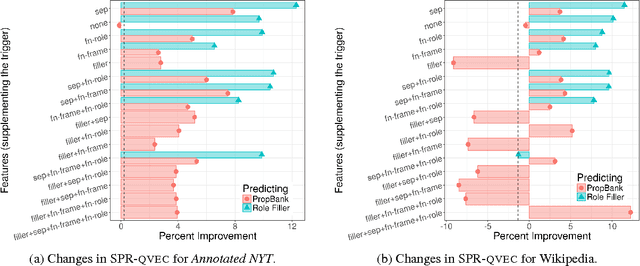
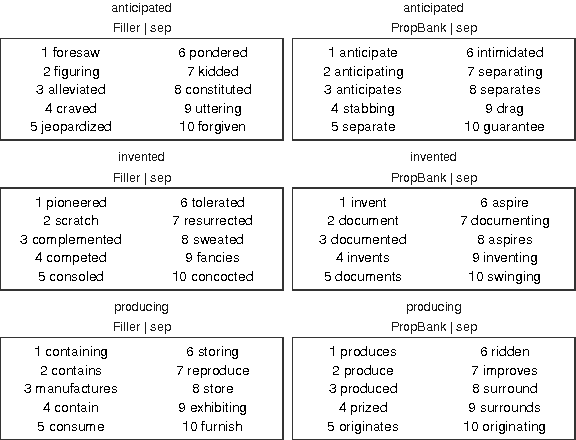
We study how different frame annotations complement one another when learning continuous lexical semantics. We learn the representations from a tensorized skip-gram model that consistently encodes syntactic-semantic content better, with multiple 10% gains over baselines.