 Add to Chrome
 Add to Firefox
 Add to Edge
Practicing with Language Models Cultivates Human Empathic Communication
Mar 16, 2026
Empathy is central to human connection, yet people often struggle to express it effectively. In blinded evaluations, large language models (LLMs) generate responses that are often judged more empathic than human-written ones. Yet when a response is attributed to AI, recipients feel less heard and validated than when comparable responses are attributed to a human. To probe and address this gap in empathic communication skill, we built Lend an Ear, an experimental conversation platform in which participants are asked to offer empathic support to an LLM role-playing personal and workplace troubles. From 33,938 messages spanning 2,904 text-based conversations between 968 participants and their LLM conversational partners, we derive a data-driven taxonomy of idiomatic empathic expressions in naturalistic dialogue. Based on a pre-registered randomized experiment, we present evidence that a brief LLM coaching intervention offering personalized feedback on how to effectively communicate empathy significantly boosts alignment of participants' communication patterns with normative empathic communication patterns relative to both a control group and a group that received video-based but non-personalized feedback. Moreover, we find evidence for a silent empathy effect that people feel empathy but systematically fail to express it. Nonetheless, participants reliably identify responses aligned with normative empathic communication criteria as more expressive of empathy. Together, these results advance the scientific understanding of how empathy is expressed and valued and demonstrate a scalable, AI-based intervention for scaffolding and cultivating it.

When Large Language Models are Reliable for Judging Empathic Communication
Jun 11, 2025Large language models (LLMs) excel at generating empathic responses in text-based conversations. But, how reliably do they judge the nuances of empathic communication? We investigate this question by comparing how experts, crowdworkers, and LLMs annotate empathic communication across four evaluative frameworks drawn from psychology, natural language processing, and communications applied to 200 real-world conversations where one speaker shares a personal problem and the other offers support. Drawing on 3,150 expert annotations, 2,844 crowd annotations, and 3,150 LLM annotations, we assess inter-rater reliability between these three annotator groups. We find that expert agreement is high but varies across the frameworks' sub-components depending on their clarity, complexity, and subjectivity. We show that expert agreement offers a more informative benchmark for contextualizing LLM performance than standard classification metrics. Across all four frameworks, LLMs consistently approach this expert level benchmark and exceed the reliability of crowdworkers. These results demonstrate how LLMs, when validated on specific tasks with appropriate benchmarks, can support transparency and oversight in emotionally sensitive applications including their use as conversational companions.
Characterizing Photorealism and Artifacts in Diffusion Model-Generated Images
Feb 17, 2025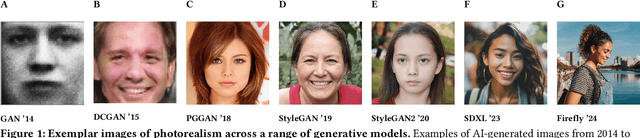

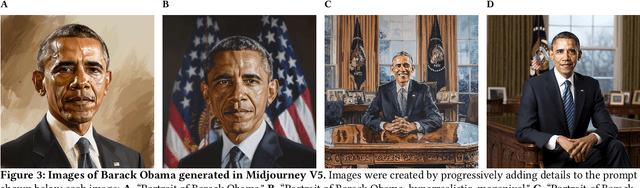
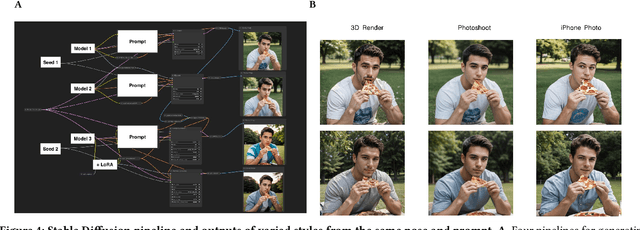
Diffusion model-generated images can appear indistinguishable from authentic photographs, but these images often contain artifacts and implausibilities that reveal their AI-generated provenance. Given the challenge to public trust in media posed by photorealistic AI-generated images, we conducted a large-scale experiment measuring human detection accuracy on 450 diffusion-model generated images and 149 real images. Based on collecting 749,828 observations and 34,675 comments from 50,444 participants, we find that scene complexity of an image, artifact types within an image, display time of an image, and human curation of AI-generated images all play significant roles in how accurately people distinguish real from AI-generated images. Additionally, we propose a taxonomy characterizing artifacts often appearing in images generated by diffusion models. Our empirical observations and taxonomy offer nuanced insights into the capabilities and limitations of diffusion models to generate photorealistic images in 2024.
The Calibration Gap between Model and Human Confidence in Large Language Models
Jan 24, 2024For large language models (LLMs) to be trusted by humans they need to be well-calibrated in the sense that they can accurately assess and communicate how likely it is that their predictions are correct. Recent work has focused on the quality of internal LLM confidence assessments, but the question remains of how well LLMs can communicate this internal model confidence to human users. This paper explores the disparity between external human confidence in an LLM's responses and the internal confidence of the model. Through experiments involving multiple-choice questions, we systematically examine human users' ability to discern the reliability of LLM outputs. Our study focuses on two key areas: (1) assessing users' perception of true LLM confidence and (2) investigating the impact of tailored explanations on this perception. The research highlights that default explanations from LLMs often lead to user overestimation of both the model's confidence and its' accuracy. By modifying the explanations to more accurately reflect the LLM's internal confidence, we observe a significant shift in user perception, aligning it more closely with the model's actual confidence levels. This adjustment in explanatory approach demonstrates potential for enhancing user trust and accuracy in assessing LLM outputs. The findings underscore the importance of transparent communication of confidence levels in LLMs, particularly in high-stakes applications where understanding the reliability of AI-generated information is essential.
Capturing Humans' Mental Models of AI: An Item Response Theory Approach
May 15, 2023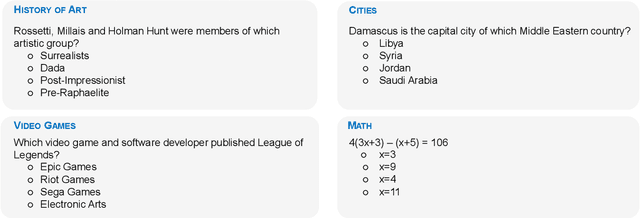
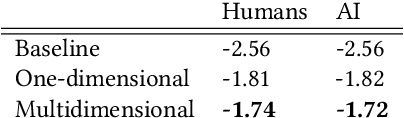

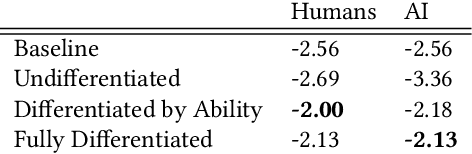
Improving our understanding of how humans perceive AI teammates is an important foundation for our general understanding of human-AI teams. Extending relevant work from cognitive science, we propose a framework based on item response theory for modeling these perceptions. We apply this framework to real-world experiments, in which each participant works alongside another person or an AI agent in a question-answering setting, repeatedly assessing their teammate's performance. Using this experimental data, we demonstrate the use of our framework for testing research questions about people's perceptions of both AI agents and other people. We contrast mental models of AI teammates with those of human teammates as we characterize the dimensionality of these mental models, their development over time, and the influence of the participants' own self-perception. Our results indicate that people expect AI agents' performance to be significantly better on average than the performance of other humans, with less variation across different types of problems. We conclude with a discussion of the implications of these findings for human-AI interaction.