 Add to Chrome
 Add to Firefox
 Add to Edge
Stock Price Prediction
Stock Price Prediction is the task of forecasting future stock prices based on historical data and various market indicators. It involves using statistical models and machine learning algorithms to analyze financial data and make predictions about the future performance of a stock. The goal of stock price prediction is to help investors make informed investment decisions by providing a forecast of future stock prices.
Papers and Code
Innovative Sentiment Analysis and Prediction of Stock Price Using FinBERT, GPT-4 and Logistic Regression: A Data-Driven Approach
Dec 07, 2024
This study explores the comparative performance of cutting-edge AI models, i.e., Finaance Bidirectional Encoder representations from Transsformers (FinBERT), Generatice Pre-trained Transformer GPT-4, and Logistic Regression, for sentiment analysis and stock index prediction using financial news and the NGX All-Share Index data label. By leveraging advanced natural language processing models like GPT-4 and FinBERT, alongside a traditional machine learning model, Logistic Regression, we aim to classify market sentiment, generate sentiment scores, and predict market price movements. This research highlights global AI advancements in stock markets, showcasing how state-of-the-art language models can contribute to understanding complex financial data. The models were assessed using metrics such as accuracy, precision, recall, F1 score, and ROC AUC. Results indicate that Logistic Regression outperformed the more computationally intensive FinBERT and predefined approach of versatile GPT-4, with an accuracy of 81.83% and a ROC AUC of 89.76%. The GPT-4 predefined approach exhibited a lower accuracy of 54.19% but demonstrated strong potential in handling complex data. FinBERT, while offering more sophisticated analysis, was resource-demanding and yielded a moderate performance. Hyperparameter optimization using Optuna and cross-validation techniques ensured the robustness of the models. This study highlights the strengths and limitations of the practical applications of AI approaches in stock market prediction and presents Logistic Regression as the most efficient model for this task, with FinBERT and GPT-4 representing emerging tools with potential for future exploration and innovation in AI-driven financial analytics
* 21 pages

Modeling Regime Structure and Informational Drivers of Stock Market Volatility via the Financial Chaos Index
Apr 26, 2025This paper investigates the structural dynamics of stock market volatility through the Financial Chaos Index, a tensor- and eigenvalue-based measure designed to capture realized volatility via mutual fluctuations among asset prices. Motivated by empirical evidence of regime-dependent volatility behavior and perceptual time dilation during financial crises, we develop a regime-switching framework based on the Modified Lognormal Power-Law distribution. Analysis of the FCIX from January 1990 to December 2023 identifies three distinct market regimes, low-chaos, intermediate-chaos, and high-chaos, each characterized by differing levels of systemic stress, statistical dispersion and persistence characteristics. Building upon the segmented regime structure, we further examine the informational forces that shape forward-looking market expectations. Using sentiment-based predictors derived from the Equity Market Volatility tracker, we employ an elastic net regression model to forecast implied volatility, as proxied by the VIX index. Our findings indicate that shifts in macroeconomic, financial, policy, and geopolitical uncertainty exhibit strong predictive power for volatility dynamics across regimes. Together, these results offer a unified empirical perspective on how systemic uncertainty governs both the realized evolution of financial markets and the anticipatory behavior embedded in implied volatility measures.
A Dynamic Approach to Stock Price Prediction: Comparing RNN and Mixture of Experts Models Across Different Volatility Profiles
Oct 04, 2024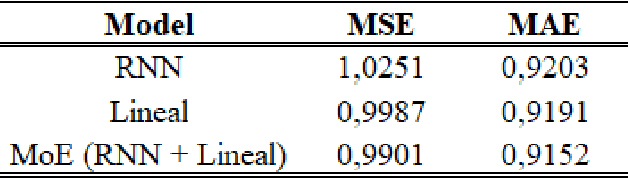
This study evaluates the effectiveness of a Mixture of Experts (MoE) model for stock price prediction by comparing it to a Recurrent Neural Network (RNN) and a linear regression model. The MoE framework combines an RNN for volatile stocks and a linear model for stable stocks, dynamically adjusting the weight of each model through a gating network. Results indicate that the MoE approach significantly improves predictive accuracy across different volatility profiles. The RNN effectively captures non-linear patterns for volatile companies but tends to overfit stable data, whereas the linear model performs well for predictable trends. The MoE model's adaptability allows it to outperform each individual model, reducing errors such as Mean Squared Error (MSE) and Mean Absolute Error (MAE). Future work should focus on enhancing the gating mechanism and validating the model with real-world datasets to optimize its practical applicability.
Predicting Stock Movement with BERTweet and Transformers
Mar 13, 2025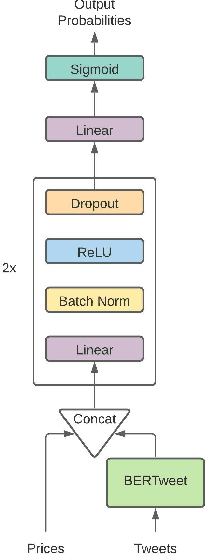
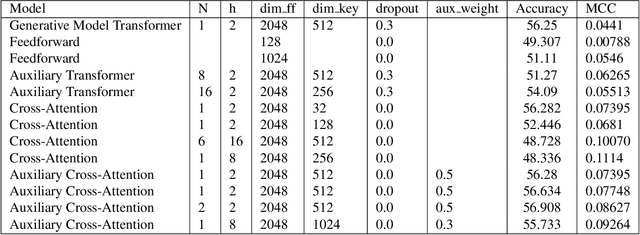
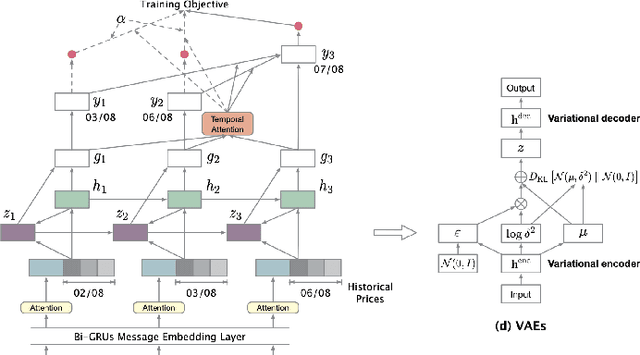
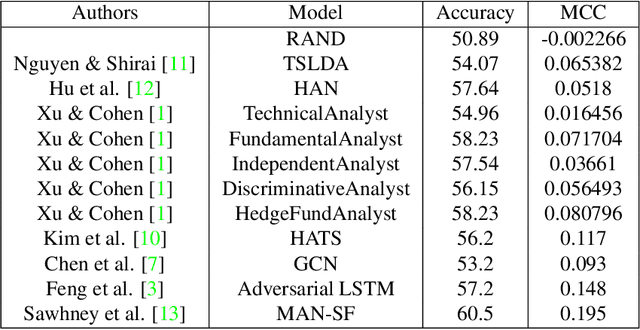
Applying deep learning and computational intelligence to finance has been a popular area of applied research, both within academia and industry, and continues to attract active attention. The inherently high volatility and non-stationary of the data pose substantial challenges to machine learning models, especially so for today's expressive and highly-parameterized deep learning models. Recent work has combined natural language processing on data from social media to augment models based purely on historic price data to improve performance has received particular attention. Previous work has achieved state-of-the-art performance on this task by combining techniques such as bidirectional GRUs, variational autoencoders, word and document embeddings, self-attention, graph attention, and adversarial training. In this paper, we demonstrated the efficacy of BERTweet, a variant of BERT pre-trained specifically on a Twitter corpus, and the transformer architecture by achieving competitive performance with the existing literature and setting a new baseline for Matthews Correlation Coefficient on the Stocknet dataset without auxiliary data sources.
FinGPT: Enhancing Sentiment-Based Stock Movement Prediction with Dissemination-Aware and Context-Enriched LLMs
Dec 14, 2024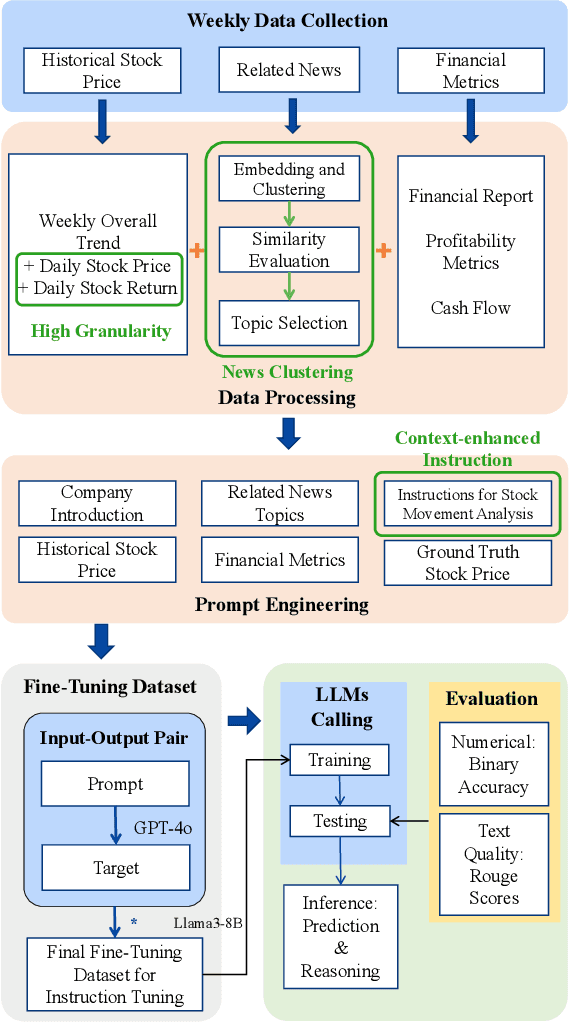

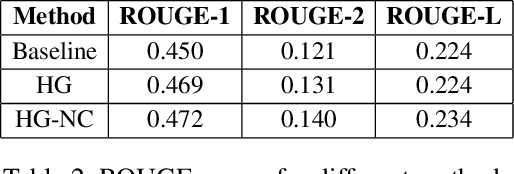
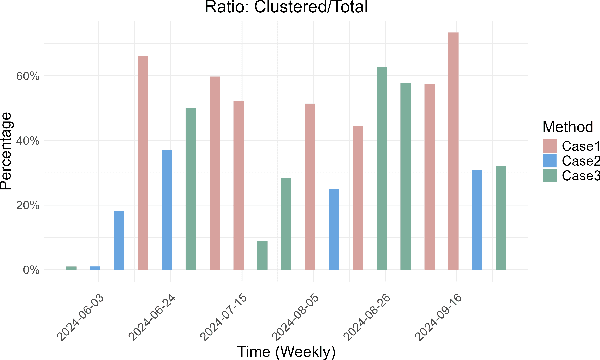
Financial sentiment analysis is crucial for understanding the influence of news on stock prices. Recently, large language models (LLMs) have been widely adopted for this purpose due to their advanced text analysis capabilities. However, these models often only consider the news content itself, ignoring its dissemination, which hampers accurate prediction of short-term stock movements. Additionally, current methods often lack sufficient contextual data and explicit instructions in their prompts, limiting LLMs' ability to interpret news. In this paper, we propose a data-driven approach that enhances LLM-powered sentiment-based stock movement predictions by incorporating news dissemination breadth, contextual data, and explicit instructions. We cluster recent company-related news to assess its reach and influence, enriching prompts with more specific data and precise instructions. This data is used to construct an instruction tuning dataset to fine-tune an LLM for predicting short-term stock price movements. Our experimental results show that our approach improves prediction accuracy by 8\% compared to existing methods.
Combining Financial Data and News Articles for Stock Price Movement Prediction Using Large Language Models
Nov 02, 2024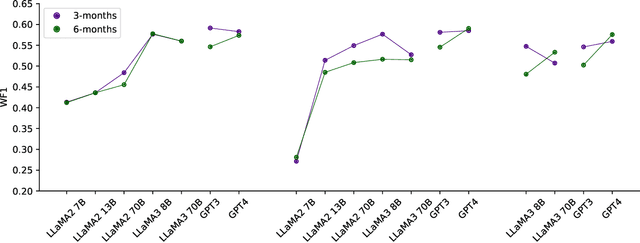
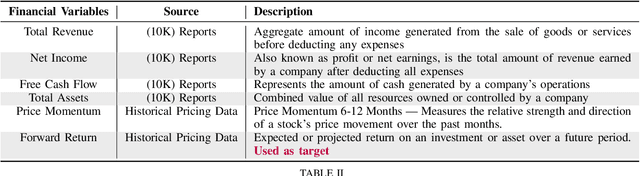
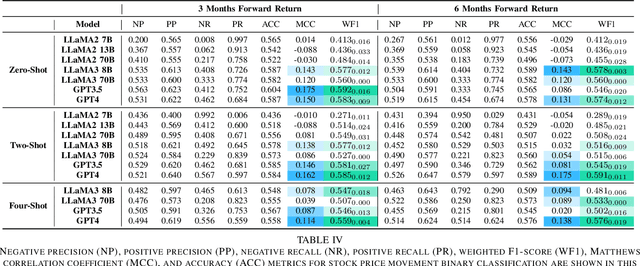
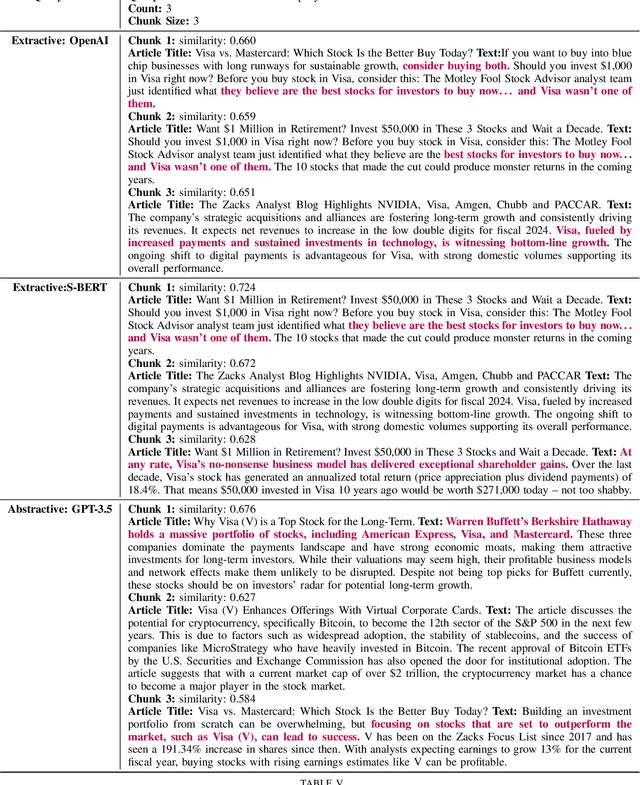
Predicting financial markets and stock price movements requires analyzing a company's performance, historic price movements, industry-specific events alongside the influence of human factors such as social media and press coverage. We assume that financial reports (such as income statements, balance sheets, and cash flow statements), historical price data, and recent news articles can collectively represent aforementioned factors. We combine financial data in tabular format with textual news articles and employ pre-trained Large Language Models (LLMs) to predict market movements. Recent research in LLMs has demonstrated that they are able to perform both tabular and text classification tasks, making them our primary model to classify the multi-modal data. We utilize retrieval augmentation techniques to retrieve and attach relevant chunks of news articles to financial metrics related to a company and prompt the LLMs in zero, two, and four-shot settings. Our dataset contains news articles collected from different sources, historic stock price, and financial report data for 20 companies with the highest trading volume across different industries in the stock market. We utilized recently released language models for our LLM-based classifier, including GPT- 3 and 4, and LLaMA- 2 and 3 models. We introduce an LLM-based classifier capable of performing classification tasks using combination of tabular (structured) and textual (unstructured) data. By using this model, we predicted the movement of a given stock's price in our dataset with a weighted F1-score of 58.5% and 59.1% and Matthews Correlation Coefficient of 0.175 for both 3-month and 6-month periods.
Transfer learning for financial data predictions: a systematic review
Sep 24, 2024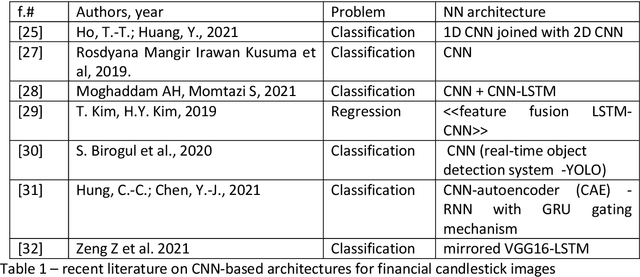
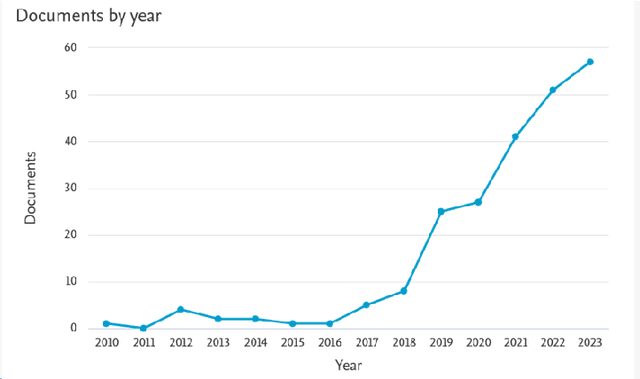
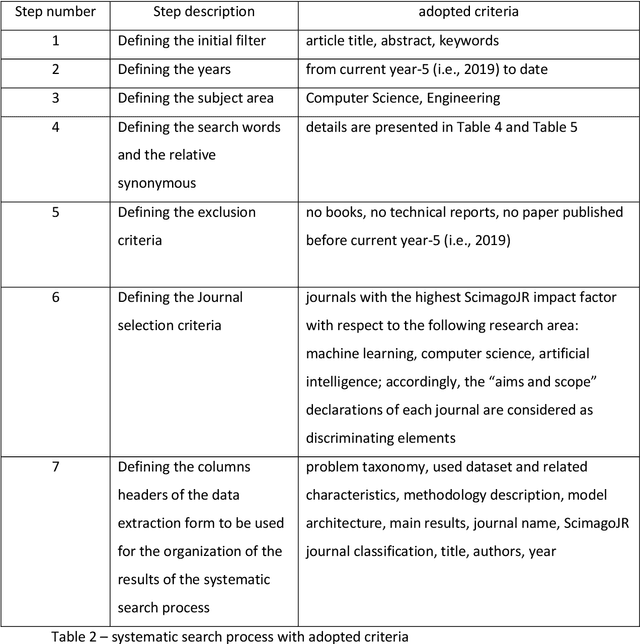
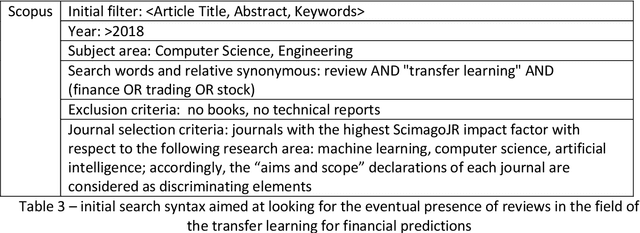
Literature highlighted that financial time series data pose significant challenges for accurate stock price prediction, because these data are characterized by noise and susceptibility to news; traditional statistical methodologies made assumptions, such as linearity and normality, which are not suitable for the non-linear nature of financial time series; on the other hand, machine learning methodologies are able to capture non linear relationship in the data. To date, neural network is considered the main machine learning tool for the financial prices prediction. Transfer Learning, as a method aimed at transferring knowledge from source tasks to target tasks, can represent a very useful methodological tool for getting better financial prediction capability. Current reviews on the above body of knowledge are mainly focused on neural network architectures, for financial prediction, with very little emphasis on the transfer learning methodology; thus, this paper is aimed at going deeper on this topic by developing a systematic review with respect to application of Transfer Learning for financial market predictions and to challenges/potential future directions of the transfer learning methodologies for stock market predictions.
Stock Type Prediction Model Based on Hierarchical Graph Neural Network
Dec 09, 2024

This paper introduces a novel approach to stock data analysis by employing a Hierarchical Graph Neural Network (HGNN) model that captures multi-level information and relational structures in the stock market. The HGNN model integrates stock relationship data and hierarchical attributes to predict stock types effectively. The paper discusses the construction of a stock industry relationship graph and the extraction of temporal information from historical price sequences. It also highlights the design of a graph convolution operation and a temporal attention aggregator to model the macro market state. The integration of these features results in a comprehensive stock prediction model that addresses the challenges of utilizing stock relationship data and modeling hierarchical attributes in the stock market.
Context Matters: Leveraging Contextual Features for Time Series Forecasting
Oct 17, 2024Time series forecasts are often influenced by exogenous contextual features in addition to their corresponding history. For example, in financial settings, it is hard to accurately predict a stock price without considering public sentiments and policy decisions in the form of news articles, tweets, etc. Though this is common knowledge, the current state-of-the-art (SOTA) forecasting models fail to incorporate such contextual information, owing to its heterogeneity and multimodal nature. To address this, we introduce ContextFormer, a novel plug-and-play method to surgically integrate multimodal contextual information into existing pre-trained forecasting models. ContextFormer effectively distills forecast-specific information from rich multimodal contexts, including categorical, continuous, time-varying, and even textual information, to significantly enhance the performance of existing base forecasters. ContextFormer outperforms SOTA forecasting models by up to 30% on a range of real-world datasets spanning energy, traffic, environmental, and financial domains.
Learning Universal Multi-level Market Irrationality Factors to Improve Stock Return Forecasting
Feb 07, 2025Recent years have witnessed the perfect encounter of deep learning and quantitative trading has achieved great success in stock investment. Numerous deep learning-based models have been developed for forecasting stock returns, leveraging the powerful representation capabilities of neural networks to identify patterns and factors influencing stock prices. These models can effectively capture general patterns in the market, such as stock price trends, volume-price relationships, and time variations. However, the impact of special irrationality factors -- such as market sentiment, speculative behavior, market manipulation, and psychological biases -- have not been fully considered in existing deep stock forecasting models due to their relative abstraction as well as lack of explicit labels and data description. To fill this gap, we propose UMI, a Universal multi-level Market Irrationality factor model to enhance stock return forecasting. The UMI model learns factors that can reflect irrational behaviors in market from both individual stock and overall market levels. For the stock-level, UMI construct an estimated rational price for each stock, which is cointegrated with the stock's actual price. The discrepancy between the actual and the rational prices serves as a factor to indicate stock-level irrational events. Additionally, we define market-level irrational behaviors as anomalous synchronous fluctuations of stocks within a market. Using two self-supervised representation learning tasks, i.e., sub-market comparative learning and market synchronism prediction, the UMI model incorporates market-level irrationalities into a market representation vector, which is then used as the market-level irrationality factor.