 Add to Chrome
 Add to Firefox
 Add to Edge
Diabetic Retinopathy Detection
Diabetic retinopathy detection is the process of identifying and diagnosing the growth of abnormal blood vessels and damage in the retina due to high blood sugar from diabetes, using deep learning techniques.
Papers and Code
Early detection of diabetes through transfer learning-based eye (vision) screening and improvement of machine learning model performance and advanced parameter setting algorithms
Apr 04, 2025
Diabetic Retinopathy (DR) is a serious and common complication of diabetes, caused by prolonged high blood sugar levels that damage the small retinal blood vessels. If left untreated, DR can progress to retinal vein occlusion and stimulate abnormal blood vessel growth, significantly increasing the risk of blindness. Traditional diabetes diagnosis methods often utilize convolutional neural networks (CNNs) to extract visual features from retinal images, followed by classification algorithms such as decision trees and k-nearest neighbors (KNN) for disease detection. However, these approaches face several challenges, including low accuracy and sensitivity, lengthy machine learning (ML) model training due to high data complexity and volume, and the use of limited datasets for testing and evaluation. This study investigates the application of transfer learning (TL) to enhance ML model performance in DR detection. Key improvements include dimensionality reduction, optimized learning rate adjustments, and advanced parameter tuning algorithms, aimed at increasing efficiency and diagnostic accuracy. The proposed model achieved an overall accuracy of 84% on the testing dataset, outperforming prior studies. The highest class-specific accuracy reached 89%, with a maximum sensitivity of 97% and an F1-score of 92%, demonstrating strong performance in identifying DR cases. These findings suggest that TL-based DR screening is a promising approach for early diagnosis, enabling timely interventions to prevent vision loss and improve patient outcomes.

The Role of AI in Early Detection of Life-Threatening Diseases: A Retinal Imaging Perspective
May 27, 2025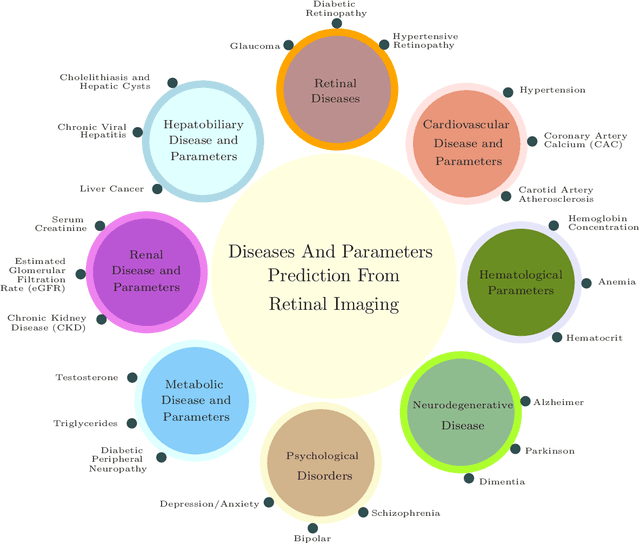
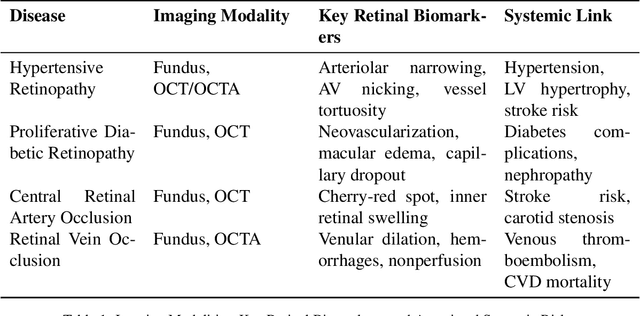
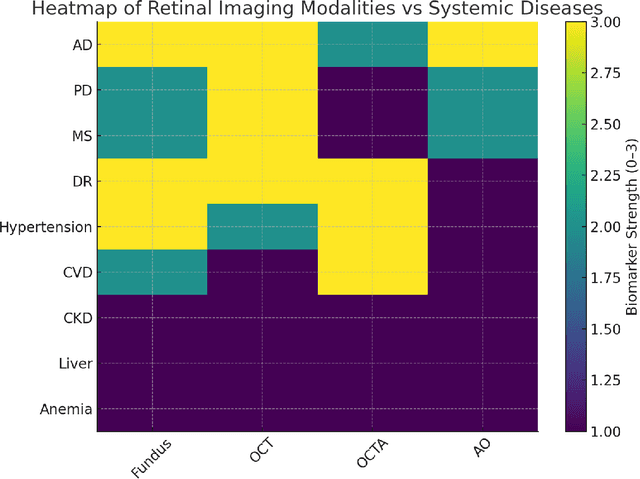
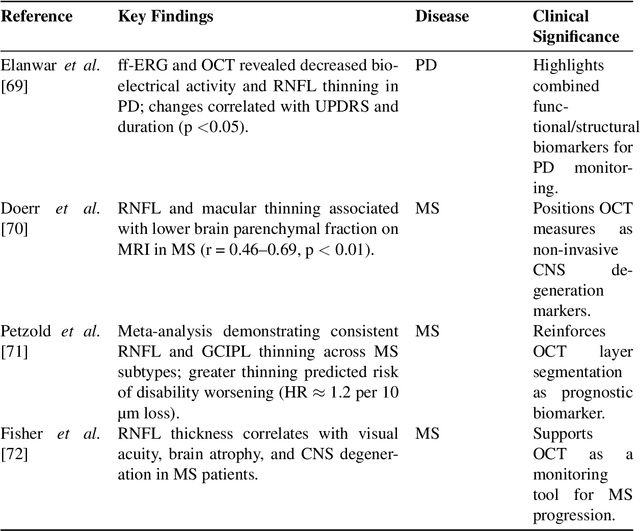
Retinal imaging has emerged as a powerful, non-invasive modality for detecting and quantifying biomarkers of systemic diseases-ranging from diabetes and hypertension to Alzheimer's disease and cardiovascular disorders but current insights remain dispersed across platforms and specialties. Recent technological advances in optical coherence tomography (OCT/OCTA) and adaptive optics (AO) now deliver ultra-high-resolution scans (down to 5 {\mu}m ) with superior contrast and spatial integration, allowing early identification of microvascular abnormalities and neurodegenerative changes. At the same time, AI-driven and machine learning (ML) algorithms have revolutionized the analysis of large-scale retinal datasets, increasing sensitivity and specificity; for example, deep learning models achieve > 90 \% sensitivity for diabetic retinopathy and AUC = 0.89 for the prediction of cardiovascular risk from fundus photographs. The proliferation of mobile health technologies and telemedicine platforms further extends access, reduces costs, and facilitates community-based screening and longitudinal monitoring. Despite these breakthroughs, translation into routine practice is hindered by heterogeneous imaging protocols, limited external validation of AI models, and integration challenges within clinical workflows. In this review, we systematically synthesize the latest OCT/OCT and AO developments, AI/ML approaches, and mHealth/Tele-ophthalmology initiatives and quantify their diagnostic performance across disease domains. Finally, we propose a roadmap for multicenter protocol standardization, prospective validation trials, and seamless incorporation of retinal screening into primary and specialty care pathways-paving the way for precision prevention, early intervention, and ongoing treatment of life-threatening systemic diseases.
AI-Driven Diabetic Retinopathy Diagnosis Enhancement through Image Processing and Salp Swarm Algorithm-Optimized Ensemble Network
Mar 18, 2025Diabetic retinopathy is a leading cause of blindness in diabetic patients and early detection plays a crucial role in preventing vision loss. Traditional diagnostic methods are often time-consuming and prone to errors. The emergence of deep learning techniques has provided innovative solutions to improve diagnostic efficiency. However, single deep learning models frequently face issues related to extracting key features from complex retinal images. To handle this problem, we present an effective ensemble method for DR diagnosis comprising four main phases: image pre-processing, selection of backbone pre-trained models, feature enhancement, and optimization. Our methodology initiates with the pre-processing phase, where we apply CLAHE to enhance image contrast and Gamma correction is then used to adjust the brightness for better feature recognition. We then apply Discrete Wavelet Transform (DWT) for image fusion by combining multi-resolution details to create a richer dataset. Then, we selected three pre-trained models with the best performance named DenseNet169, MobileNetV1, and Xception for diverse feature extraction. To further improve feature extraction, an improved residual block is integrated into each model. Finally, the predictions from these base models are then aggregated using weighted ensemble approach, with the weights optimized by using Salp Swarm Algorithm (SSA).SSA intelligently explores the weight space and finds the optimal configuration of base architectures to maximize the performance of the ensemble model. The proposed model is evaluated on the multiclass Kaggle APTOS 2019 dataset and obtained 88.52% accuracy.
Enhancing Diabetic Retinopathy Detection with CNN-Based Models: A Comparative Study of UNET and Stacked UNET Architectures
Nov 02, 2024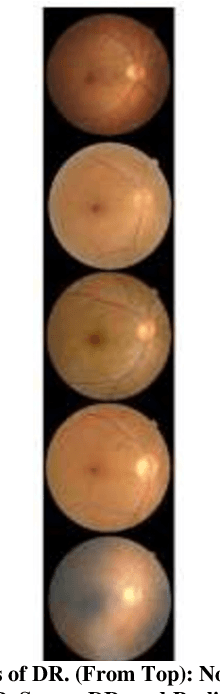
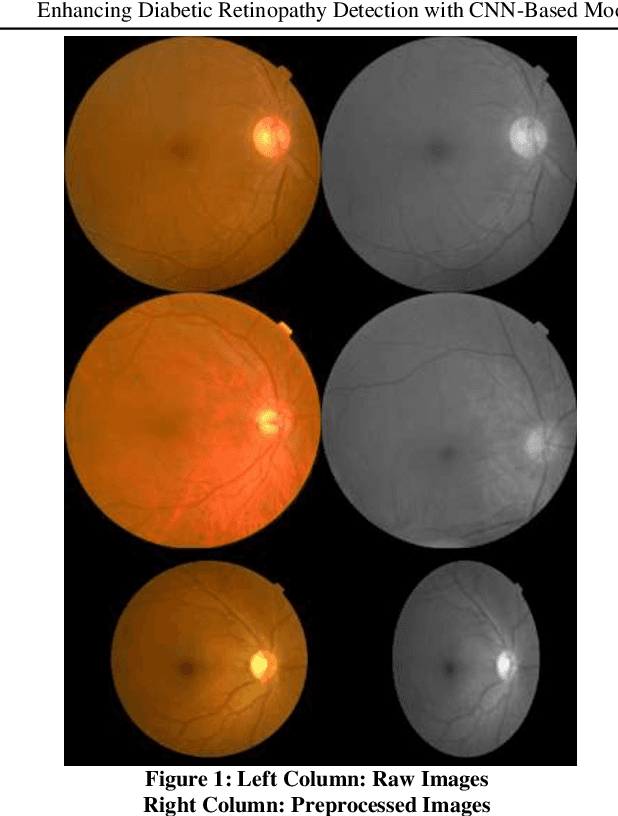

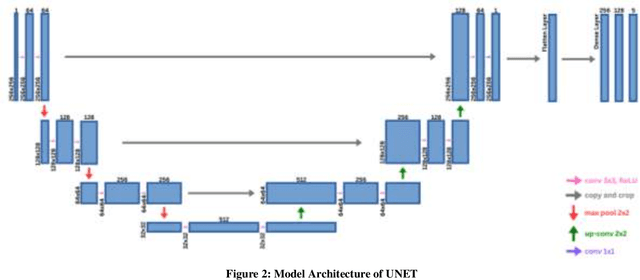
Diabetic Retinopathy DR is a severe complication of diabetes. Damaged or abnormal blood vessels can cause loss of vision. The need for massive screening of a large population of diabetic patients has generated an interest in a computer-aided fully automatic diagnosis of DR. In the realm of Deep learning frameworks, particularly convolutional neural networks CNNs, have shown great interest and promise in detecting DR by analyzing retinal images. However, several challenges have been faced in the application of deep learning in this domain. High-quality, annotated datasets are scarce, and the variations in image quality and class imbalances pose significant hurdles in developing a dependable model. In this paper, we demonstrate the proficiency of two Convolutional Neural Networks CNNs based models, UNET and Stacked UNET utilizing the APTOS Asia Pacific Tele-Ophthalmology Society Dataset. This system achieves an accuracy of 92.81% for the UNET and 93.32% for the stacked UNET architecture. The architecture classifies the images into five categories ranging from 0 to 4, where 0 is no DR and 4 is proliferative DR.
AI-Driven Diabetic Retinopathy Screening: Multicentric Validation of AIDRSS in India
Jan 13, 2025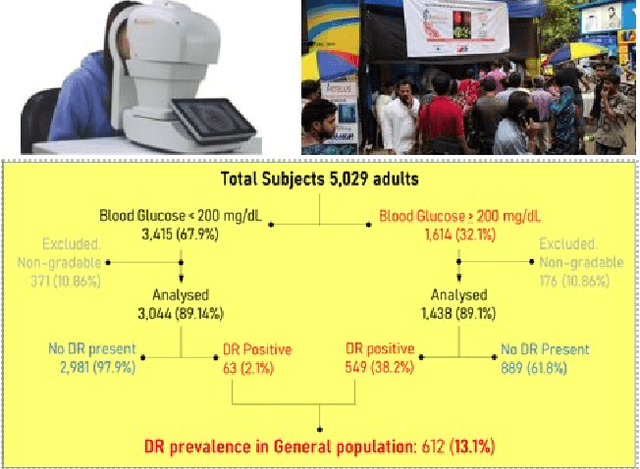
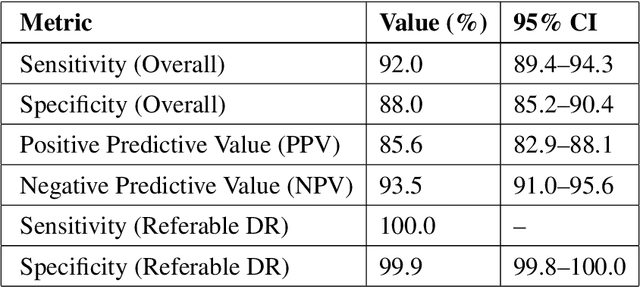
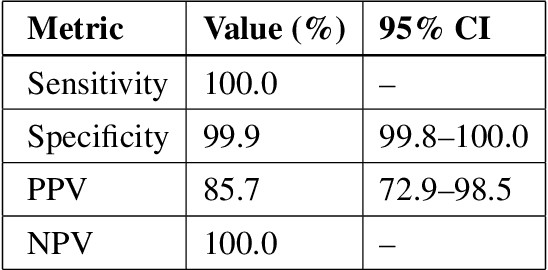
Purpose: Diabetic retinopathy (DR) is a major cause of vision loss, particularly in India, where access to retina specialists is limited in rural areas. This study aims to evaluate the Artificial Intelligence-based Diabetic Retinopathy Screening System (AIDRSS) for DR detection and prevalence assessment, addressing the growing need for scalable, automated screening solutions in resource-limited settings. Approach: A multicentric, cross-sectional study was conducted in Kolkata, India, involving 5,029 participants and 10,058 macula-centric retinal fundus images. The AIDRSS employed a deep learning algorithm with 50 million trainable parameters, integrated with Contrast Limited Adaptive Histogram Equalization (CLAHE) preprocessing for enhanced image quality. DR was graded using the International Clinical Diabetic Retinopathy (ICDR) Scale, categorizing disease into five stages (DR0 to DR4). Statistical metrics including sensitivity, specificity, and prevalence rates were evaluated against expert retina specialist assessments. Results: The prevalence of DR in the general population was 13.7%, rising to 38.2% among individuals with elevated random blood glucose levels. The AIDRSS achieved an overall sensitivity of 92%, specificity of 88%, and 100% sensitivity for detecting referable DR (DR3 and DR4). These results demonstrate the system's robust performance in accurately identifying and grading DR in a diverse population. Conclusions: AIDRSS provides a reliable, scalable solution for early DR detection in resource-constrained environments. Its integration of advanced AI techniques ensures high diagnostic accuracy, with potential to significantly reduce the burden of diabetes-related vision loss in underserved regions.
Training Over a Distribution of Hyperparameters for Enhanced Performance and Adaptability on Imbalanced Classification
Oct 04, 2024


Although binary classification is a well-studied problem, training reliable classifiers under severe class imbalance remains a challenge. Recent techniques mitigate the ill effects of imbalance on training by modifying the loss functions or optimization methods. We observe that different hyperparameter values on these loss functions perform better at different recall values. We propose to exploit this fact by training one model over a distribution of hyperparameter values--instead of a single value--via Loss Conditional Training (LCT). Experiments show that training over a distribution of hyperparameters not only approximates the performance of several models but actually improves the overall performance of models on both CIFAR and real medical imaging applications, such as melanoma and diabetic retinopathy detection. Furthermore, training models with LCT is more efficient because some hyperparameter tuning can be conducted after training to meet individual needs without needing to retrain from scratch.
Diabetic Retinopathy Classification from Retinal Images using Machine Learning Approaches
Dec 03, 2024Diabetic Retinopathy is one of the most familiar diseases and is a diabetes complication that affects eyes. Initially, diabetic retinopathy may cause no symptoms or only mild vision problems. Eventually, it can cause blindness. So early detection of symptoms could help to avoid blindness. In this paper, we present some experiments on some features of diabetic retinopathy, like properties of exudates, properties of blood vessels and properties of microaneurysm. Using the features, we can classify healthy, mild non-proliferative, moderate non-proliferative, severe non-proliferative and proliferative stages of DR. Support Vector Machine, Random Forest and Naive Bayes classifiers are used to classify the stages. Finally, Random Forest is found to be the best for higher accuracy, sensitivity and specificity of 76.5%, 77.2% and 93.3% respectively.
Context-Aware Vision Language Foundation Models for Ocular Disease Screening in Retinal Images
Mar 19, 2025Foundation models are large-scale versatile systems trained on vast quantities of diverse data to learn generalizable representations. Their adaptability with minimal fine-tuning makes them particularly promising for medical imaging, where data variability and domain shifts are major challenges. Currently, two types of foundation models dominate the literature: self-supervised models and more recent vision-language models. In this study, we advance the application of vision-language foundation (VLF) models for ocular disease screening using the OPHDIAT dataset, which includes nearly 700,000 fundus photographs from a French diabetic retinopathy (DR) screening network. This dataset provides extensive clinical data (patient-specific information such as diabetic health conditions, and treatments), labeled diagnostics, ophthalmologists text-based findings, and multiple retinal images for each examination. Building on the FLAIR model $\unicode{x2013}$ a VLF model for retinal pathology classification $\unicode{x2013}$ we propose novel context-aware VLF models (e.g jointly analyzing multiple images from the same visit or taking advantage of past diagnoses and contextual data) to fully leverage the richness of the OPHDIAT dataset and enhance robustness to domain shifts. Our approaches were evaluated on both in-domain (a testing subset of OPHDIAT) and out-of-domain data (public datasets) to assess their generalization performance. Our model demonstrated improved in-domain performance for DR grading, achieving an area under the curve (AUC) ranging from 0.851 to 0.9999, and generalized well to ocular disease detection on out-of-domain data (AUC: 0.631-0.913).
Optical Coherence Tomography Angiography-OCTA dataset for the study of Diabetic Retinopathy
Sep 06, 2024This study presents a dataset consisting of 268 retinal images from 179 individuals, including 133 left-eye and 135 right-eye images, collected from Natasha Eye Care and Research Institute in Pune, Maharashtra, India. The images were captured using a nonmydriatic Optical Coherence Tomography Angiography (OCTA) device, specifically the Optovue Avanti Edition machine as per the protocol mentioned in this paper. Two ophthalmologists then annotated the images. This dataset can be used by researchers and doctors to develop automated diagnostic tools for early detection of diabetic retinopathy (DR).
Adaptive Class Learning to Screen Diabetic Disorders in Fundus Images of Eye
Jan 21, 2025The prevalence of ocular illnesses is growing globally, presenting a substantial public health challenge. Early detection and timely intervention are crucial for averting visual impairment and enhancing patient prognosis. This research introduces a new framework called Class Extension with Limited Data (CELD) to train a classifier to categorize retinal fundus images. The classifier is initially trained to identify relevant features concerning Healthy and Diabetic Retinopathy (DR) classes and later fine-tuned to adapt to the task of classifying the input images into three classes: Healthy, DR, and Glaucoma. This strategy allows the model to gradually enhance its classification capabilities, which is beneficial in situations where there are only a limited number of labeled datasets available. Perturbation methods are also used to identify the input image characteristics responsible for influencing the models decision-making process. We achieve an overall accuracy of 91% on publicly available datasets.