 Add to Chrome
 Add to Firefox
 Add to Edge
Lesion Segmentation
Papers and Code
Tumor-anchored deep feature random forests for out-of-distribution detection in lung cancer segmentation
Dec 09, 2025
Accurate segmentation of cancerous lesions from 3D computed tomography (CT) scans is essential for automated treatment planning and response assessment. However, even state-of-the-art models combining self-supervised learning (SSL) pretrained transformers with convolutional decoders are susceptible to out-of-distribution (OOD) inputs, generating confidently incorrect tumor segmentations, posing risks for safe clinical deployment. Existing logit-based methods suffer from task-specific model biases, while architectural enhancements to explicitly detect OOD increase parameters and computational costs. Hence, we introduce a plug-and-play and lightweight post-hoc random forests-based OOD detection framework called RF-Deep that leverages deep features with limited outlier exposure. RF-Deep enhances generalization to imaging variations by repurposing the hierarchical features from the pretrained-then-finetuned backbone encoder, providing task-relevant OOD detection by extracting the features from multiple regions of interest anchored to the predicted tumor segmentations. Hence, it scales to images of varying fields-of-view. We compared RF-Deep against existing OOD detection methods using 1,916 CT scans across near-OOD (pulmonary embolism, negative COVID-19) and far-OOD (kidney cancer, healthy pancreas) datasets. RF-Deep achieved AUROC > 93.50 for the challenging near-OOD datasets and near-perfect detection (AUROC > 99.00) for the far-OOD datasets, substantially outperforming logit-based and radiomics approaches. RF-Deep maintained similar performance consistency across networks of different depths and pretraining strategies, demonstrating its effectiveness as a lightweight, architecture-agnostic approach to enhance the reliability of tumor segmentation from CT volumes.

Instruction-Guided Lesion Segmentation for Chest X-rays with Automatically Generated Large-Scale Dataset
Nov 19, 2025The applicability of current lesion segmentation models for chest X-rays (CXRs) has been limited both by a small number of target labels and the reliance on long, detailed expert-level text inputs, creating a barrier to practical use. To address these limitations, we introduce a new paradigm: instruction-guided lesion segmentation (ILS), which is designed to segment diverse lesion types based on simple, user-friendly instructions. Under this paradigm, we construct MIMIC-ILS, the first large-scale instruction-answer dataset for CXR lesion segmentation, using our fully automated multimodal pipeline that generates annotations from chest X-ray images and their corresponding reports. MIMIC-ILS contains 1.1M instruction-answer pairs derived from 192K images and 91K unique segmentation masks, covering seven major lesion types. To empirically demonstrate its utility, we introduce ROSALIA, a vision-language model fine-tuned on MIMIC-ILS. ROSALIA can segment diverse lesions and provide textual explanations in response to user instructions. The model achieves high segmentation and textual accuracy in our newly proposed task, highlighting the effectiveness of our pipeline and the value of MIMIC-ILS as a foundational resource for pixel-level CXR lesion grounding.
Precise Liver Tumor Segmentation in CT Using a Hybrid Deep Learning-Radiomics Framework
Dec 08, 2025Accurate three-dimensional delineation of liver tumors on contrast-enhanced CT is a prerequisite for treatment planning, navigation and response assessment, yet manual contouring is slow, observer-dependent and difficult to standardise across centres. Automatic segmentation is complicated by low lesion-parenchyma contrast, blurred or incomplete boundaries, heterogeneous enhancement patterns, and confounding structures such as vessels and adjacent organs. We propose a hybrid framework that couples an attention-enhanced cascaded U-Net with handcrafted radiomics and voxel-wise 3D CNN refinement for joint liver and liver-tumor segmentation. First, a 2.5D two-stage network with a densely connected encoder, sub-pixel convolution decoders and multi-scale attention gates produces initial liver and tumor probability maps from short stacks of axial slices. Inter-slice temporal consistency is then enforced by a simple three-slice refinement rule along the cranio-caudal direction, which restores thin and tiny lesions while suppressing isolated noise. Next, 728 radiomic descriptors spanning intensity, texture, shape, boundary and wavelet feature groups are extracted from candidate lesions and reduced to 20 stable, highly informative features via multi-strategy feature selection; a random forest classifier uses these features to reject false-positive regions. Finally, a compact 3D patch-based CNN derived from AlexNet operates in a narrow band around the tumor boundary to perform voxel-level relabelling and contour smoothing.
Clinical Interpretability of Deep Learning Segmentation Through Shapley-Derived Agreement and Uncertainty Metrics
Dec 08, 2025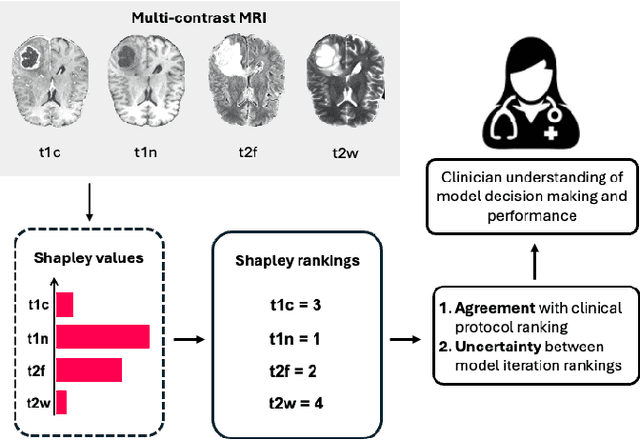
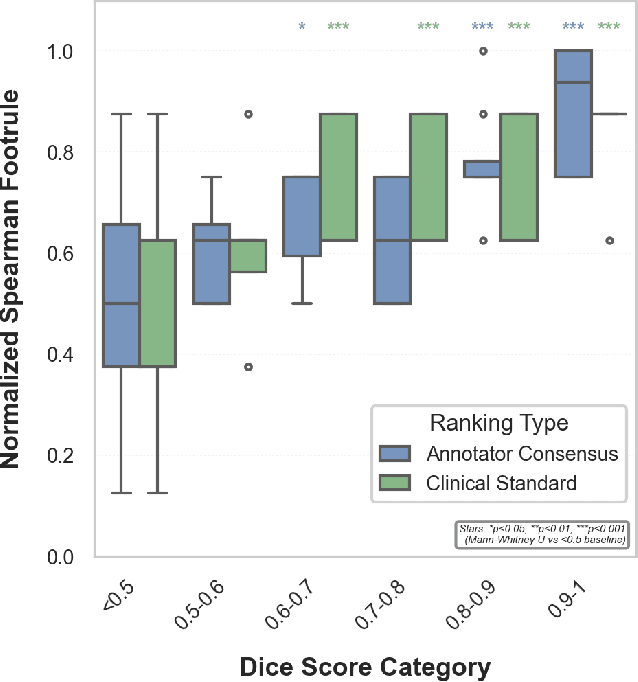
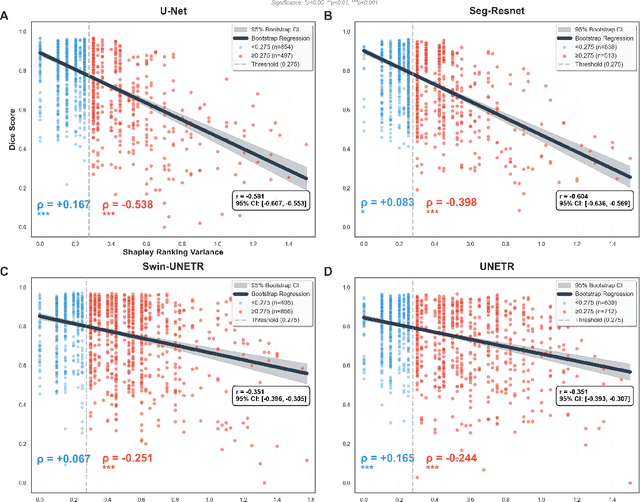
Segmentation is the identification of anatomical regions of interest, such as organs, tissue, and lesions, serving as a fundamental task in computer-aided diagnosis in medical imaging. Although deep learning models have achieved remarkable performance in medical image segmentation, the need for explainability remains critical for ensuring their acceptance and integration in clinical practice, despite the growing research attention in this area. Our approach explored the use of contrast-level Shapley values, a systematic perturbation of model inputs to assess feature importance. While other studies have investigated gradient-based techniques through identifying influential regions in imaging inputs, Shapley values offer a broader, clinically aligned approach, explaining how model performance is fairly attributed to certain imaging contrasts over others. Using the BraTS 2024 dataset, we generated rankings for Shapley values for four MRI contrasts across four model architectures. Two metrics were proposed from the Shapley ranking: agreement between model and ``clinician" imaging ranking, and uncertainty quantified through Shapley ranking variance across cross-validation folds. Higher-performing cases (Dice \textgreater0.6) showed significantly greater agreement with clinical rankings. Increased Shapley ranking variance correlated with decreased performance (U-Net: $r=-0.581$). These metrics provide clinically interpretable proxies for model reliability, helping clinicians better understand state-of-the-art segmentation models.
Large-scale modality-invariant foundation models for brain MRI analysis: Application to lesion segmentation
Nov 14, 2025The field of computer vision is undergoing a paradigm shift toward large-scale foundation model pre-training via self-supervised learning (SSL). Leveraging large volumes of unlabeled brain MRI data, such models can learn anatomical priors that improve few-shot performance in diverse neuroimaging tasks. However, most SSL frameworks are tailored to natural images, and their adaptation to capture multi-modal MRI information remains underexplored. This work proposes a modality-invariant representation learning setup and evaluates its effectiveness in stroke and epilepsy lesion segmentation, following large-scale pre-training. Experimental results suggest that despite successful cross-modality alignment, lesion segmentation primarily benefits from preserving fine-grained modality-specific features. Model checkpoints and code are made publicly available.
Cancer-Net PCa-MultiSeg: Multimodal Enhancement of Prostate Cancer Lesion Segmentation Using Synthetic Correlated Diffusion Imaging
Nov 11, 2025


Current deep learning approaches for prostate cancer lesion segmentation achieve limited performance, with Dice scores of 0.32 or lower in large patient cohorts. To address this limitation, we investigate synthetic correlated diffusion imaging (CDI$^s$) as an enhancement to standard diffusion-based protocols. We conduct a comprehensive evaluation across six state-of-the-art segmentation architectures using 200 patients with co-registered CDI$^s$, diffusion-weighted imaging (DWI) and apparent diffusion coefficient (ADC) sequences. We demonstrate that CDI$^s$ integration reliably enhances or preserves segmentation performance in 94% of evaluated configurations, with individual architectures achieving up to 72.5% statistically significant relative improvement over baseline modalities. CDI$^s$ + DWI emerges as the safest enhancement pathway, achieving significant improvements in half of evaluated architectures with zero instances of degradation. Since CDI$^s$ derives from existing DWI acquisitions without requiring additional scan time or architectural modifications, it enables immediate deployment in clinical workflows. Our results establish validated integration pathways for CDI$^s$ as a practical drop-in enhancement for PCa lesion segmentation tasks across diverse deep learning architectures.
WaveFuse-AL: Cyclical and Performance-Adaptive Multi-Strategy Active Learning for Medical Images
Nov 19, 2025Active learning reduces annotation costs in medical imaging by strategically selecting the most informative samples for labeling. However, individual acquisition strategies often exhibit inconsistent behavior across different stages of the active learning cycle. We propose Cyclical and Performance-Adaptive Multi-Strategy Active Learning (WaveFuse-AL), a novel framework that adaptively fuses multiple established acquisition strategies-BALD, BADGE, Entropy, and CoreSet throughout the learning process. WaveFuse-AL integrates cyclical (sinusoidal) temporal priors with performance-driven adaptation to dynamically adjust strategy importance over time. We evaluate WaveFuse-AL on three medical imaging benchmarks: APTOS-2019 (multi-class classification), RSNA Pneumonia Detection (binary classification), and ISIC-2018 (skin lesion segmentation). Experimental results demonstrate that WaveFuse-AL consistently outperforms both single-strategy and alternating-strategy baselines, achieving statistically significant performance improvements (on ten out of twelve metric measurements) while maximizing the utility of limited annotation budgets.
Integrated Pipeline for Coronary Angiography With Automated Lesion Profiling, Virtual Stenting, and 100-Vessel FFR Validation
Dec 09, 2025Coronary angiography is the main tool for assessing coronary artery disease, but visual grading of stenosis is variable and only moderately related to ischaemia. Wire based fractional flow reserve (FFR) improves lesion selection but is not used systematically. Angiography derived indices such as quantitative flow ratio (QFR) offer wire free physiology, yet many tools are workflow intensive and separate from automated anatomy analysis and virtual PCI planning. We developed AngioAI-QFR, an end to end angiography only pipeline combining deep learning stenosis detection, lumen segmentation, centreline and diameter extraction, per millimetre Relative Flow Capacity profiling, and virtual stenting with automatic recomputation of angiography derived QFR. The system was evaluated in 100 consecutive vessels with invasive FFR as reference. Primary endpoints were agreement with FFR (correlation, mean absolute error) and diagnostic performance for FFR <= 0.80. On held out frames, stenosis detection achieved precision 0.97 and lumen segmentation Dice 0.78. Across 100 vessels, AngioAI-QFR correlated strongly with FFR (r = 0.89, MAE 0.045). The AUC for detecting FFR <= 0.80 was 0.93, with sensitivity 0.88 and specificity 0.86. The pipeline completed fully automatically in 93 percent of vessels, with median time to result 41 s. RFC profiling distinguished focal from diffuse capacity loss, and virtual stenting predicted larger QFR gain in focal than in diffuse disease. AngioAI-QFR provides a practical, near real time pipeline that unifies computer vision, functional profiling, and virtual PCI with automated angiography derived physiology.
Segmentation of Ischemic Stroke Lesions using Transfer Learning on Multi-sequence MRI
Nov 10, 2025The accurate understanding of ischemic stroke lesions is critical for efficient therapy and prognosis of stroke patients. Magnetic resonance imaging (MRI) is sensitive to acute ischemic stroke and is a common diagnostic method for stroke. However, manual lesion segmentation performed by experts is tedious, time-consuming, and prone to observer inconsistency. Automatic medical image analysis methods have been proposed to overcome this challenge. However, previous approaches have relied on hand-crafted features that may not capture the irregular and physiologically complex shapes of ischemic stroke lesions. In this study, we present a novel framework for quickly and automatically segmenting ischemic stroke lesions on various MRI sequences, including T1-weighted, T2-weighted, DWI, and FLAIR. The proposed methodology is validated on the ISLES 2015 Brain Stroke sequence dataset, where we trained our model using the Res-Unet architecture twice: first, with pre-existing weights, and then without, to explore the benefits of transfer learning. Evaluation metrics, including the Dice score and sensitivity, were computed across 3D volumes. Finally, a Majority Voting Classifier was integrated to amalgamate the outcomes from each axis, resulting in a comprehensive segmentation method. Our efforts culminated in achieving a Dice score of 80.5\% and an accuracy of 74.03\%, showcasing the efficacy of our segmentation approach.
SAM-Fed: SAM-Guided Federated Semi-Supervised Learning for Medical Image Segmentation
Nov 18, 2025Medical image segmentation is clinically important, yet data privacy and the cost of expert annotation limit the availability of labeled data. Federated semi-supervised learning (FSSL) offers a solution but faces two challenges: pseudo-label reliability depends on the strength of local models, and client devices often require compact or heterogeneous architectures due to limited computational resources. These constraints reduce the quality and stability of pseudo-labels, while large models, though more accurate, cannot be trained or used for routine inference on client devices. We propose SAM-Fed, a federated semi-supervised framework that leverages a high-capacity segmentation foundation model to guide lightweight clients during training. SAM-Fed combines dual knowledge distillation with an adaptive agreement mechanism to refine pixel-level supervision. Experiments on skin lesion and polyp segmentation across homogeneous and heterogeneous settings show that SAM-Fed consistently outperforms state-of-the-art FSSL methods.