 Add to Chrome
 Add to Firefox
 Add to Edge
Cancer-Net PCa-MultiSeg: Multimodal Enhancement of Prostate Cancer Lesion Segmentation Using Synthetic Correlated Diffusion Imaging
Nov 11, 2025


Current deep learning approaches for prostate cancer lesion segmentation achieve limited performance, with Dice scores of 0.32 or lower in large patient cohorts. To address this limitation, we investigate synthetic correlated diffusion imaging (CDI$^s$) as an enhancement to standard diffusion-based protocols. We conduct a comprehensive evaluation across six state-of-the-art segmentation architectures using 200 patients with co-registered CDI$^s$, diffusion-weighted imaging (DWI) and apparent diffusion coefficient (ADC) sequences. We demonstrate that CDI$^s$ integration reliably enhances or preserves segmentation performance in 94% of evaluated configurations, with individual architectures achieving up to 72.5% statistically significant relative improvement over baseline modalities. CDI$^s$ + DWI emerges as the safest enhancement pathway, achieving significant improvements in half of evaluated architectures with zero instances of degradation. Since CDI$^s$ derives from existing DWI acquisitions without requiring additional scan time or architectural modifications, it enables immediate deployment in clinical workflows. Our results establish validated integration pathways for CDI$^s$ as a practical drop-in enhancement for PCa lesion segmentation tasks across diverse deep learning architectures.

Cancer-Net PCa-Seg: Benchmarking Deep Learning Models for Prostate Cancer Segmentation Using Synthetic Correlated Diffusion Imaging
Jan 15, 2025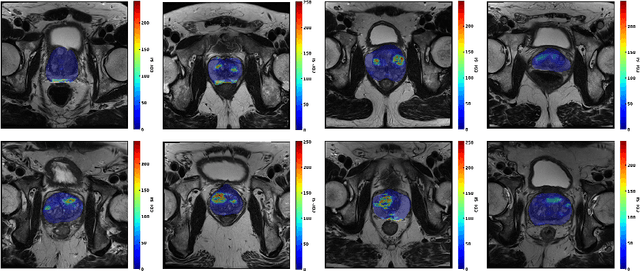
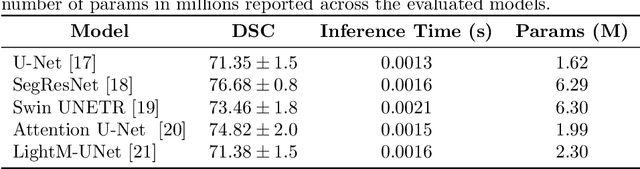

Prostate cancer (PCa) is the most prevalent cancer among men in the United States, accounting for nearly 300,000 cases, 29% of all diagnoses and 35,000 total deaths in 2024. Traditional screening methods such as prostate-specific antigen (PSA) testing and magnetic resonance imaging (MRI) have been pivotal in diagnosis, but have faced limitations in specificity and generalizability. In this paper, we explore the potential of enhancing PCa lesion segmentation using a novel MRI modality called synthetic correlated diffusion imaging (CDI$^s$). We employ several state-of-the-art deep learning models, including U-Net, SegResNet, Swin UNETR, Attention U-Net, and LightM-UNet, to segment PCa lesions from a 200 CDI$^s$ patient cohort. We find that SegResNet achieved superior segmentation performance with a Dice-Sorensen coefficient (DSC) of $76.68 \pm 0.8$. Notably, the Attention U-Net, while slightly less accurate (DSC $74.82 \pm 2.0$), offered a favorable balance between accuracy and computational efficiency. Our findings demonstrate the potential of deep learning models in improving PCa lesion segmentation using CDI$^s$ to enhance PCa management and clinical support.